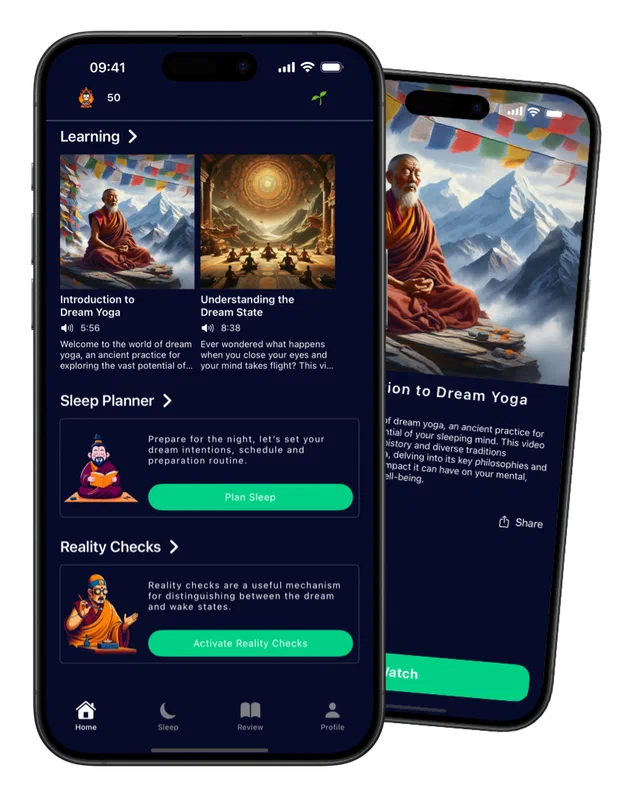
Type “yoga nidra” into any search bar and you’ll meet a giant of the wellness world: tens of millions of plays on guided “yogic sleep” sessions, hospital programs, military resilience training, and a viral rebrand called NSDR. Type “dream yoga” and you’ll meet something quieter and older: Tibetan Buddhism’s art of waking up inside your dreams.
Because both practices involve yoga, sleep, and awareness in unusual states, they are constantly mixed up. Articles use the names interchangeably. Comment threads insist they’re the same thing. They aren’t — though they turn out to be excellent companions.
The short answer: yoga nidra keeps you aware at the edge of sleep while your body rests; dream yoga makes you aware inside the dream itself. One is a guided relaxation practice done while awake. The other is a lucidity practice done while asleep. In this guide, you’ll learn:
- What yoga nidra actually is — its origins, its stages, and what a session feels like
- What dream yoga actually is — and why lucidity is only its starting point
- How they differ across seven dimensions, at a glance and in depth
- What the science says about each (including which popular claims to ignore)
- Which to choose for your goals — and how to combine both in one evening
If you’re completely new to the Tibetan side, our pillar guide to what dream yoga is covers it in full. This article is the bridge: everything a curious yogi, meditator, or terrible sleeper needs in order to place both practices on the same map.
What Is Yoga Nidra?
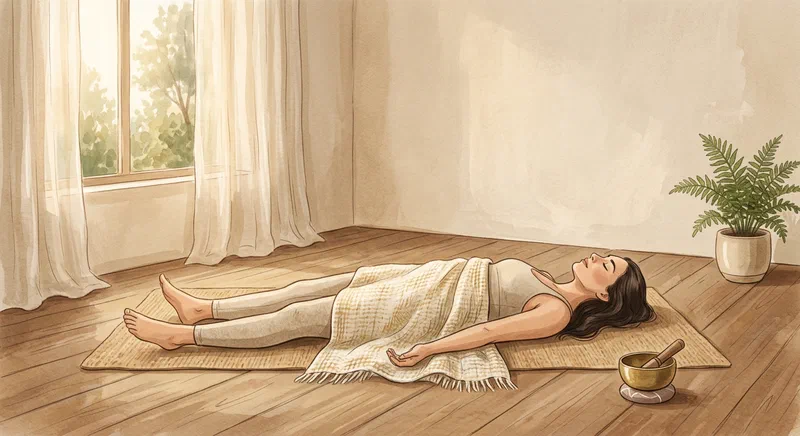
Yoga nidra (Sanskrit: योग निद्रा, “yogic sleep”) is a guided practice of conscious rest. You lie down in savasana, follow a teacher’s voice through a structured sequence — body sensing, breath awareness, opposite sensations, imagery — and settle into profound physical and mental relaxation while a thread of awareness stays awake. The classic image is paradoxical on purpose: the body sleeps, the mind watches.
The state it targets is the hypnagogic threshold — that drifting, heavy-limbed borderland between waking and sleep. Anyone who has hovered there knows the feeling: sounds recede, the body goes distant, thoughts loosen into imagery, yet “you” are still faintly there. Yoga nidra systematizes that borderland into a repeatable practice. Falling fully asleep, notably, counts as drifting off from the practice rather than succeeding at it — a 2025 EEG study found that participants with prior experience tend to stay awake through sessions, while beginners mostly fall asleep, and that staying mentally engaged is associated with better mood outcomes afterward. [1] [2]
Where yoga nidra comes from
The name is old; the method, in its modern form, is young:
- Ancient roots. The term yoganidrā appears in Indian literature — for example, as the cosmic sleep of Vishnu between ages of the world — and lying-still contemplative postures surface in medieval yoga texts. Scholars note, however, that these are precedents and relatives, not the modern guided practice. [3]
- The modern system (1970s). The yoga nidra taught worldwide today was systematized by Swami Satyananda Saraswati of the Bihar School of Yoga and published in his book Yoga Nidra (1976). Drawing on tantric nyasa (mentally placing mantras/attention on parts of the body), Western relaxation therapies, and his own experimentation, Satyananda built a fixed sequence of around eight stages: preparation, sankalpa (a resolve or intention), rotation of consciousness through the body, breath awareness, pairs of opposite sensations, visualization, a repeated sankalpa, and gentle externalization back to waking. [3] [4]
- Secular and clinical offshoots. Swami Rama brought related Himalayan practices West; psychologist Richard Miller adapted the method into iREST (Integrative Restoration) — a trauma-sensitive, secular protocol now used with veterans, soldiers with PTSD, and clinical populations; and neuroscientist Andrew Huberman repackaged the territory as NSDR, non-sleep deep rest. [5]
So when someone says “yoga nidra,” they might mean the Bihar School sequence, an iREST session at a VA clinic, a YouTube “yoga nidra for sleep” recording, or an NSDR protocol — same family, different dialects. The core is constant: lie down, listen, relax completely, stay aware.
What a yoga nidra session is like
A typical 20–40 minute session runs like this:
- Arrive and settle — lie in savasana, supported and warm, eyes closed; notice sounds, then let them recede.
- Sankalpa — silently state a short, positive resolve in the present tense (“I am calm and steady” rather than “I will stop being anxious”). It is planted again at the end, when the mind is most receptive.
- Rotation of consciousness — attention sweeps through body parts in a fixed order (right hand, wrist, elbow…), briskly, without moving anything. This occupies the mind so it can’t ruminate.
- Breath awareness — observe the natural breath, sometimes counted, without controlling it.
- Opposites — paired sensations are evoked in turn: heaviness/lightness, heat/cold, tension/ease. Experiencing both without reacting trains equanimity.
- Visualization — the guide names images (a sunrise, stairs descending, a vast ocean) while you simply watch what arises.
- Return — the sankalpa is repeated, awareness is widened back to the room, and you sit up slowly.
No experience is required, no posture to master, no teacher-student transmission. That accessibility is a large part of why “yoga nidra” became one of the most-searched terms in all of yoga.
What Is Dream Yoga?
Dream yoga (Tibetan: milam, རྨི་ལམ་) is Tibetan Buddhism’s practice of becoming conscious inside the dream state and using that lucidity for spiritual insight — recognizing the dreamlike nature of all experience, transforming habitual reactions, and ultimately resting in the mind’s luminous nature (clear light). Where yoga nidra hovers at the door of sleep, dream yoga walks through it awake.
A few essentials, condensed from our full guide to what dream yoga is:
- Lucidity is the doorway, not the house. Becoming aware “this is a dream” is only stage one. The practice continues through transforming dream content, confronting fear, meditating inside the dream, and recognizing waking life as equally dreamlike.
- It belongs to a larger system. Dream yoga is one of the Six Yogas of Naropa — advanced completion-stage practices spanning waking life (inner heat, illusory body), sleep (dream yoga, clear light), and death (bardo navigation, consciousness transference). Dreams are explicitly treated as rehearsal for dying: the skills are the same — recognize awareness, don’t grasp at appearances, stay steady through transitions. Our guide to the bardo and lucid dreams explores that parallel.
- It has lineages, prerequisites, and teachers. From the Bön tradition to Gampopa’s Kagyu presentation, dream yoga is transmitted within a path of ethics, daytime mindfulness, and usually a qualified instructor — not a recording you press play on.
- The direction is opposite. Yoga nidra moves toward rest and release of effort. Dream yoga moves toward sharper recognition inside an already-unconscious state. One down-regulates; the other wakes up.

Yoga Nidra vs Dream Yoga at a Glance
| Aspect | Yoga Nidra | Dream Yoga |
|---|---|---|
| Meaning | “Yogic sleep” — rest with awareness | Milam — the yoga of dreams |
| Roots | Indian yoga; modern system by Satyananda Saraswati (1976, Bihar School) | Tibetan Buddhism & Bön; one of the Six Yogas of Naropa (11th c. transmission) |
| When practiced | While awake, usually daytime or before bed | While asleep and dreaming (plus daytime preparation) |
| State of consciousness | Hypnagogic threshold — the edge of sleep; body rests, witnessing remains | REM lucidity — fully dreaming, yet knowing it; advanced stages extend into deep sleep |
| Guidance | Externally guided (teacher/recording leads every step) | Self-directed (you navigate alone inside the dream, trained by daytime habits and a teacher’s instructions) |
| Core technique | Body scan, breath, opposites, imagery, sankalpa | Dream recall, reality checks, intention (MILD), stabilization, transformation, clear-light recognition |
| Role of lucidity | None required — lucidity would mean you’ve left the practice for ordinary dreaming | The entire foundation — everything starts from “this is a dream” |
| Primary goal | Deep rest, stress relief, better sleep, emotional balance | Insight into illusion, freedom from habitual fear, preparation for death, awakening |
| Who can start | Anyone, tonight, with a recording | Anyone can begin foundations (recall, mindfulness); the full practice traditionally needs preparation and a teacher |
| Session length | 10–45 minutes, bounded | All night, plus daytime mindfulness |
| Evidence base | Growing: small RCTs on stress, anxiety, insomnia; EEG/sleep-lab studies | Smaller: lucid-dreaming science (EEG gamma, induction meta-analyses) supports components; the full soteriological claims are matters of tradition, not trials |
The Key Differences, in Depth
1. Different states of consciousness
This is the real distinction, and everything else follows from it. Sleep science recognizes a spectrum: waking → drowsy N1 (hypnagogia) → light/deep NREM sleep → REM dreaming. Yoga nidra parks you at the very first transition — N1’s drifting edge — and tries to keep you there, relaxed but not gone. EEG research on the practice finds slow-wave (theta, sometimes alpha) activity coexisting with maintained consciousness: the brain looks drowsy while the practitioner stays responsive. [1]
Dream yoga operates one or two stages deeper — inside REM, when the brain is highly active and the dorsolateral prefrontal cortex (self-reflection, reality-testing) has mostly gone offline. Lucid dreaming, its entry point, shows a distinctive signature: waking-like gamma-band activity reappearing in frontal regions during REM, a hybrid state with features of both sleeping and waking. [6] Advanced dream yoga then pushes further still, toward maintaining awareness in dreamless sleep itself (clear-light practice) — the mirror image of yoga nidra’s project, approached from the other side of the night.
2. Awake and guided vs asleep and self-directed
A yoga nidra practitioner outsources the “practice” to a voice. Your only job is to listen and not fall asleep — effort is the enemy, and trying hard ruins it. A dream yogi has no voice to follow: at 3 a.m. inside a crumbling building, with dream logic dissolving, you must remember to question reality, stabilize the scene, and recall what you intended to practice. That self-direction inside an unconscious state is precisely why dream yoga demands months of daytime training (reality checks, MILD, journaling) before it works at all — systematic reviews confirm induction techniques work but require consistent practice. [7]
3. Relaxation vs recognition
Ask what each practice does with a difficult experience and the contrast snaps into focus. In yoga nidra, a surge of anxiety is met by returning attention to the body scan and the guide’s voice — soothing through structure. In dream yoga, a nightmare figure is met by recognizing it as dream, perhaps transforming it or asking what it represents — liberation through recognition. The first calms the nervous system; the second investigates the mind. Both are valuable; they are not the same skill.
4. Rest vs rehearsal for death
Yoga nidra’s horizon is this life: rest now, sleep better tonight, feel steadier tomorrow. Its framing texts speak of sankalpa fulfilled, stress dissolved, personality integrated. Dream yoga’s horizon is explicitly ultimate: because Tibetan Buddhism views dying as a sequence of dissolutions structurally parallel to falling asleep and dreaming, every lucid night is framed as practice for the final transition. [8] Neither framing is obligatory for a modern practitioner — but it explains why dream yoga texts sound like soteriology while yoga nidra scripts sound like therapy.
5. Accessibility and learning curve
Yoga nidra works the first time: lie down, press play, feel better. Its benefits scale gently with repetition. Dream yoga typically yields its first lucid dreams after weeks of daily practice, stable lucidity after months, and its advanced stages after years — traditionally under guidance. This isn’t a quality ranking; it’s a calendar. If you need rest this week, the choice is obvious.
6. Relationship to religion
Yoga nidra carries Hindu philosophical vocabulary (sankalpa, pratyahara, the kosha model in iREST) but is most often taught stripped of doctrine — and the NSDR rebrand removes even the Sanskrit. Dream yoga remains more tightly woven to its source: refuge, bodhicitta, guru yoga, and the view of emptiness aren’t decorations but the operating system, as teachers from Tenzin Wangyal Rinpoche to the Kagyu lineage masters present it. [9] Secular lucid-dreaming practice borrows its techniques freely — which is legitimate — but “dream yoga” properly named implies the Buddhist container.
What They Share
The confusion is understandable, because the family resemblance is real:
- Sleep as practice, not just recovery. Both refuse the modern idea that the night is blank downtime. A third of life happens there; both traditions want it back.
- Pratyahara — sense withdrawal. Yoga nidra explicitly frames itself as pratyahara (the limbs of yoga concerned with turning attention inward); dream yoga’s daytime mindfulness and sleep visualizations train the same inward turn.
- Attention without grasping. Following a body scan without controlling it and watching a dreamscape without being captured by it are cousins: sustained, non-reactive awareness.
- The intention mechanism. Yoga nidra’s sankalpa and dream yoga’s bedtime intention (“tonight I recognize I’m dreaming”) both exploit the same psychology — prospective memory, remembering to remember — that researchers from LaBerge onward have formalized. [10]
- Overlapping benefits. Both are associated with fewer nightmares, lower anxiety, and richer self-knowledge — via different routes (calming vs confronting).
Think of them as two gates into the same territory: yoga nidra enters through the body and rest; dream yoga enters through the dream and recognition.
What Does the Science Say?
Mindful Slumber’s editorial line is citation-first and hype-free, so let’s be precise — including about beloved claims that don’t survive contact with the data.
Yoga nidra: promising, early-stage, often overstated
- Stress, anxiety, mood. The most consistent finding: people report feeling calmer, with pooled analyses finding favorable average effects on stress, anxiety, and depression — though reviewers judge the underlying trials methodologically weak (small samples, varied protocols, high risk of bias), so these are signals, not verdicts. [11]
- Sleep. A randomized trial in chronic insomnia patients (Datta et al., 2021, National Medical Journal of India) found improved sleep with yoga nidra practice; a 2023 PLOS ONE study in novices found that two weeks of practice improved sleep efficiency, reduced wake-after-sleep-onset, increased slow-wave (delta) sleep, and sped cognitive processing. [12] A 2025 systematic review of six RCTs (244 participants) found improvements in sleep onset, total sleep time, and efficiency versus controls including CBT-I components and relaxation — while flagging heterogeneity and moderate-to-high risk of bias. [13]
- Brain and body during practice. Sleep-lab work finds the practice feasible and relaxing (respiration slows), but a controlled 2023 study found no increase in alpha power versus lying quietly — and yoga nidra put 89% of participants to sleep, underscoring that staying aware is genuinely hard. [14] The consistent EEG theme across studies is increased slow (theta) activity in experienced practitioners who stay awake — not a universal magic frequency. [1]
- Claims to retire. Current evidence does not establish that yoga nidra replaces sleep (“45 minutes equals 4 hours” has no basis), reliably raises dopamine (one tiny, unreplicated PET study in expert meditators), balances hormones, or “resets” the nervous system. It is a genuinely useful rest protocol that marketing keeps dressing as a miracle. [11]
Dream yoga and lucid dreaming: a smaller, fascinating literature
- Lucidity is real and measurable. Sleep-lab protocols verify lucid dreaming via pre-arranged eye-movement signals; EEG shows the REM-plus-gamma hybrid signature. [6]
- Induction works — with effort. Meta-analysis finds techniques combining intention, reality testing, and timed awakenings (MILD + WBTB) reliably raise lucid-dream frequency. [7]
- Therapeutic hints. Lucid-dreaming therapy shows promise for recurrent nightmares and PTSD-related dreams, and practitioners report creative and emotional benefits — an evidence base that is encouraging but far smaller than meditation’s or yoga nidra’s.
- The spiritual claims — recognition of emptiness, clear-light awareness, bardo preparation — belong to contemplative tradition and first-person expertise, articulated by masters like Tenzin Wangyal Rinpoche and contemporary bridges like Andrew Holecek. [15] [16] Science can study their neural correlates; it cannot certify awakening.
Bottom line: yoga nidra has the broader clinical-adjacent evidence for rest and stress; lucid-dream science validates dream yoga’s mechanisms (lucidity, induction, nightmare work) while its ultimate aims remain matters of practice and lineage. Neither field is mature enough for grand promises.
Which Should You Choose?
Start from your goal, not from hype:
Choose yoga nidra (or NSDR/iREST) if you want to…
- fall asleep faster or wind down in the evening
- recover from stress, overwhelm, or a bad night without napping
- begin something tonight with zero learning curve
- support anxiety or low mood alongside professional care
- rest while injured, exhausted, or unable to sit in meditation
Choose dream yoga if you want to…
- experience lucid dreams and explore consciousness directly
- work with recurring nightmares through recognition rather than relaxation alone
- connect your practice to Tibetan Buddhism’s path (emptiness, clear light, bardo)
- turn all eight hours of sleep into a field of training
- undertake a long, demanding, potentially life-altering discipline
Choose both if you sense what many practitioners discover: they form a complete evening arc. Yoga nidra settles the nervous system before sleep; dream yoga continues the thread of awareness through it.
A combined evening routine
- 90 minutes before bed: screens dimmed, day reviewed — optionally note the day’s emotional charge in a dream journal (tomorrow’s dream material).
- 30 minutes before bed: a 15–20 minute yoga nidra or NSDR session — not in your bed if possible, to protect the bed–sleep association. Let it end; sit up; move to bed normally.
- Lights out: set a dream-yoga intention (“When I dream tonight, I’ll recognize it”), perhaps with a gentle visualization such as the throat-chakra practice. Sleep normally — no alarms, no heroic wake-ups at first.
- Morning: record whatever you remember before touching your phone. “No recall” is a valid entry.
One caution both traditions agree on: never sacrifice sleep to practice. If nighttime techniques leave you tired, scale back to the yoga nidra wind-down and morning recall only. Rest is the foundation lucidity stands on.
Trying Yoga Nidra Tonight: A 15-Minute Starter
You don’t need a course. Find any reputable guided recording (search “yoga nidra” or “NSDR” plus a duration), or follow this skeleton:
- Lie in savasana — warm, supported, eyes closed. Take five slow breaths.
- Silently state your sankalpa once, in the present tense, three times over (“My body rests; my mind stays gently aware”).
- Move attention briskly through the body: right thumb to right shoulder, left thumb to left shoulder, then torso, legs, head. Don’t linger; keep it moving.
- Watch the breath at the nostrils for a minute without changing it.
- Alternate paired feelings — heaviness, then lightness; warmth, then coolness — a few rounds each.
- Picture a simple scene: dawn light over still water. Watch without directing.
- Repeat your sankalpa once more. Widen attention to the room, wiggle fingers, sit up slowly.
If you fell asleep, congratulations on being tired — try earlier in the evening next time, or seated upright. If you stayed aware and feel deeply rested, you’ve tasted the state the whole literature points at.
Beginning Dream Yoga: Where Lucidity Starts
Dream yoga’s on-ramp is equally simple to describe and harder to do: recall → reality checks → intention → induction.
- Recall: journal every morning (see above — non-negotiable).
- Reality checks: 5–10 daily tests of “am I dreaming?” with genuine doubt. Our reality-check guide lists twelve, with the habit mechanics that make them transfer into dreams.
- Intention/MILD: the LaBerge method of rehearsing recognition, best combined with brief timed awakenings (WBTB). Start with MILD before any advanced technique.
- View: read the four stages of dream yoga to understand where lucidity leads, and the Gampopa overview for the lineage container.
Expect weeks, not nights. That timeline filters for the people dream yoga is actually for.
Five Myths Worth Retiring
- “Yoga nidra gives you the benefits of hours of sleep.” No study shows this. It improves rest and possibly subsequent sleep — a real, unglamorous win.
- “NSDR is a different, scientific thing.” NSDR is a useful secular label for substantially the same practices, per its own coiner’s definition. [5] Use whichever recordings you like; don’t pay a premium for the acronym.
- “Dream yoga is just controlling your dreams.” Control (transforming the dream) is one early stage; the tradition explicitly warns against mistaking fireworks for insight. [17]
- “Yoga nidra will make me lucid.” It isn’t designed to, and falling asleep during it produces ordinary non-lucid sleep. Relaxation supports practice; it doesn’t substitute for induction technique.
- “You must pick one tradition and stay in it.” Respect the sources, but practitioners have always cross-trained: calm-abiding (zhiné) steadies dream yoga; dream recall deepens anyone’s inner life; a body scan harms no philosophy.
Frequently Asked Questions
What is yoga nidra?
Is yoga nidra the same as dream yoga?
Can yoga nidra replace sleep?
What is the difference between yoga nidra and NSDR?
Which is better for anxiety and sleep: yoga nidra or dream yoga?
Can yoga nidra make you lucid dream?
Do I need to be Hindu or Buddhist to practice either one?
Is yoga nidra safe?
Start Where You Are
If you arrived searching “yoga nidra,” here’s your takeaway: yoga nidra is the guided art of resting while aware — lie down, listen, and let the nervous system stand down. It asks nothing of you but twenty minutes and a floor. If the night then calls you further — toward lucidity, toward the question of what mind is when the world switches off — dream yoga is waiting with a much older, much steeper map.
Rest first. Then dream — awake.



 Dream Yoga: What It Is, Benefits, and How to Practice
 Reality Checks: 12 Tests That Trigger Lucidity
 Yoga Nidra and yogic sleep: early evidence, real limits
 Chotrul Düchen: The 15 Days of Miracles and Why They Matter for Dream Yoga
 What is Nyungné? A Beginner's Guide to Tibetan Purification Practice