For centuries, Nyungné has been practiced in monasteries across Tibet, Nepal, Bhutan, and Himalayan India. Today, it is increasingly accessible to practitioners everywhere, including through virtual and in-person retreats in the West. This guide will walk you through everything a beginner needs to know: what Nyungné is, where it comes from, what actually happens during the practice, and whether it might be right for you.
What is Nyungné?
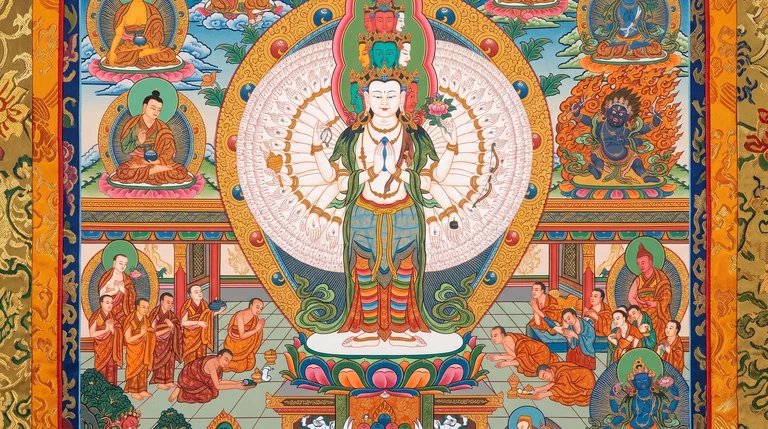
The word Nyungné (Tibetan: བཉུང་གནས།, pronounced “nyoong-nay”) translates loosely as “abiding in restraint” or “dwelling in fasting.” It is a two-day purification retreat centred on the eleven-faced, thousand-armed form of Chenrezig (Sanskrit: Avalokiteśvara), the Bodhisattva of Compassion — one of the most beloved figures in all of Tibetan Buddhism.
Nyungné is simultaneously a purification practice, a compassion meditation, a fasting discipline, and a devotional ceremony. It weaves together mantra recitation, prostrations, visualisation, and ethical restraint into a single sustained practice — traditionally performed over the two days surrounding the new or full moon.
“Nyungné is said to purify the negative karma of countless lifetimes. But more than that, it opens the heart to the suffering of all beings and cultivates the aspiration to be truly useful in this world."
— Traditional Tibetan teaching on Nyungné
At its core, Nyungné is an act of love — for oneself, for all sentient beings, and for the awakened potential that lies within us all.
Origins and Lineage

The Nyungné lineage traces back to a remarkable 11th-century Indian Buddhist nun known as Gelongma Palmo (Sanskrit: Bhikṣuṇī Lakṣmī). According to traditional accounts, Palmo was a princess who renounced her wealth to become a fully ordained nun. She later contracted leprosy and, in her suffering and desperate devotion, turned to Chenrezig with complete one-pointed prayer.
Through years of intensive practice and fasting, she is said to have received a vision of Chenrezig himself, who cured her illness and transmitted the Nyungné practice directly. She then passed this lineage to her disciples, and it spread throughout Tibet, Nepal, and the Himalayan world.
Gelongma Palmo’s story is not simply a founding myth. For practitioners, it is a living reminder of the transformative power of sincere devotion and of what becomes possible when the mind turns fully toward compassion.
Today, the Nyungné lineage is held within several Tibetan Buddhist traditions, most prominently within the Kagyu and Gelug schools, and is transmitted by qualified lamas who have themselves completed many rounds of the practice.
The Structure of the Practice
Nyungné is always performed over two consecutive days, and the structure of those days is precise and meaningful. Each element has a function, and together they form an integrated path of purification.
The Eight Mahayana Precepts On both days of Nyungné, practitioners take the Eight Mahayana Precepts at dawn. These include:
- Refraining from taking life
- Refraining from taking what is not given
- Refraining from sexual conduct
- Refraining from false speech
- Refraining from intoxicants
- Refraining from eating after midday
- Refraining from high or luxurious seats and beds
- Refraining from music, dance, and personal adornment
Day One — Eating and Practice
The first day is demanding but not prohibitive. Practitioners take the Eight Mahayana Precepts at dawn and then engage in long sessions of Chenrezig sadhana — structured liturgical practice that includes mantra recitation, visualisation of the deity, prostrations, and offerings. A single simple vegetarian meal may be eaten before midday. No speech is strictly required, though some traditions observe silence. The day closes with more practice and dedication of merit.
Day Two — Complete Fasting and Silence
The second day is more intense. No food is consumed — traditionally, no water either, though many contemporary teachers allow water for health reasons. Complete silence is observed. The practice sessions continue: prostrations, mantra, visualisation. The body’s discomfort becomes part of the path, a reminder of the suffering of all beings and a direct training in renunciation. By the close of the second day, many practitioners describe a profound sense of clarity and tenderness.
At the conclusion, the precepts are released, food is eaten, and the merit accumulated over both days is dedicated to the benefit of all sentient beings.
Core Elements of the Practice
Within each session, several key components are woven together. Understanding these will help you know what to expect before you participate.
Refuge and Bodhicitta All practice begins by taking refuge in the Three Jewels (Buddha, Dharma, Sangha) and generating bodhicitta — the wish to attain awakening for the benefit of all sentient beings. This sets the motivational foundation.
Chenrezig Visualisation Practitioners visualise the deity Chenrezig — radiantly white, with eleven faces and a thousand arms, each palm bearing a watchful eye. Through this visualisation, practitioners identify their own buddha-nature with the compassion of Chenrezig.
Mantra Recitation The six-syllable mantra of Chenrezig — Om Mani Padme Hum — is recited thousands of times across the retreat, traditionally counted on a mala (prayer beads). Each syllable is said to purify one of the six realms of existence.
Prostrations Full-body prostrations are performed, often hundreds across the retreat. They are simultaneously a physical discipline, an act of devotion, and a method for reducing ego-clinging and cultivating humility.
Offering and Dedication At the close of each session, symbolic offerings are made to the deity and all the merit accumulated through the practice is dedicated outward — to all beings without exception, including enemies and those who have caused us harm.
What are the Benefits of Nyungné?
Traditional texts describe the benefits of Nyungné in sweeping terms: the purification of immense negative karma, liberation from lower rebirths, swift progress toward awakening. These are not claims to be taken literally or dismissed lightly — they reflect a view of the mind’s potential that is central to Tibetan Buddhist understanding.
From a more immediate, experiential perspective, practitioners consistently report several things:
“After Nyungné, I felt like something heavy had been washed away — not just mentally, but in my body. The silence and fasting brought a kind of tenderness I hadn’t expected."
— Retreat participant, Western practitioner
Increased compassion. The practice is explicitly designed to open the heart. Extended focus on Chenrezig — the very embodiment of compassion — has a softening, opening effect that many practitioners describe as lasting well beyond the retreat itself.
Mental clarity. Fasting and silence strip away the usual noise. Many practitioners find that the second day in particular brings a luminous stillness to the mind.
Purification. Tibetan Buddhism holds that our minds carry deep habitual patterns formed over countless lifetimes. Nyungné is considered one of the most powerful practices for purifying these patterns — particularly around anger, craving, and ignorance.
Connection to lineage. Performing a practice that millions of beings have performed across centuries creates a palpable sense of belonging to something much larger than oneself. You are joining a river that has been flowing for a long time.
Nyungné and the Dream State
For practitioners of Dream Yoga — the Tibetan contemplative science of the nocturnal mind — Nyungné holds a particular significance. The combination of fasting, restraint, intense mantra, and compassion cultivation creates what many teachers describe as ideal conditions for heightened lucidity: both in waking life and in sleep.
When the ordinary mind is quieted through fasting and silence, and the heart has been opened through hours of Chenrezig meditation, the boundary between waking and dreaming can become remarkably thin. Many practitioners report unusually vivid, meaningful, or lucid dreams during and after Nyungné retreats.
“The fasting and silence of Nyungné quieten the winds in the channels, and this directly supports the arising of clear light in the dream state. These practices are not separate — they inform and deepen each other."
— Traditional teaching on the relationship between Nyungné and Dream Yoga
If you are exploring Dream Yoga alongside Nyungné, pay particular attention to your dreams during and after the retreat. Keep a dream journal nearby, and notice whether the quality or texture of your dreams shifts.
Is Nyungné Right for Me?
Nyungné is open to practitioners of all levels, including complete beginners. You do not need to have a formal Tibetan Buddhist practice to participate, nor do you need prior experience with fasting or retreat.
That said, it is worth being honest with yourself about a few things:
Health considerations. The fasting and prostrations can be physically taxing. If you have medical conditions — particularly those related to blood sugar, heart health, or mobility — please consult your doctor before participating. Most contemporary teachers also allow modifications: water fasting instead of complete fasting, seated alternatives to prostrations, and reduced practice sessions for those with health limitations.
Emotional readiness. Purification practices can surface emotions that have been suppressed or buried. This is considered part of the process, not a sign that something has gone wrong. However, if you are in a period of acute mental health difficulty, it is worth speaking with a teacher before undertaking intensive practice.
Motivation. The most important ingredient is a sincere wish to benefit — yourself and others. Whether you come seeking healing, spiritual progress, or simply a taste of something ancient and real, that sincerity is enough to begin.
How to Prepare for Your First Nyungné
Learn the basics of Chenrezig Spend some time familiarising yourself with the deity and mantra. Even a few days of simple Om Mani Padme Hum recitation — seated quietly, holding the wish for all beings to be free of suffering — is a beautiful way to prepare.
Begin to simplify your diet In the days before the retreat, reduce heavy foods, alcohol, and meat if possible. Eating lightly and vegetarianly in the lead-up helps the body adjust to the fasting.
Prepare a simple altar Even a small altar — a candle, an image of Chenrezig, a bowl of water, a flower — creates a dedicated space that supports the retreat. This is particularly important for virtual or home-based practice.
Set your intention Before you begin, sit quietly and ask yourself: why am I doing this? Who do I want to benefit? Holding a clear intention — however simple — gives the practice direction and heart.
Arrange your schedule Nyungné requires two full days of relatively uninterrupted time. Do your best to clear obligations, inform those around you that you will be in silence, and create space for the practice to breathe.
A Final Reflection
Nyungné is an unusual thing: a practice that asks quite a lot of you, and returns something difficult to name. Many practitioners describe finishing a Nyungné with a sense of lightness, of tenderness, of having washed something off. Others find tears, or laughter, or a quiet that they carry into their ordinary days.
Whatever your experience, the teaching at the heart of Nyungné is simple and profound: that compassion is our deepest nature, and that every act of genuine renunciation — every moment of choosing love over habit — is a step closer to what we already are.
Om Mani Padme Hum
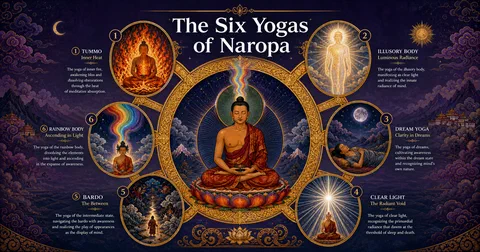 The Six Yogas of Naropa Explained: A Complete Guide
 Dream Yoga: What It Is, Benefits, and How to Practice
 Yoga Nidra vs Dream Yoga: What's the Difference?
 About Us — Where Ancient Wisdom Meets Modern Sleep Science