For practitioners of Tibetan Dream Yoga, understanding the sacred calendar is not merely cultural literacy. These dates mark windows when, according to traditional teaching, the mind is more receptive, merit is magnified, and the subtle dimensions of awareness become more accessible. Knowing when those windows fall — and why — is part of the practice itself.
The Shared Root: What All Buddhist Calendars Celebrate
Before exploring the differences, it is worth grounding ourselves in what all Buddhist traditions hold in common.
At the heart of every Buddhist calendar is the life of Shakyamuni Buddha — Siddhartha Gautama, the historical prince who renounced his palace, sought the nature of suffering, and attained full enlightenment beneath the Bodhi tree in Bodh Gaya. The events of his life — his birth, his enlightenment, his first teaching, and his passing into parinirvana — are the fixed stars around which all Buddhist sacred time revolves.
Every tradition venerates these events. Where traditions diverge is in when they fall in the calendar, how they are grouped, and what additional observances have developed within each lineage over centuries of practice.
Buddhist teachers often emphasize that enlightenment is not merely a historical event but an ever-present reality that practitioners connect with through sustained practice—including through the rhythms of the sacred calendar.
— Concept commonly associated with Pema Chödrön’s teaching; paraphrased from themes in When Things Fall Apart (Shambhala, 1996) and related writings
What Is Wesak?
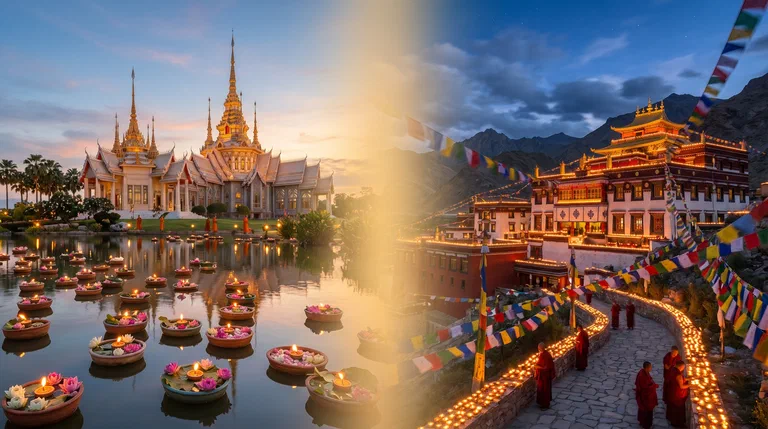
Wesak (also spelled Vesak, Vaisākha, or Waisak) is the most widely observed Buddhist festival in the world. It is celebrated across Theravāda countries — Sri Lanka, Thailand, Myanmar, Cambodia, Laos, and parts of India and Indonesia — as well as in many Mahāyāna communities globally.
What It Commemorates
Wesak is remarkable for combining three of the most significant events in the Buddha’s life into a single observance:
- The Buddha’s birth — his emergence into the world as Prince Siddhartha
- The Buddha’s enlightenment — his attainment of full Buddhahood beneath the Bodhi tree
- The Buddha’s parinirvana — his final passing from the conditioned world
The tradition that all three events occurred on the same lunar date — the full moon of the month of Vaisākha (the fourth lunar month in the Indian calendar) — is attested in the Pāli canon and remains one of the most beloved facts in Buddhist devotional life.
When It Falls
Wesak falls on the full moon of the fourth lunar month. In the Gregorian calendar, this typically lands somewhere between April and June, depending on the year. In 2026, Wesak falls in May.
How It Is Observed
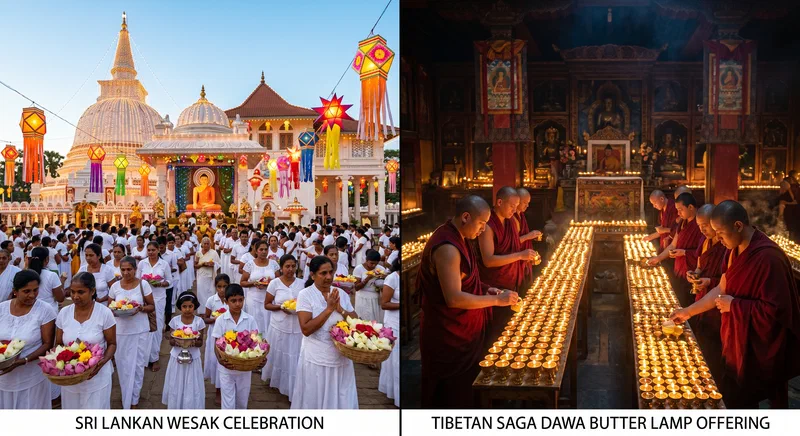
In Theravāda countries, Wesak is a national holiday. Observances typically include:
- Circumambulation of temples and stupas by candlelight
- Offerings of flowers, incense, and candles at shrines
- Release of caged birds as a symbol of liberation
- Giving of alms to monastics and the poor
- Listening to Dhamma teachings throughout the day and night
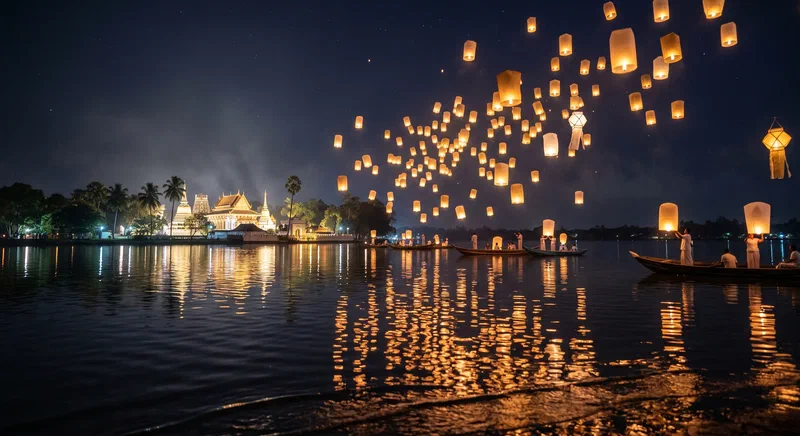
- The lighting of butter lamps and paper lanterns at dusk
The mood is simultaneously joyful and contemplative — a celebration of awakening that invites every practitioner to reflect on their own potential for liberation.
The Tibetan Buddhist Calendar: A Different Architecture of Sacred Time
The Tibetan Buddhist calendar (rooted in the Kālacakra Tantra, introduced to Tibet in the eleventh century) shares the Indian lunar foundation of the Theravāda calendar — both follow the cycles of the moon — but it organises sacred time in a distinctly different way.
Rather than gathering all major commemorations onto a single full moon, the Tibetan calendar distributes observance across four great festivals (Düchen) and a network of monthly and annual practice days.
The Four Great Düchen
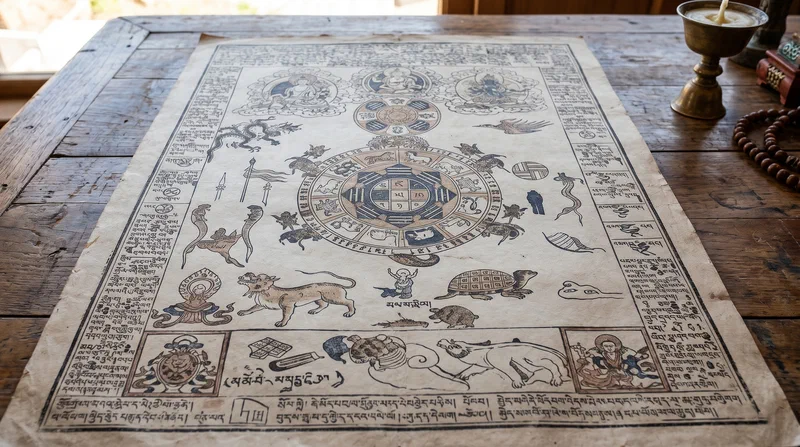
The word Düchen (དུས་ཆེན་) means “great occasion” or “great time.” The four Düchen are the pillars of the Tibetan ceremonial year:
1. Chotrul Düchen — The Festival of Miracles First lunar month, days 1–15 (full moon) Commemorates the fifteen days during which Shakyamuni performed miracles to inspire the faith of beings. This is considered by many teachers to be the most merit-magnifying period of the entire year.
2. Saga Dawa Düchen — The Month of Merits Fourth lunar month, particularly the full moon on the 15th This is the Tibetan commemoration of the Buddha’s birth, enlightenment, and parinirvana — making it the Tibetan equivalent most closely aligned with Wesak. Saga Dawa (literally “fourth month”) is considered so sacred that the entire month carries elevated merit, with the full moon being the peak.
3. Chökhor Düchen — The Festival of Turning the Wheel Sixth lunar month, 4th day Commemorates the Buddha’s first teaching — the First Turning of the Wheel of Dharma — in the Deer Park at Sarnath, when he taught the Four Noble Truths to the five ascetics.
4. Lhabab Düchen — The Festival of Descent Ninth lunar month, 22nd day Commemorates the Buddha’s descent from the Tushita heaven after spending three months teaching the Dharma to his mother.
Traditional Tibetan teachings describe the four great Düchen—Chotrul, Saga Dawa, Chökhor, and Lhabab—as occasions of extraordinary spiritual opportunity. Some texts say merit is multiplied one hundred million times during these days, making them particularly important for practice, offering, and purification.
— Attributed to FPMT teachings associated with Lama Zopa Rinpoche; paraphrased from traditional descriptions
Wesak and Saga Dawa: Cousins, Not Twins
Here is where the question practitioners most often ask deserves a careful answer: Is Wesak the same as Saga Dawa?
The honest answer is: almost, but not quite — and the differences matter.
What They Share
Both Wesak and Saga Dawa Düchen commemorate the same cluster of events — the Buddha’s birth, enlightenment, and parinirvana — and both are understood to be occasions of extraordinary karmic potency. In both traditions, the full moon of the fourth lunar month is the centrepoint of observance, and in most years they fall within the same two-week window on the Gregorian calendar.
Both also call practitioners toward the same types of activity: increased generosity, purification practice, offerings, circumambulation, and dedicated meditation.
Where They Differ
| Wesak | Saga Dawa | |
|---|---|---|
| Tradition | Primarily Theravāda / pan-Buddhist | Tibetan Buddhist |
| Calendar basis | Full moon, 4th Indian lunar month | Full moon, 4th Tibetan lunar month |
| Scope | Single day (the full moon) | The entire fourth month is sacred; full moon is the peak |
| Merit teaching | General auspiciousness | Formally 100 million-fold multiplication |
| Associated practices | Precept-taking, alms-giving, lantern release | Vajrasattva, Mani recitation, circumambulation, vegetarianism |
| Relationship to other festivals | Stands alone | Part of a system of four Düchen |
The most significant practical difference is scope: in the Tibetan system, Saga Dawa is not a single day but an entire sacred month. The fourth Tibetan lunar month is treated as a period of intensified practice throughout, with many practitioners adopting vegetarianism, abstaining from alcohol, and increasing their daily recitation from the first day of the month to the last.
Monthly Observances in the Tibetan Calendar
Beyond the four Düchen, the Tibetan calendar is studded with monthly practice days that form a continuous rhythm of remembrance and aspiration. Understanding these gives a sense of just how differently Tibetan Buddhism structures sacred time compared to traditions that observe a handful of annual festivals.
The 10th and 25th: Guru Rinpoche and Dakini Days
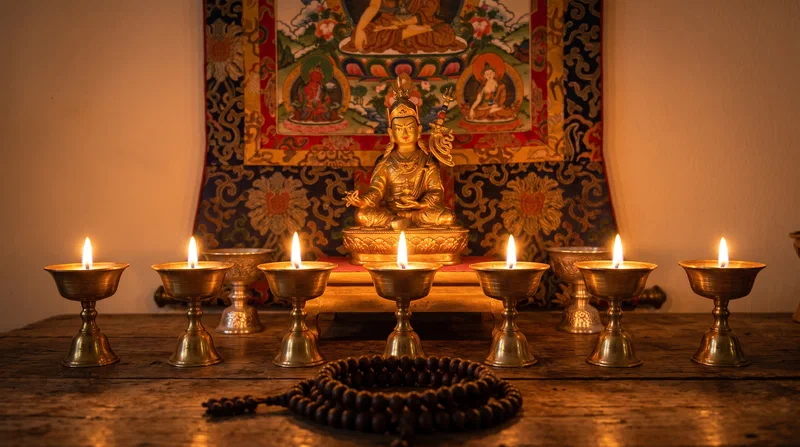
- The 10th day of each month is Guru Rinpoche Day (Tshechu) — a celebration of Padmasambhava, the Indian master who brought Vajrayana Buddhism to Tibet in the eighth century. Practitioners recite the Vajra Guru mantra, make feast offerings, and study Guru Rinpoche’s teachings.
- The 25th day is Dakini Day — devoted to the wisdom feminine principle of awakening, particularly Vajrayogini and the lineage of female masters. It is considered especially potent for practices related to inner heat, subtle body yoga, and — significantly for our community — Dream Yoga.
New and Full Moon Days
The new moon (1st of the lunar month) and full moon (15th) are recognised across virtually all Buddhist traditions as days of heightened merit and intensified practice. In Tibetan monasteries, these days typically feature longer puja sessions, confession practices, and tsok offerings.
The 29th: Nāgpa Day
The final days of the Tibetan lunar month are associated with protector practices and the clearing of obstacles for the month ahead.
What Does This Mean for Dream Yoga Practice?
For practitioners working with the Tibetan yoga of dream, the sacred calendar is not background information — it is a practical tool.
Tibetan Dream Yoga holds that the clarity of the dream state is directly related to the purification of the subtle channels (nadis) and the quality of prana circulating through them. Both Wesak and the great Tibetan Düchen are occasions that, through the accumulation of merit and the intensification of practice, work directly on this level.
Here is how to work with each type of occasion:
During Wesak
Even if your primary path is Tibetan Buddhist, Wesak is worth acknowledging. The field of collective devotion generated by millions of Buddhist practitioners worldwide focusing on the Buddha’s enlightenment creates an extraordinary atmosphere. Use this time for:
- Refuge and Bodhicitta: Renew your commitment to the path and to the liberation of all beings
- Mantra and prayer: Recite the Buddha’s name mantra (OM MUNI MUNI MAHA MUNI SHAKYAMUNI SVAHA) with intention before sleep
- Dream intention: Set a clear aspiration to recognise the dream state, and dedicate the merit of your practice to all sentient beings
During Saga Dawa
The entire fourth Tibetan lunar month calls for sustained intensification. For Dream Yoga practitioners, this means:
- Vegetarianism and reduced intoxicants: Both are widely practised during Saga Dawa and both have a directly beneficial effect on dream clarity
- Increased Vajrasattva practice: The purification of obscurations throughout the month progressively clears the dream channel
- Sustained dream journalling: Commit to recording every dream, however fragmentary, for the entire month
- Full moon night of the 15th: This is the peak. Treat it as you would a silent retreat evening — early to bed, no screens, a simple altar prepared, and your dream intention set with one-pointed sincerity
Saga Dawa—the fourth Tibetan lunar month—is widely regarded in Tibetan Buddhist lineages as the most important month of the year. Whatever merit or virtue is created during this time is understood to have effects that extend beyond this life into future lives. The emphasis, teachers say, should always be on practicing with pure motivation.
— Attributed to the tradition of Ringu Tulku Rinpoche, Bodhicharya teachings; paraphrased
Year-Round: Monthly Practice Rhythm
One of the gifts of the Tibetan calendar is that it prevents practice from becoming a matter of annual events only. The monthly rhythm of the 10th, 15th, 25th, and new moon days keeps the container of practice alive between the great festivals. For Dream Yoga, this means:
- Checking your dream journal around the new and full moon each month
- Intensifying practice on Dakini Days (the 25th) — particularly relevant for Dream Yoga, as the dakini principle is intimately connected with the subtlety and luminosity of the dream state
- Treating Guru Rinpoche Days (the 10th) as occasions to reconnect with lineage and receive transmission through prayer
A Simple Calendar Guide for 2026
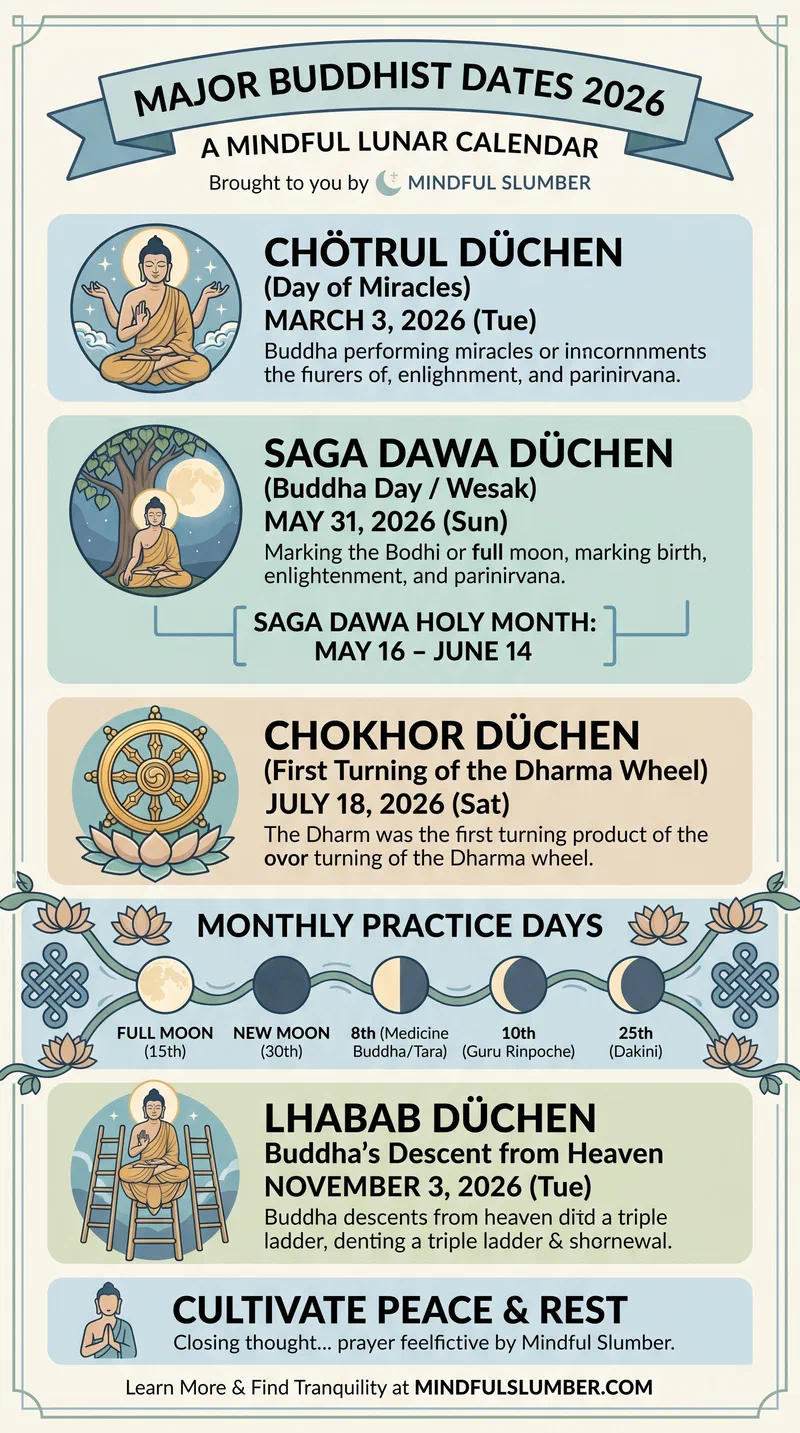
Here are the key dates to hold in your awareness for 2026:
Chotrul Düchen — Festival of Miracles: January/February (15 days from the Tibetan New Year new moon)
Wesak — Full moon of Vaisākha: May 2026
Saga Dawa — Fourth Tibetan lunar month: May–June 2026; Full moon peak in late May/early June
Chökhor Düchen — First Teaching Festival: July/August 2026
Lhabab Düchen — Descent from Heaven: October/November 2026
Note: Exact dates vary year to year with the lunar calendar. Always verify against a current Tibetan calendar or reliable Buddhist almanac.
The Deeper Unity
It would be easy to approach the differences between these calendars as a matter of comparative religion — interesting, perhaps, but essentially academic. But there is something more important to see here.
Every Buddhist calendar, from the simplest Theravāda village celebration of Wesak to the most elaborate Tibetan Vajrayana ceremonial calendar, is pointing at the same thing: the reality of enlightenment. The Buddha’s birth, awakening, and parinirvana are not events that happened to someone else in a distant time. They are pointers to the nature of mind itself — the same nature that the Dream Yoga practitioner is working to recognise in the luminous ground of sleep.
When practitioners around the world observe Wesak, they are — knowingly or not — generating an extraordinary field of aspiration, devotion, and merit. When Tibetan practitioners intensify practice throughout Saga Dawa, purifying channels and accumulating virtue, they are preparing the ground of awareness for the recognition that comes in meditation and dream alike.
These calendars are not competing. They are harmonics of the same fundamental note.
Join Us for Wesak 2026
At Mindful Slumber, we observe both Wesak and the Tibetan sacred calendar — drawing on the richness of the full tradition to support Dream Yoga practice at every level. This year, we are offering a dedicated programme to honour Wesak and the beginning of the sacred Saga Dawa season together: teachings, guided practice, community gathering, and support for your home Dream Yoga practice through one of the most potent windows of the year.
Whether you are drawn by the pan-Buddhist beauty of Wesak, the transformative power of the Saga Dawa month, or simply the recognition that these luminous dates offer a genuine opportunity for deepening — we would love to share this time with you.
👉 Join us for Wesak 2026 at Mindful Slumber
At a Glance: Wesak vs. Tibetan Buddhist Calendar
| Wesak | Tibetan Buddhist Calendar | |
|---|---|---|
| Root tradition | Theravāda / pan-Buddhist | Vajrayana / Tibetan |
| Calendar system | Indian lunar (Vaisākha) | Tibetan lunar (Kālacakra-based) |
| Major annual events | Wesak (1 day) | Four Düchen + monthly days |
| Equivalent to Wesak | — | Saga Dawa Düchen (full moon) |
| Sacred month | Not specified | Saga Dawa (entire 4th month) |
| Merit teaching | General auspiciousness | Formally 100 million-fold |
| Dream Yoga relevance | High (collective merit field) | Very high (purification + channels) |
| Monthly rhythm | Uposatha days (new/full moon) | 10th, 15th, 25th, 29th, new moon |
May these sacred seasons be a source of genuine awakening — in your waking life, in your dreams, and in all the luminous spaces in between.
With metta and moonlight, The Mindful Slumber Team
 The Six Yogas of Naropa Explained: A Complete Guide
 Dream Yoga: What It Is, Benefits, and How to Practice
 Yoga Nidra vs Dream Yoga: What's the Difference?
 The Four Stages of Dream Yoga (Milam): Gampopa's Kagyu Map