A fierce name for a subtle practice
The Tibetan word tummo (gtum mo) means, literally, “fierce woman”. Lama Thubten Yeshe, who taught the practice to Western students in the 1980s, unpacked it like this: tum is courage or ferocity, because the practice burns through delusion; mo, the feminine marker, stands for the wisdom of non-duality that the practice is meant to reveal [1]. The Sanskrit original is caṇḍālī, the “fierce goddess of heat and passion”, a name that appears in the Hevajra Tantra and in the songs of the Indian mahasiddhas centuries before Tibet received them [2].
The English rendering, inner fire or inner heat, is accurate as far as it goes. But it invites a misunderstanding that this article exists to correct. Tummo is not, in the tradition’s own eyes, a technique for staying warm. It is a method for producing a particular state of mind, subtle, blissful and non-conceptual, in which the nature of reality can be seen directly. The warmth is real, measurable, and beside the point.
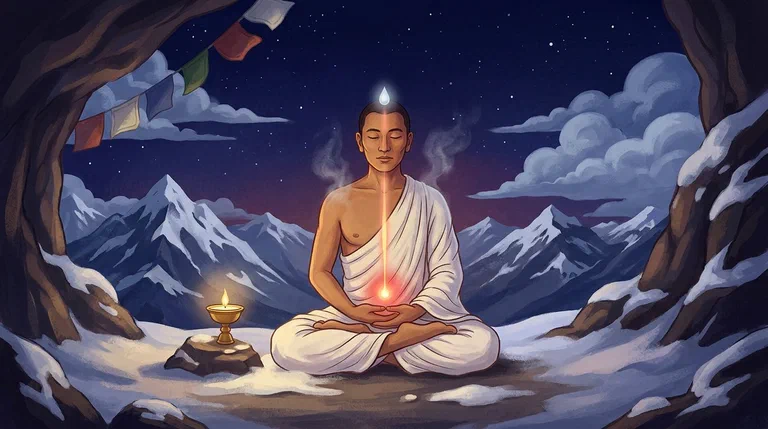
“Caṇḍālī blazes up in the navel. She burns the Five Buddhas. She burns Locanā and the others. Ahaṃ is burnt and the Moon flows down.” — Hevajra Tantra, Part I, chapter 1, trans. Farrow and Menon [2]
Everything in that verse, the fire at the navel, the burning of the ego (ahaṃ), the moon at the crown melting and flowing down, is the practice in miniature. The rest of this article unfolds it.
Where tummo sits in the Six Yogas
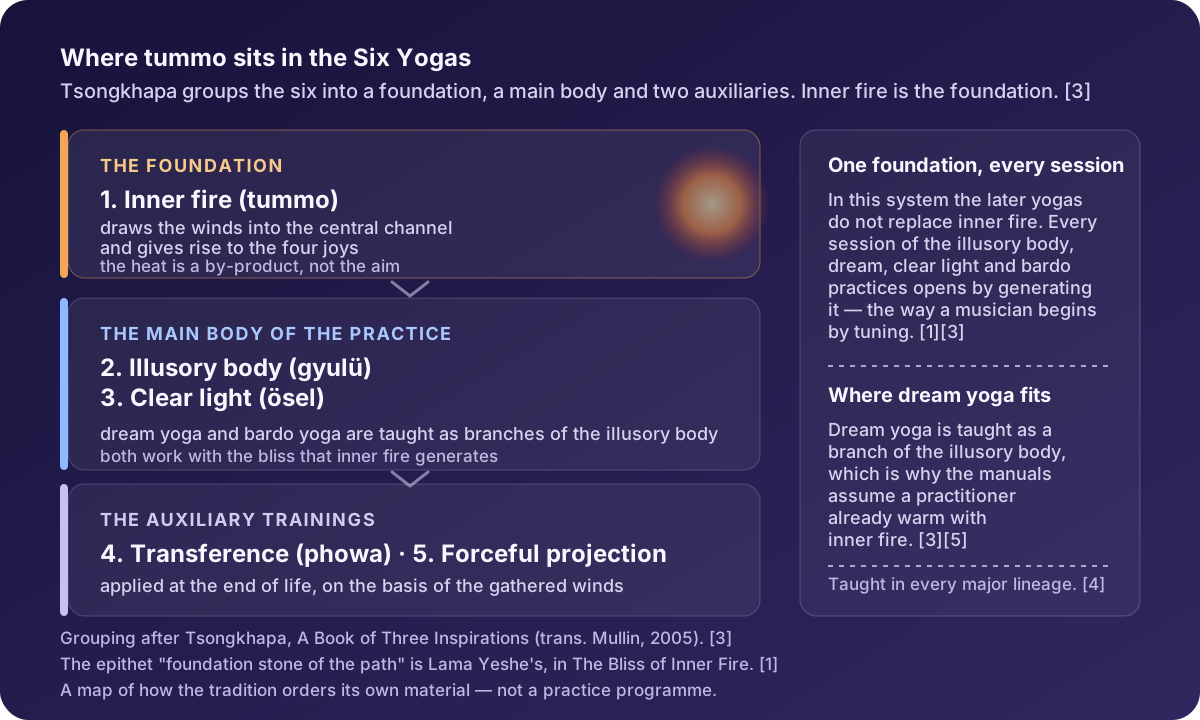
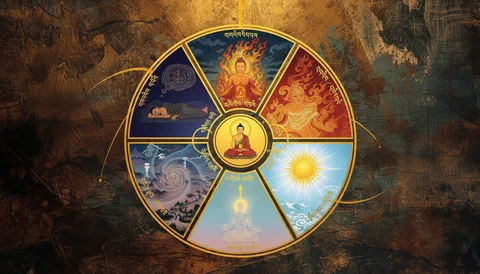
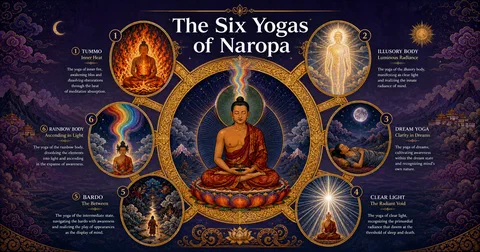
The Six Yogas of Naropa are the completion-stage practices that Marpa carried from India in the eleventh century and that pass through Milarepa and Gampopa into every Kagyu lineage, and, through Tsongkhapa, into the Gelug. The usual list is inner fire, illusory body, dream, clear light, transference (phowa) and bardo. Inner fire is always first, and the reason is structural rather than ceremonial.
Tsongkhapa, in his great commentary A Book of Three Inspirations (written around 1400 and translated by Glenn Mullin), explains that the six can be grouped as three: the foundation, which is inner fire; the main body of the practice, the illusory body and clear light yogas; and the auxiliary trainings of transference and forceful projection, with bardo yoga folded into the illusory body [3]. Inner fire is the foundation because it is the method that brings the subtle winds into the central channel. That event, and the bliss it generates, is what the other yogas work with. Without it, illusory body practice remains imagination, and clear-light sleep remains ordinary sleep.
“By practising inner fire, you can easily bring the wind energies into the central channel and easily develop the four joys. From that experience you can then meditate on clear light and the illusory body.” — Tsongkhapa, Having the Three Convictions, as quoted by Lama Yeshe [1]
Lama Yeshe gives the traditional epithet: inner fire is lam kyi mang-do, “the foundation stone of the path” [1]. In his system, and Tsongkhapa’s, one does not merely learn tummo first and move on: every session of the later yogas begins with inner fire, the way a musician begins with tuning [3].
The practice is not unique to the Naropa lineage. Versions of caṇḍālī appear in the Sakya Lamdre system, in the Kalachakra completion stage, in the Nyingma Anuyoga teachings, and in the Bon Mother Tantra, whose tradition of dream and sleep yoga rests on the same channel-and-wind practices [4]. Wherever a Tibetan tradition works with the subtle body, inner fire is near the root of it.
The map: channels, winds, drops
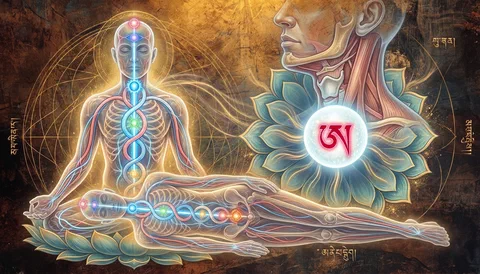
To understand what a tummo practitioner is doing, you need the map they are working from. In the tantric view, the ordinary body is animated by a subtle body (the “vajra body”) of three components: channels (tsa, Sanskrit nāḍī), winds (lung, prāṇa) that move through them, and drops (tiglé, bindu), the subtle essences that the winds carry [3][4].
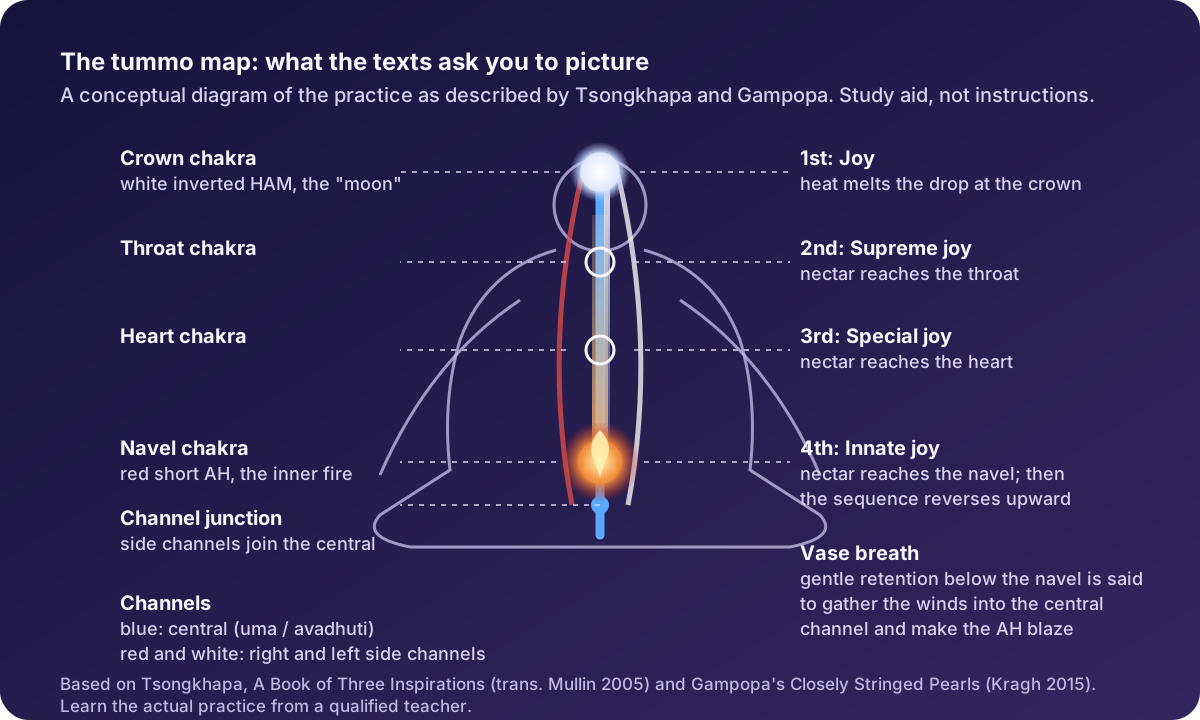
Three channels matter most. The central channel (uma, avadhūti) runs from the crown to a point below the navel; the right and left side channels run parallel to it and join it at the bottom. In ordinary life the winds move in the side channels and the mind is correspondingly dualistic and busy. The whole of completion-stage practice aims to draw the winds out of the side channels and into the central one, where, the texts say, the subtlest level of mind can manifest [3].
Along the central channel sit four chakras, described as wheels with spokes or petals. Gampopa’s manual Closely Stringed Pearls gives 64 spokes at the navel, 8 at the heart, 16 at the throat and 32 at the crown; Tsongkhapa’s description is essentially the same [3][5]. Two syllables are placed on this map. At the navel, a tiny red short AH (a-thung), a single vertical stroke with a flame-like tip, is the seat of the inner fire. At the crown, an inverted white HAM is the seat of the “moon”, the white drop whose melting produces bliss.
Tilopa’s root verses on the Six Yogas compress the entire method into a few lines:
“The vital airs are drawn in, filled, retained and dissolved. There are the two side channels, the central channel avadhūti, and the four chakras. Flames rise from the chandali fire at the navel. A stream of nectar drips down from the syllable HAM at the crown, invoking the four joys.” — Tilopa, Oral Instructions on the Six Yogas, trans. Mullin [3]
What the practice actually involves
What follows is a description, not an instruction. It is here so that a reader can recognise the real thing when they encounter it, and can tell it apart from the many things sold under its name.
Preliminaries. Tsongkhapa’s commentary opens not with the breath but with the lam-rim: the reflections on the preciousness of human life, impermanence, refuge, compassion and bodhicitta, followed by the tantric preliminaries of purification and guru yoga. He quotes Marpa, Milarepa, Gampopa and Pakmo Drupa to show that every early master taught them before the Six Yogas, and warns that skipping them is like overloading a yak on a mountain path: when it falls, the load is lost with it [3][1].
The body. The practitioner sits in the seven-point posture and performs a set of physical exercises, the trulkhor or “six exercises of Naropa”, designed to open the channels. A “hollow body” visualisation follows, in which the body is imagined as empty and translucent, and a nine-round breathing through alternate nostrils clears the side channels [3].
The visualisation. Attention is placed on the three channels and four chakras until they are stable and clear. Then the syllables are placed: HAM at the crown, an OM at the throat, a HUM at the heart, and, receiving most of the session’s attention, the short AH at the navel, imagined as tiny, the size of a mustard seed, hot, and blazing [3]. The instruction to keep it minute is repeated constantly; a large, vague flame is regarded as useless.
The breath. The distinctive breathing of tummo is the vase breath (bumpa chen, Sanskrit kumbhaka): a slow inhalation, a gentle drawing-up of energy from below and pressing-down from above so that the breath is held in the “vase” of the lower abdomen, a retention, and a quiet release. Held this way, the breath is said to fan the AH and make the fire rise. Tsongkhapa’s own caution deserves to be quoted in substance: until real progress is made, the practice should be gentle and never forceful, there should be no discomfort, and it should be done on an empty stomach [3]. Anyone teaching vase breathing as a maximal breath-hold has departed from the text.
Blazing and dripping. With the fire rising, the heat is imagined reaching the crown, where the white HAM melts. Nectar descends the central channel, and as it fills each chakra in turn a distinct experience of bliss arises: joy at the crown, supreme joy at the throat, special joy at the heart, and innate or co-emergent joy at the navel. When the sequence is stable, it is reversed, the drop rising back up through the chakras, and the four joys are experienced again in ascending order, over and over [3][4].
The point of it all. The fourth joy is not the destination. It is the state of mind the practitioner unites with the understanding of emptiness, producing what Lama Yeshe calls “simultaneously born great blissful wisdom” [1]. Gampopa’s manual ends the session with the practitioner dropping the visualisation entirely and resting in “an uncontrived state of Mahāmudrā” [5]. The elaborate machinery of channels and syllables exists to deliver the mind to that rest.
Tsongkhapa lists signs that the winds have genuinely entered the central channel, chief among them that the breath through the nostrils becomes smooth and even, then subtle, then, for a period, stops altogether [3]. He also describes the light of the inner fire eventually making the body appear transparent “as a piece of kyurura fruit held in the hand”. These are reports from a tradition, not laboratory findings; we mention them because they show how far the intended experience is from feeling a bit warmer.
The famous heat: Milarepa, wet sheets and thermometers
Then there is the heat, which is real, and which is how most people first hear of tummo.
The archetype is Milarepa (eleventh to early twelfth century; dates are given variously as 1040–1123 or 1052–1135), the poet-yogi who spent years in the caves of Lachi and the high Himalaya wearing a single cotton robe. The title repa, “cotton-clad”, marks a yogi who has mastered inner fire well enough to need nothing warmer, and a sizeable part of the Hundred Thousand Songs is Milarepa singing, to disciples and sceptics alike, about a warmth that owes nothing to fur or fire [6]. In one song he puts the whole progression into four lines:
“Then bliss-warmth of tummo burns in your body, / And when you’ve obtained mastery of currents and channels, / Developmental signs and qualities will be born, / And this mere cotton robe will be enough.” — Milarepa, Drinking the Mountain Stream, trans. Lama Kunga Rinpoche and Brian Cutillo [7]
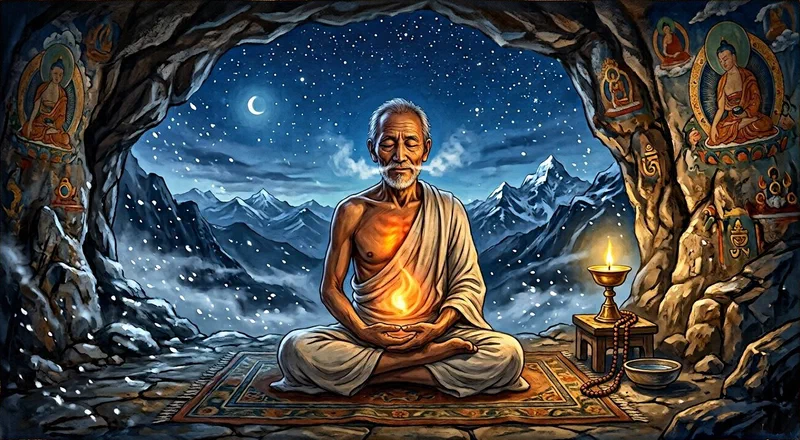
When the scholar-monk Gampopa first arrived and described his impressive meditative absorptions, Milarepa was unmoved, and told him to practise inner fire instead. Thrangu Rinpoche’s telling of the biography records that on Gampopa’s first night of tummo his body filled with warmth and bliss, and that when he dozed at dawn and woke, it had gone cold as stone, a lesson in how much the heat depended on the meditation [8]. Lama Yeshe insists that Milarepa “was not just making propaganda, exaggerating the power of inner fire”; a man who had given up all worldly competition had no reason to [1]. Our guide to Gampopa’s dream yoga picks up his story from there.
The European account everyone quotes is Alexandra David-Néel’s. In Magic and Mystery in Tibet (1929) she describes a winter-night test in which candidates sit naked on the ground beside a frozen river, wrap themselves in sheets dipped in the icy water, and dry them with body heat, repeatedly, until dawn; drying at least three, she was told, earned the right to the white cotton skirt of a repa [9]. It is a vivid story from a remarkable traveller, and it should be read as such: an ethnographic anecdote, not a measurement.
The measurements came later. In February 1981, Herbert Benson of Harvard Medical School, with the Dalai Lama’s permission, studied three experienced practitioners in unheated stone huts above Dharamsala. During tummo their finger and toe temperatures rose by as much as 8.3 °C, while core temperature did not change, a finding published in Nature the following year [10]. The result was striking, but it showed peripheral vasodilation, warm hands and feet, rather than a furnace at the core.
The best study to date is Maria Kozhevnikov’s, published in 2013. Her team recorded EEG and body temperature from nuns and monks in eastern Tibet performing two forms of the practice. The forceful breath form, vase breathing combined with visualisation of the rising flame, raised armpit temperature into the mild-fever range, to a maximum of 38.3 °C, with a rise of over 2 °C in one practitioner, accompanied by increases in alpha, beta and gamma EEG power. The gentle breath form maintained the elevated temperature. Crucially, when Western volunteers were taught the breathing alone, they achieved only modest rises within the normal range and could not sustain them; the visualisation appeared to be what allowed the heat to build and hold [11]. The same paper drily notes that the celebrated spectacle of steaming sheets proves little on its own: a warm wet cloth in freezing air will steam whatever the body underneath is doing.
The fair summary is this. Tummo produces genuine, measurable warming, larger than untrained breathing alone can produce, and the meditative component is part of the mechanism. It is not supernatural, and the tradition never claimed the warmth mattered. What the tradition claims, that the practice produces a distinctive blissful state of mind, is precisely what a thermometer cannot see.
Tummo and the Wim Hof Method
Because Wim Hof has described his cold-exposure method as inspired by tummo, the two are constantly confused. They differ in almost every respect that matters.
| Tummo (inner fire) | Wim Hof Method | |
|---|---|---|
| Aim | A blissful, non-conceptual state of mind united with insight into emptiness; heat is a by-product. | Stress resilience, cold tolerance, well-being; heat and cold are the point. |
| Breathing | Gentle vase breath: slow inhalation, retention low in the abdomen, quiet release; explicitly “without force”. | Cycles of 30–40 deep, fast breaths (voluntary hyperventilation) followed by breath holds on empty lungs. |
| Visualisation | Central to the method: channels, chakras, the short AH, the melting HAM, the four joys. | None required; “mindset” and focus are encouraged. |
| Context | Completion-stage practice of Highest Yoga Tantra; empowerment, preliminaries, vows and a teacher. | Secular course or app; no prerequisites. |
| Evidence | Peripheral and core-adjacent warming (Benson 1982; Kozhevnikov 2013); EEG changes; no trials of well-being outcomes [10][11]. | Adrenaline surge and blunted inflammatory response to endotoxin (Kox 2014); mixed evidence on other outcomes [12][13]. |
| Main hazards | Wind (lung) disturbance from forcing or premature practice; the general risks of breath retention. | Fainting; drowning after hyperventilation in or near water; cold-shock events in the cardiovascularly unfit [14]. |
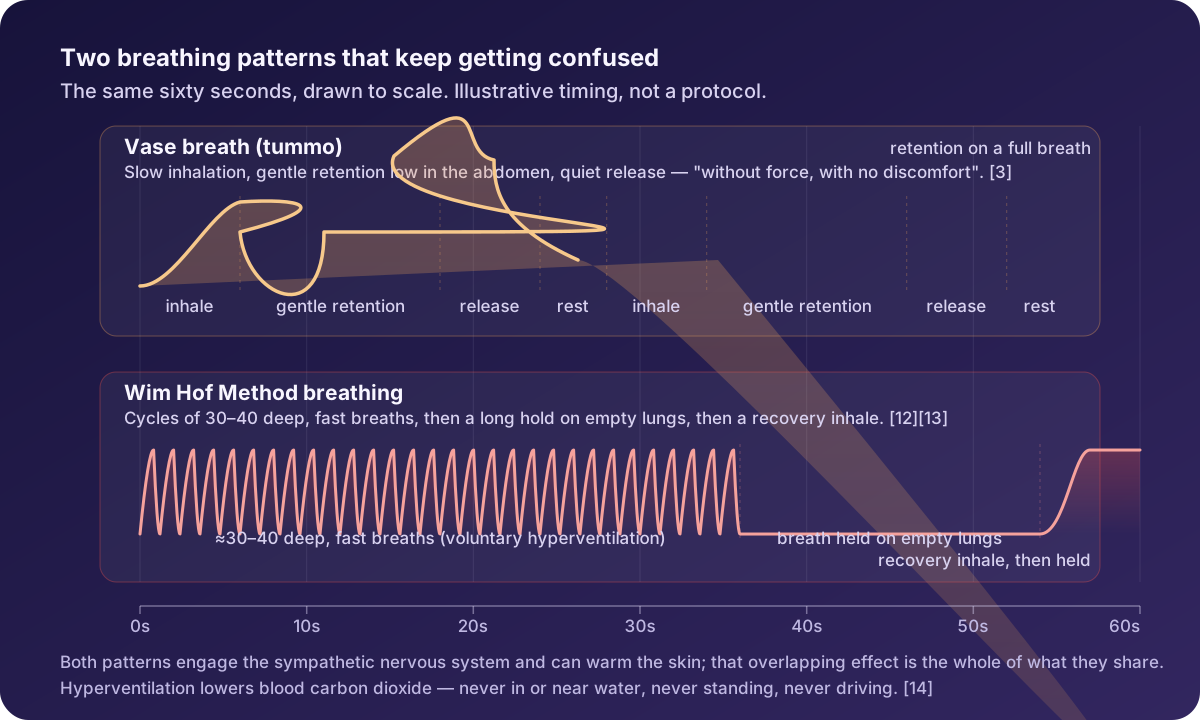
Physiologically there is some overlap: both engage the sympathetic nervous system and both can raise skin temperature. But the Wim Hof breathing pattern is a form of hyperventilation, which lowers blood carbon dioxide and suppresses the urge to breathe; that is why it has been implicated in shallow-water blackout drownings, and why every reputable source says never to do it in or near water [14]. Tummo’s vase breath is a retention on a full breath, taken slowly and held gently, and the texts forbid strain. If a “tummo” tutorial has you panting thirty times and holding your breath until you tingle, it is teaching Hof, not Naropa.
Why inner fire matters for dream yoga
Readers of this site come to tummo mostly through dream yoga, and the connection is not incidental.
In Tsongkhapa’s system the dream yoga is a branch of the illusory-body practice, and the illusory body arises from the bliss-and-emptiness of inner fire [3]. Practically, this means the dream yogi is asked to fall asleep with the winds already gathered: to lie down warm and relaxed from inner fire, hold attention at the throat chakra for dream recognition or at the heart for clear light, and let sleep come without losing the thread. Our guides to the four stages of milam and to throat-chakra visualisation describe that night-time practice; tummo is what the texts assume you bring to it.
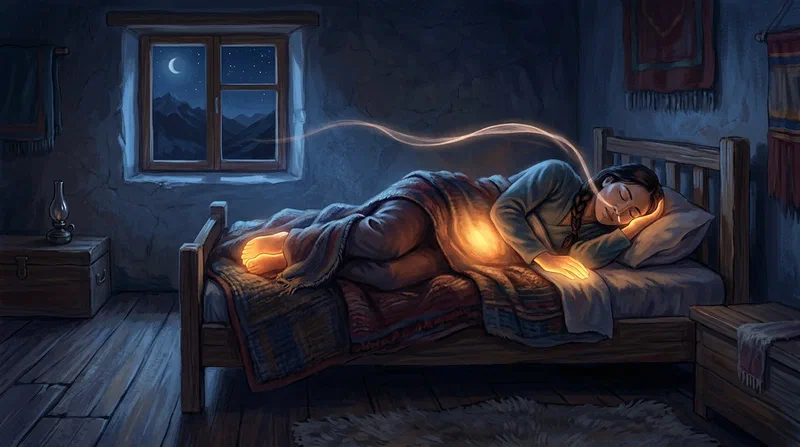
Modern sleep science offers a suggestive parallel, though not a confirmation. Falling asleep is accompanied by a redistribution of heat from the core to the hands and feet; warm extremities are one of the best predictors of rapid sleep onset, and warming the periphery before bed reliably shortens it [15]. A practice that warms the hands and feet through relaxed, low, slow breathing, which is what Benson measured, is, at the very least, pointed in the right direction for sleep, and the state of alert calm it cultivates is the same one that supports dream recall and lucidity. That is a physiological footnote to a contemplative practice, but it is one reason a gentle, teacher-free version of “warmth at the navel, attention at rest” makes a sensible pre-sleep routine.
What you can, and cannot, do without a teacher
We want to be direct here, because the internet is full of tummo tutorials, and because this site takes safety seriously.
Do not self-teach vase breathing or forceful tummo from videos. The tradition’s reasons are not mystical. Held breath and strong abdominal pressure raise blood pressure and can cause fainting; in the Tibetan medical understanding, premature or forced practice disturbs lung, the wind element, producing insomnia, anxiety, palpitations and agitation, a syndrome Tibetan doctors see often enough in over-eager meditators to have a name for it [16]. Lama Yeshe, who was more enthusiastic about inner fire than almost any teacher of his generation, still devotes a chapter to what can go wrong, including “uncontrolled kundalini” and heat that drenches the body in sweat [1]. And the general rules of breath-retention practice apply: never in or near water, never standing, never while driving, and not at all if you have heart or lung disease, epilepsy, uncontrolled high blood pressure, or are pregnant, without medical advice. If you have a history of mania, psychosis or dissociation, discuss any intensive energy practice with your clinician first; our safety brief lists the red flags.
What you can do, and what every lineage expects you to do first, is the preparation. The steps below are the traditional sequence.
This is a path measured in months and years, not sessions. None of the steps below involves breath retention or forceful breathing; those belong to step five, under a teacher.
Understand what inner fire is for
Read enough to know that the heat is a by-product and the goal is a subtle, blissful, non-conceptual state of mind used to realise emptiness. Glenn Mullin’s translation of Tsongkhapa’s A Book of Three Inspirations and Lama Yeshe’s The Bliss of Inner Fire are the two standard English sources. Knowing the aim protects you from the commonest error: treating tummo as a performance or a cold-tolerance hack.Build calm abiding first
Every lineage manual assumes the practitioner can already rest attention on a chosen object for a sustained period without agitation or dullness. Establish a daily zhiné (calm-abiding) practice of twenty to forty minutes. The visualisations of tummo, tiny syllables held steady at the navel for long stretches, are impossible without this, and the tradition regards attempting them without it as one cause of lung (wind) disturbance.Practise the common and uncommon preliminaries
Tsongkhapa opens his commentary by insisting on the lam-rim meditations, the reflections on motivation, impermanence, compassion and bodhicitta, followed by the tantric preliminaries of refuge, purification and guru yoga. He quotes Marpa, Milarepa and Gampopa to show that every early master taught them before the Six Yogas. In practical terms this is where the ethical and emotional stability comes from that makes intense inner experiences safe. Our bodhicitta and dream yoga guide covers the heart of it.Find a qualified lineage teacher and receive transmission
Tummo is a completion-stage practice of Highest Yoga Tantra and is taught after empowerment into a deity system such as Chakrasamvara, Vajrayogini or Hevajra. Look for a teacher within a living lineage (Kagyu, Gelug, Sakya, Nyingma or Bon) who teaches inner fire as part of a graded programme, not as a weekend intensive. A good sign is that they ask about your meditation history and your health before they teach you anything about the breath.Learn the physical exercises and vase breathing under supervision
Only now do the trulkhor exercises, the nine-round breathing and the vase breath enter. Tsongkhapa’s instruction is explicit: until progress is made, practise gently, without force, with no discomfort, and on an empty stomach. A teacher corrects posture, pace and retention, watches for signs of wind disturbance, and adjusts the practice to your body. This is the step where self-teaching from videos goes wrong.Carry the warmth into sleep and dream practice
In Tsongkhapa’s system, inner fire is generated at the start of every session of the other yogas, including dream yoga and clear-light sleep. As stability grows, the practitioner learns to fall asleep with the mind gathered at the heart or throat and the body warm and relaxed, so that dream recognition arises from within the same calm. Long before that, a simple version is available to anyone: settle the breath low and slow, rest attention gently at the navel or heart, and let sleep come.
Notice how much of that path is available immediately. Study is open to everyone. Calm abiding is the single most transferable skill in the whole system and the one that Thrangu Rinpoche, among others, calls the best remedy for wind disturbance rather than its cause. The preliminaries are, in modern terms, a training in motivation and emotional regulation. And a gentle, unforced awareness of the breath settling low in the belly, with attention resting warmly at the navel, is not tummo, but it is a harmless and pleasant doorway into sleep that points toward it.
Finding a teacher
Inner fire is taught today in every major Tibetan tradition. The Kagyu schools teach it within the three-year retreat and, increasingly, in graded lay programmes; the Gelug teach it from Tsongkhapa’s commentary, often within Vajrayogini practice; the Sakya within Lamdre; the Nyingma within the Anuyoga and Dzogchen preliminaries; and the Bon within the Mother Tantra cycle that Tenzin Wangyal Rinpoche has made widely available. Several Western scholar-practitioners also teach the preparatory tsa lung exercises openly.
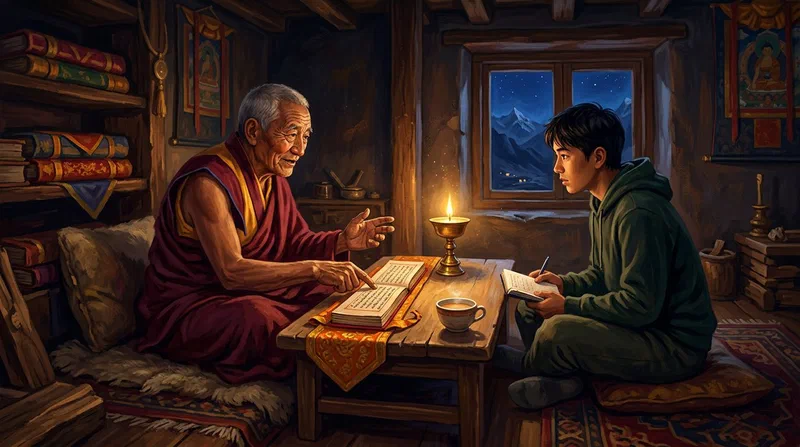
Whatever the lineage, the same signs of a trustworthy teacher apply. They will ask you to have a settled meditation practice first. They will teach the view, the map and the preliminaries before the breath. They will want to know about your health. They will progress you gradually, will not sell the heat as the point, and will say clearly that empowerment and transmission are required for the full practice. Lama Yeshe used to tell his students to check him as they would check anything else, “not blindly accept what he says but check up on whether it is right or wrong” [1]. That attitude is itself part of the tradition.
The bottom line
Tummo is the foundation of the Six Yogas because it is the method that gathers the mind’s energies into the central channel, and everything else, the illusory body, the clear light, the dream and bardo yogas, is built on the bliss that follows. The heat that made Milarepa’s cotton robe famous and that Harvard measured in Dharamsala is real, modest, and incidental. The practice is a discipline of body, breath and imagination in the service of a single insight, and it is transmitted, for good reasons, from teacher to student within a living lineage. Study it freely, prepare for it thoroughly, and let a qualified teacher light the fire.
“We really need tantra these days because there is a tremendous explosion of delusion and distraction… and we need the atomic energy of inner fire to blast us out of our confusion.” — Lama Thubten Yeshe, The Bliss of Inner Fire [1]
 Chotrul Düchen: The 15 Days of Miracles and Why They Matter for Dream Yoga
 Cultivating Bodhicitta Through Dream Yoga: Awakening Compassion in the Dream State
 What is Nyungné? A Beginner's Guide to Tibetan Purification Practice
 The 3am Alarm You Didn't Set: Tibetan Dream Yoga for Better Sleep