What the SSILD technique is
SSILD stands for Senses Initiated Lucid Dream (the doubled “S” in the acronym is deliberate). It is an induction method for lucid dreaming built around one simple move: as you return to sleep, you rotate your attention, gently and repeatedly, through your senses—what you “see” behind closed eyes, what you hear, and what your body feels. Then you stop doing anything at all and let sleep take you.
Where MILD trains prospective memory with a mantra, and WBTB only sets the timing, SSILD works on perception itself. Its selling point is how little it demands: no elaborate visualizations, no attempt to keep consciousness from going out, no equipment. This makes it a favorite of beginners, people who fall asleep the moment they start “trying,” and anyone for whom repeating a phrase feels awkward or ineffective.
It also has something rarer than popularity: peer-reviewed evidence. SSILD was one of the techniques tested head-to-head in the International Lucid Dream Induction Study (ILDIS), the largest study of lucid dream induction methods conducted to date. We’ll look at those numbers below—and they’re the reason this guide opens with them.
Where SSILD came from
Unlike LaBerge’s methods, SSILD didn’t come out of a university lab. It came out of the lucid dreaming community. The technique was developed around 2011 by a prolific forum poster known as Cosmic_Iron, who circulated it on the LD4all and DreamViews forums. A refined “official tutorial” was edited and published by Gary Zhang in 2013, and that version—with its fast and slow sensory cycles—became the standard text. When researchers later designed the ILDIS protocol, they wrote the instructions in consultation with the technique’s creator, which is why the study protocol below matches the community how-to so closely.
The technique’s sensory-rotation idea has clear cousins. Michael Raduga’s phase-training school had long taught “indirect techniques” built on repeated short returns to bed, and community members pointed out the family resemblance; versions influenced by that school sometimes swap the single sitting of cycles for repeated five-minute intervals. Betty Erickson’s self-hypnosis procedures, which also drift attention between the senses, were cited in the original tutorial as a precedent. Whatever the genealogy, the version that escaped the forums and entered a controlled study is the Cosmic_Iron/Zhang protocol described here.
“When you do the cycles, do not expect anything will happen. You should focus on losing focus.” — The original SSILD tutorial (Cosmic_Iron’s official guide, 2013)
Why rotating your senses might induce lucidity
Nobody knows exactly why SSILD works—there is no settled mechanism, and that honesty is part of what the researchers concluded, too. Three plausible explanations, two of them from the ILDIS discussion itself:
- Perceptual awareness that persists into the dream. Repeatedly checking what am I sensing right now? may leave a residual habit of monitoring perception, which then continues into REM sleep. A dreamer running that background check is more likely to notice that the dream’s visuals, sounds, or body-feel are… off—and that noticing is lucidity. One study participant reported continuing the cycles while drifting off, “even though I wasn’t trying to.”
- A touch more cortical activation. Alternating attention between sensory channels is mildly activating, and lucid dreaming appears to require a slightly more awake brain than ordinary REM (our brief on what neuroscience has actually measured covers the prefrontal and gamma findings).
- Sensory adaptation. The community’s favorite theory: each sense’s “short-term memory” gets fatigued by repeated sampling, so the brain starts generating its own content (hypnagogic imagery, inner sounds, tingling) as the channels go quiet. These effects can either nudge you into a dream scene you recognize as dreamt, or simply deepen the drowsy, observation-first mindset that makes dream signs noticeable.
None of these explanations requires “phase states” or any particular metaphysics, which is part of why SSILD sits comfortably next to both a lab bench and a meditation cushion.
What the research shows
The ILDIS was run online by the University of Adelaide’s lucid dreaming group. Over 1,600 people enrolled; 355 completed both weeks—one baseline week of sleep and dream logging, then one week practicing an assigned technique with the Wake-Back-to-Bed method. Unlike most induction studies before it (a systematic review found the field’s evidence to be largely small and methodologically shaky), this was a large, diverse, mostly non-student sample, and participants reported lucid dreaming on the mornings after nights of practice—counting lucid nights, not impressions.
Here is how the main technique groups did, as the percentage of nights with a self-reported lucid dream:
| Week 2 group | Baseline (week 1) | Technique week | Change | Effect size |
|---|---|---|---|---|
| All participants combined | 5.3% | 15.8% | +199% | 0.44 |
| MILD + WBTB (group 1) | 6.5% | 18.4% | +186% | 0.42 |
| MILD + WBTB (group 4) | 6.8% | 20.2% | +198% | 0.50 |
| SSILD + WBTB | 4.7% | 16.9% | +259% | 0.51 |
| SSILD/MILD hybrid + WBTB | 6.3% | 13.3% | +110% | 0.32 |
The headline findings for SSILD:
- SSILD was effective, with a large effect size—lucid dreaming on 16.9% of practice nights in a single week, up from a 4.7% baseline. For a technique that had lived only on forums, and had been published for barely a decade, matching MILD in the largest test to date was an extraordinary debut.
- It worked even without daytime reality testing. Groups that added reality checks to MILD did no better over one week (this says nothing about longer practices; reality checks remain one of the cheapest ways to build awareness—see our guide to the 12 tests).
- The hybrid did not beat the simple version. Bolting MILD’s mantra onto SSILD’s cycles gave no advantage. Pick one protocol and do it cleanly.
- Two things predicted success: better general dream recall (train it with our morning recall protocol), and falling asleep within about ten minutes of finishing the technique (lucid on 18.3% of those nights versus 11.1% of nights with longer lie-awake time).
- Sleep quality did not suffer—participants actually reported better sleep on nights a lucid dream succeeded. Unsuccessful attempts, spent lying awake, were what cost them.
Read honestly: it was one week of self-reports from self-selected volunteers, with heavy drop-off. Researchers have rightly called for more work on induction methods and on what frequent lucid dreaming does to REM over the long term. Treat these numbers as “the best evidence we currently have,” not as physics.
The SSILD technique, step by step
The protocol below follows the version tested in the study, with the timing conventions from the original tutorial. It is also available in a compact format:
Practice on nights when a slightly tired next day is acceptable. If you are already sleep-deprived, skip the technique that night—both the research protocol and common sense say the same thing.
Set your timing
Set an alarm for about five hours after you fall asleep (four to six hours works—longer sleeps push you toward morning and can make returning to sleep harder). Put the alarm across the room so that switching it off means getting out of bed. Don’t practice when you’re already sleep-deprived, and don’t practice on nights before anything demanding.Wake gently and re-orient
When the alarm sounds, get up briefly. Keep the light dim (the study found lights on versus off made no difference to success, so choose what helps you return to sleep). Stay quietly awake for a few minutes up to about half an hour—read a page of your dream journal or skim this article. The feeling to aim for is alert enough to follow instructions, sleepy enough to fall asleep within ten minutes of getting back under the covers.Get back to bed and settle
Lie down comfortably, close your eyes, and keep your body still. Take a few unhurried breaths. There is nothing to relax into and nothing to achieve yet—you are simply letting the body know this is bedtime. Settle before you start the cycles, not after.Do four fast sensory cycles
Rotate attention through three senses for just 2–3 seconds each: (1) Vision—notice the darkness behind your closed eyelids; colors, dots, patterns, or plain black are all fine. (2) Hearing—notice ambient sounds, the quiet, or faint inner ringing. (3) Body—notice weight, warmth, contact points, or tingling. That is one cycle. Repeat four times, quickly and lightly. Don’t strain to perceive anything and don’t count precisely.Do four to six slow sensory cycles
Now run the same vision–hearing–body rotation more slowly, resting roughly 20 seconds on each sense. Do at least four and no more than about six of these slow rounds. If unusual sensations appear—floating, warmth, buzzing, imagery—just observe them; the original tutorial’s advice was to “focus on losing focus.” If you drift off mid-cycle, congratulations: stop and sleep.Let go and sleep as usual
After the final cycle, do nothing technique-ish. Fall asleep the normal way; there is nothing to hold on to. Lucidity usually arrives later, inside the next dream, not during the transition—so no reality checks are needed yet. If a dream-like scene or a false start does appear, do one reliable reality check before celebrating. In the morning, write down whatever you remember—lucid or not.
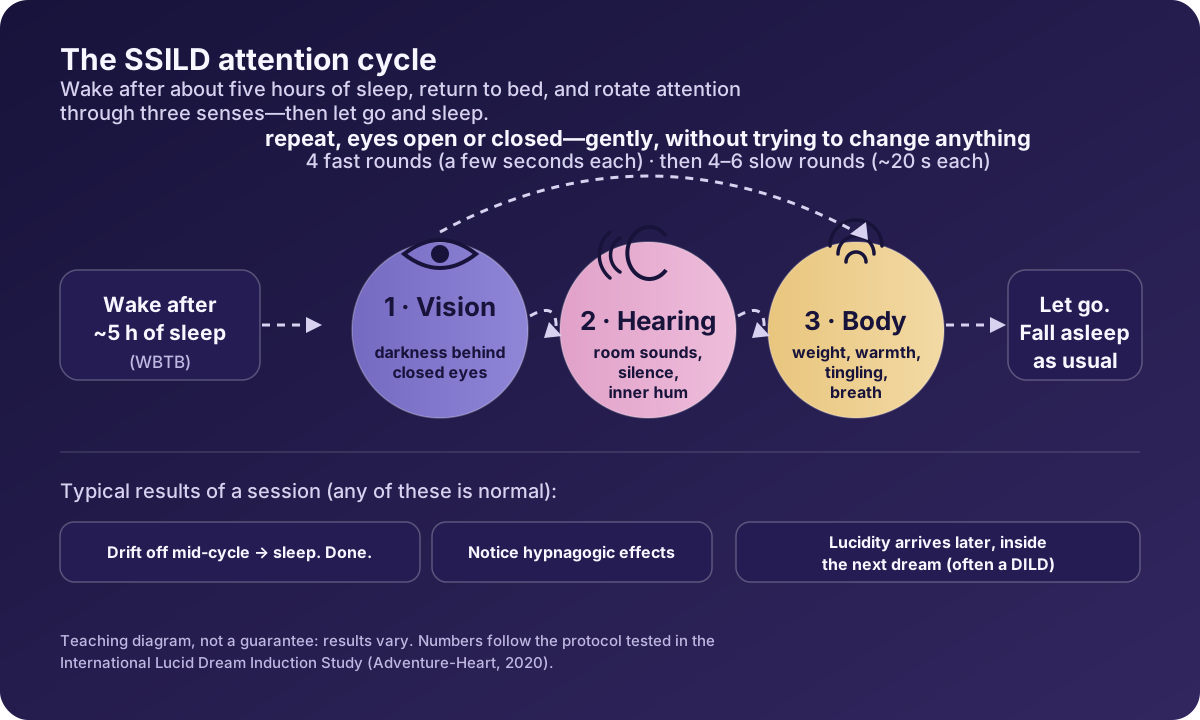
Two small notes that matter more than they look. First, passivity is the technique. In WILD-like methods you keep attention locked; here you keep it loose, moving it the way you’d flip through TV channels with nothing you actually want to watch. Second, the goal is falling asleep, not seeing sparks. If nothing special happens during the cycles, the technique still did its job.
What to expect on a typical night
Picture the realistic sequence: you wake at 4:30am, sit up in the dark, blink at the wall, run the alarm to another room, maybe flip on a dim lamp, read your journal for ten minutes, and get back into bed. You run the cycles. Around the second slow round, your attention wanders into half-formed images—a doorway from childhood, a face, a smear of color—and the doorway is gone before you can look directly at it. That’s hypnagogia: the sensory material dreams are assembled from. If you notice a sensation drifting into something spatial—a rocking, a floating, the bed becoming vague—stay still and keep watching the way you’d watch weather.

Most SSILD successes don’t feel dramatic at the transition. They arrive later: you’re walking through an ordinary-feeling dream, something is subtly wrong (the text swims, a room has one wall missing), and a thought occurs to you with absurd clarity—“This is a dream. I am dreaming.” Lucid. The study’s participants reported exactly this flavor of dream-initiated recognition, some mid-cycle and some much later in the night.
SSILD vs. MILD vs. WILD: choosing your induction
Three popular methods, three different skills:
- MILD is a memory exercise. You rehearse the intention “next time I’m dreaming, I will remember I’m dreaming” around a recalled dream scene. It works by planting a prospective-memory cue that fires inside REM. Best if you can hold an intention without anxiety and prefer the method that has the most evidence behind it (see our full MILD guide).
- WBTB is not an induction but a timing device: the brief wake period that makes every other method land inside a REM-rich stretch. All of the research above paired these techniques with it (guide here).
- SSILD is an attention exercise. Instead of remembering, you perceive—cycling through sensory channels until the dreaming state starts generating content on its own. Best if mantras feel fake to you, if you fall asleep too fast to repeat anything, or if WILD’s vigilance keeps jolting you awake.
If you already practice zhiné (calm abiding), SSILD will feel like its drowsy cousin: same quality of gentle returning, no object to stay on. That familiarity is probably why meditators pick it up quickly—and why the technique can quietly double as an evening concentration practice.
Practical tips and honest cautions
- Give it a fortnight, not one night. In the study, a successful week meant lucid dreaming on roughly one night in six—not every night, and usually not on the first try. Expect it to take several nights of consistent practice before the first lucid dream lands.
- Don’t overdo the cycles. Four to six slow rounds is the prescription. Lying there cycling for an hour did not help in the data and predictably costs you tomorrow.
- Plan around your calendar. WBTB-anchored methods trade a little sleep for a lot of REM proximity. On work nights, or during any stretch of sleep deprivation, skip it—the study instructions said the same.
- Return to sleep fast, on purpose. Keep the wake period quiet and deliberately brief, so you finish the cycles genuinely sleepy; falling back asleep within ten minutes is the sweet spot the data supports.
- If effects appear, watch, don’t grab. Imagery, buzzing, heaviness, floating: normal material. Reaching for it is how beginners wake themselves up.
- Know when to stop entirely. If the practice starts making you dread bedtime, fragments your sleep for days, or you experience frightening transitions regularly, take a break and talk with a healthcare professional. A small number of people should simply not do sleep-transition practices; our safety brief on when to see a clinician has the fuller picture, including cautions raised in the research literature about intensive lucid-dream cultivation.
Beyond induction: why bother becoming lucid?
Induction is a gateway, not a destination. On this site, lucid dreaming is usually the first stretch of a longer path: in the Tibetan milam tradition, recognizing the dream is followed by working with it—stabilizing it, transforming it, and finally questioning what any experience is made of (a map of those stages is in our four-stages guide, with background in what dream yoga actually is).
SSILD fits that framework surprisingly well, because it is trained on passive noticing—which is precisely the faculty dream yoga matures. You can keep the technique entirely secular, or use the lucidity it brings as a morning-hours laboratory for the same recognition you practice during the day. Either way, the first night’s goal stays small and kind: notice the senses, fall asleep, remember the dream. If lucidity happens, you’ll know—and you’ll know you’re the one who set the table for it.



 WBTB: Wake-Back-to-Bed Method Explained
 Is Lucid Dreaming Dangerous? Safety, Sleep Paralysis & Who Should Be Careful
 How to Remember Your Dreams (9 Science-Backed Tips)
 Reality Checks: 12 Tests That Trigger Lucidity