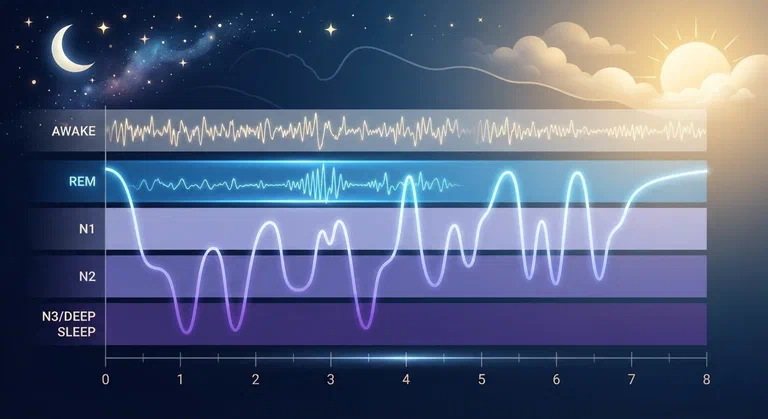
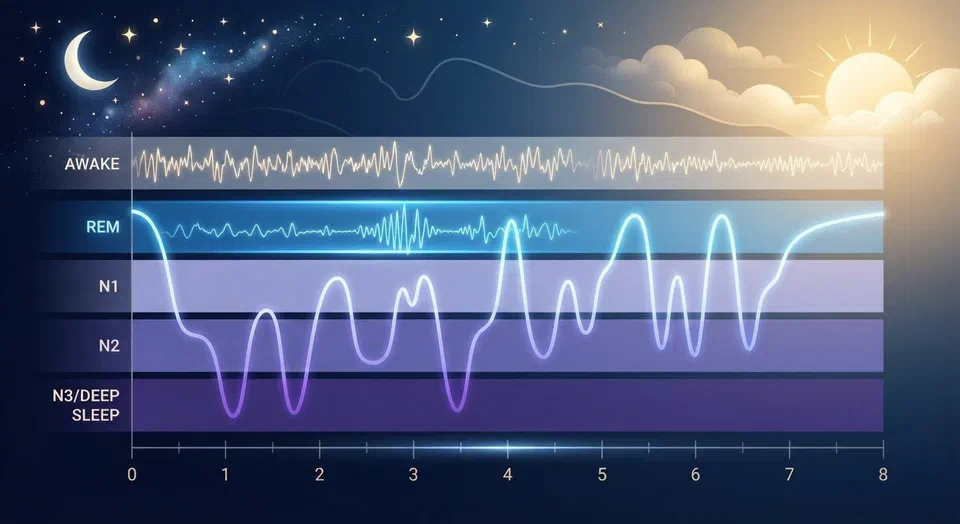
“Sleep comes in 90-minute cycles, so set your alarm for multiples of 90.” You have seen the graphic. It is tidy, it is appealing, and it is about half true.
Sleep does cycle. That part is among the oldest findings in sleep science — William Dement, Nathaniel Kleitman, and Eugene Aserinsky documenting REM in the 1950s, Mary Carskadon and Dement mapping the stages that follow. But the neat 90.0-minute block is a population average that has hardened into a rule. Real cycles run about 70–120 minutes, vary within the same night, and vary between people. Knowing the real shape helps you use it — for bedtime, for waking, and, if you practise, for WBTB and dream yoga — without pretending you can stage-calculate your night to the minute.
This guide gives you the accurate picture, the honest limits, and a low-friction way to respect your architecture tonight.
The four stages and the repeating cycle
Sleep architecture is the name for the structure of a night: how the brain moves through the stages, and how that distribution changes.
Polysomnography distinguishes:
- N1 — the briefest, lightest drowse (2–5% of the night). The doorway in and between cycles. A lot of N1 usually means fragmentation.
- N2 — light, stable sleep, home to sleep spindles and K-complexes (45–55% of the night). The quiet majority.
- N3 — slow-wave (deep) sleep (10–20% of the night, most of it early). Growth hormone surges here; the glymphatic system is most active; the cost of waking from here is the heavy inertia you sometimes feel.
- REM — rapid-eye-movement sleep (20–25% of the night, most of it late). Dreaming is common, atonia holds the body still, and emotional-memory processing is thought to depend on it in part.
The classic order, repeated 4–6 times per night, is N1 → N2 → N3 → N2 → REM, with brief returns through lighter stages between. The interval between the starts of successive REM episodes — the operational definition of one NREM–REM cycle — averages roughly 90–110 minutes in healthy adults, but the spread is wide [1][2].
“The first episode of REM sleep occurs about 80–100 minutes after sleep onset, and the cycle between NREM and REM repeats every 90 minutes, with REM episodes getting longer throughout the night.” — Stanford Center for Sleep Sciences and Medicine [1]
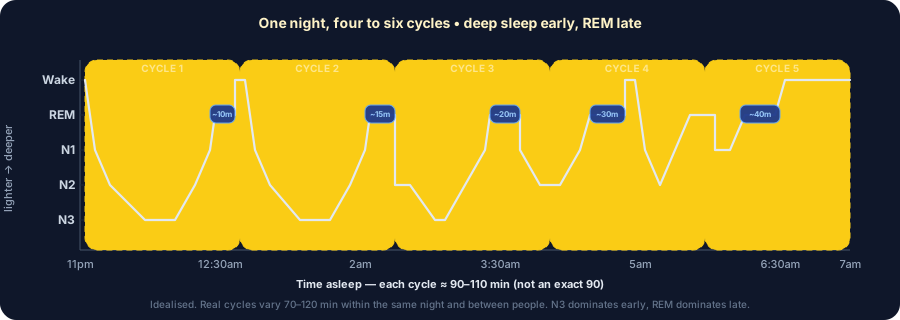
That last clause is the part the calculator graphic usually drops: REM lengthens across the night. The first REM period is often ~10 minutes. The last, in the final third, can be 30–60 minutes — the very stretch most people cut with an early alarm [5].
The curve across the night
Two curves describe the same fact:
- N3 dominates early. If you sleep 11 p.m.–7 a.m., most slow-wave sleep is done by about 2–3 a.m.
- REM dominates late. By cycles 4 and 5, N3 has shrunk or vanished; REM fills the space.
Both matter, for different reasons. Lose the start of the night and you lose the deepest, most physically restorative portion. Lose the end and you disproportionately lose REM — the stage most associated with vivid dreaming, next-day emotional regulation, and the long, recall-rich dreams from which lucidity is easiest [1][5].
So what about the 90 minutes?
The number comes from the ultradian rhythm that governs the alternation. An ultradian rhythm is a biological rhythm shorter than a day; the NREM–REM rhythm is its best-studied human example. The label Basic Rest–Activity Cycle (BRAC) for the ~90-minute remainder-of-the-day version was proposed by Kleitman (1963), who suggested the same oscillation might continue, more subtly, during wakefulness as waves of higher and lower alertness [3][4].
The modern data refine that to:
- In sleep, the 90 is the centre, not the clock. Carskadon and Dement’s foundational work, and two large modern datasets, make the point quantitatively. One wrist-actigraphy study of 16,441 nights from 573 subjects found a median cycle length of ~110 minutes, with the middle 75% between 95 and 130 minutes. A polysomnography study of 2,312 nights found a mean of 116.9 minutes with a huge standard deviation. The right mental model is ~90–110 minutes on average, 70–120 in practice — not 90.00. Within a single night, the first cycle tends to run shorter (70–80 min) than the last (100–120 min), because the later, REM-heavy cycles stretch [6].
- Between people, age and debt matter. Newborns cycle at ~50 minutes; newborn REM occupies about half the night. By early childhood the cycle lengthens toward the adult range, and by older adulthood it tends to shorten again, with less N3. Acute sleep debt lengthens early slow-wave and can postpone the first REM — the homeostatic pressure is discharged by more N3 up front — while alcohol shortens early REM and creates rebound REM later [5][8].
- By day, the evidence is real but softer. Reviews confirm that alertness, reaction time, hormonal pulses, and EEG fluctuate with ultradian periodicities during wakefulness, but the clean 90-minute BRAC in the waking state is harder to detect and likely varies between people and across the day. Folkard and Monk’s 1995 work found both a ~90–100 minute behavioural rhythm and a slower multi-hour EEG rhythm; Lavie’s earlier ultrashort-sleep paradigms found ~90-minute “sleep gates” when falling asleep was easiest. The honest summary from recent syntheses: ultradian variation during wakefulness is well supported; the claim that everyone cycles exactly every 90 minutes is not [3][4].
“The alternation between non-REM and REM sleep occurs in a regular, cyclical pattern called an ultradian rhythm… Individuals progress through the sleep stages in cycles that last approximately 90 minutes.” — Carskadon & Dement structure, as summarised in contemporary sleep architecture reviews [2]
Knowing the average is useful. Pretending it is exact is where the calculators mislead.
What this actually means for bedtime and alarms
Here is how to hold the science without clock-watching.
1. Think windows, not stage predictions
If you must wake at 7:00, work backwards: 7:00 minus 15 minutes of typical sleep-onset latency, minus 7.5–9 hours of opportunity (not just “sleep obtained”), lands you at roughly 10:30–11:30 p.m. That window gives you five-ish cycles at the population mean and room for real variability, without trying to thread a stage needle no consumer device can reliably locate. The population finding that total-sleep-time plus architecture quality predicts how restored you feel is more actionable than any single-cycle forecast [2][6].
2. Protect both ends, for different reasons
This is the most underused lesson of architecture.
- Protect the first third for N3. Late, bright light and a second wind after midnight steal N3 you cannot fully make up later; the first cycles are where slow-wave is due.
- Protect the last 60–90 minutes for REM. This is the portion most people sacrifice to an early alarm — and it is the portion richest in dreaming, recall, and the emotional-memory work REM is thought to support.
A useful way to remember: fragmentation matters as much as duration. Eight hours that is broken by awakenings, apnea, or an irregular schedule can produce as much daytime impairment as a shorter but consolidated night, because stage continuity is lost even when clock time looks adequate [1][8].
3. Make the alarm kinder, not cleverer
If your mornings allow it, a sunrise-type alarm, a light cue, or a vibrating band is gentler than a precision-timed 90-minute alarm set for a guessed stage — especially because you cannot know which cycle you were in from a calculator. If a groggy awakening happens, a brief upright period, light, and movement reduce sleep inertia (which is maximal after N3) faster than debating the cycle you just left. Regularity again beats optimisation: the most reliable predictor of “I woke up rested” in the literature remains a consistent window [1][2].
What it means for lucid-dreaming and dream-yoga practice
This is the bridge to the site you are actually on.
Dream yoga (milam) and modern lucidity training both use the same architecture, and the same caveat applies to both: technique sits on top of healthy sleep. The most cited modern protocols are explicitly late-night techniques because long, vivid REM is late.
- WBTB (Wake-Back-to-Bed) lifts success because it places a brief wake and an intention practice adjacent to the longest REM periods. Classical instructions put the wake after roughly 4–6 hours of sleep; recent randomised trials using MILD or SSILD that were positive placed the wake after about 5 hours, kept the wake to ~10–30 minutes, and had participants return to sleep practising intention (MILD) or a gentle sensory cycling (SSILD). In the International Lucid Dream Induction Study, lucidity on a technique night roughly tripled versus baseline. The effect is protocol-plus-timing, not timing alone [9][10].
- “Sleep cycle calculators” are not required, and pretending they are can hurt. If you already have short or fragmented sleep, adding a fragmented induction night costs more than it gives, because you are interrupting the homeostatic and REM recovery the practice needs. Our safety guidance is explicit on this: consolidate sleep first; add induction when the nights are steady and you can afford a slightly tired morning; prefer dream-initiated methods (MILD, SSILD) over techniques that deliberately hold consciousness through the sleep transition unless you are already comfortable with sleep paralysis and false awakenings [10][11].
- Recall lives at the end of the night. Dream journaling works best from the long, late REM — especially the final cycle before natural waking. A consistent wake time plus a 2-minute morning note before the phone (“any face, place, feeling?”) is the highest-return habit for the architecture. The how-to-remember-dreams guide gives the exact morning protocol.

A Tibetan note: the tradition has always distinguished night practices by where in the sleep period they sit. Early-night training builds on the descent into slow-wave; later-night training meets the long REM where lucidity is most accessible; clear-light (ösel) practice belongs to the deepest slow-wave and the luminosity of dreamless sleep. Architecture gives that map a measurable shape; it does not replace the view, the teacher, or the daylight stability the tradition requires [12][13].
Two myths worth retiring
Myth 1 — “A 90-minute nap always completes one cycle.” A nap’s cycle structure depends on prior sleep pressure, circadian phase, and length. A 90-minute nap can include a full cycle and is more likely to include REM in the afternoon than a 20-minute nap, but it frequently contains only N1–N2, or N1–N3 without REM, and sometimes REM with little N3. Length alone does not guarantee a tidy cycle. The consistent finding is simpler: a 10–20 minute nap reliably lowers subjective sleepiness; a 90-minute nap is more likely to produce grogginess on waking if it ended in N3, and more likely to yield dream content if it caught REM [5][8].
Myth 2 — “If I sleep in multiples of 90, I’ll wake refreshed regardless of total.” Total opportunity still dominates. Sleeping five hours because it is “two cycles” leaves you in meaningful deficit after successive nights; the dose–response literature shows cumulative cognitive impairment at 6 hours per night that equals two nights of total deprivation after two weeks, even though every night was a multiple of something [11]. Multiples do not make up for scarcity. Window first, stage-optimisation a distant second.
5 minutes of planning in the morning plus one consistent habit at night. No rigid 90-minute arithmetic; real cycles vary too much for that to be reliable.
Anchor one fixed wake time, 7 days a week
Pick the earliest time you must be up and keep it, weekends included, within an hour. A fixed wake time is the single strongest stabiliser of circadian rhythm and, downstream, of cycle structure. If you are repaying debt, allow a modest extra 30–60 minutes of time in bed, but keep the wake anchor — add sleep to the start of the night, not the end, so you protect morning REM rather than truncate it [1][8].Think in windows, not multiples of 90
If you need to be up at 7:00, a practical window to be falling asleep is roughly 11:00–11:30 for 7.5–8 hours. That covers 5 cycles at the population average without pretending you can hit a stage boundary on demand. Real cycles run 70–120 minutes and vary within the same night; no consumer calculator can know where you are. Aim for enough time rather than a stage-perfect minute [2][6].Protect both ends of the night, for different reasons
Deep slow-wave sleep (N3) concentrates in the first third of the night; REM lengthens systematically across cycles and dominates the last third. Cutting the start of the night cuts physical restoration; cutting the end (the early alarm) disproportionately cuts vivid dreaming, emotional-memory processing, and the REM from which morning recall comes. A night cut at both ends loses more than a night cut by the same total at one end [1][5].If you use WBTB — align it with late-night REM
When and only when your sleep is already consolidated and you can afford a slightly tired next day, a Wake-Back-to-Bed that lands in the second half of the night places you next to the longest REM episodes. Classic protocols use ~4.5–6 hours after falling asleep; modern SSILD and MILD trials use ~5 hours, then a short 10–30 minute wake before returning to sleep with intention. Do not use this while you are repaying debt or fighting insomnia — fragmented sleep undermines both [9][10].Let the light cue end the night, not a stage prediction
Waking gently with light, a sunrise alarm, or a vibrating band is kinder to sleep inertia than a precise 90-minute alarm set for a guessed stage. Allow 15 minutes of sleep-onset latency when you count backwards, keep caffeine off the evening table, and judge the habit over a week (sleepiness, recall, mood) rather than one night’s guess at where a cycle ended [1][2].
The bottom line
Sleep cycles are real. The neat 90-minute rule is a true average stretched into a false precision.
Across a normal 7.5–9 hour night you will cycle 4–6 times. Each cycle lasts roughly 90–110 minutes on average and 70–120 minutes in practice, with deep sleep concentrated early and REM steadily lengthening late. Variation within the night and between people dwarfs the tidy graphic.
Use the structure the way good science invites you to: anchor a consistent wake time, give the night a generous window, protect its last hour, and — if you practise lucidity — place your one WBTB night where the long REM actually lives. The 90-minute rhythm is not a lock you can pick with an alarm. It is a tide you can move with.
 How to Stop Nightmares (and What Lucidity Can & Can't Do)
 Is Lucid Dreaming Dangerous? Safety, Sleep Paralysis & Who Should Be Careful
 SSILD Technique: Senses-Initiated Lucid Dreaming
 Racing Thoughts at Night: 5 Ways to Quiet the Mind Before Bed
 MILD Technique: Mnemonic Induction of Lucid Dreams
 WBTB: Wake-Back-to-Bed Method Explained