Ask most people what Tibetan Buddhism’s most advanced meditation practices are, and you’ll hear about monks meditating in freezing caves, warmed by inner heat; yogis who transform their bodies into light; and masters who stay conscious through death itself. All three come from the same source: the Six Yogas of Naropa.
For dream yoga practitioners, the Six Yogas matter for a simple reason: dream yoga is one of them. Understanding the full system shows exactly where dream practice sits on the path — and where it leads.
In this guide, you’ll learn:
- What the Six Yogas of Naropa are and where they come from
- Each of the six practices, explained in plain language
- How dream yoga fits into the system and what comes after it
- What the prerequisites are — and what’s safe to explore as a beginner
What Are the Six Yogas of Naropa?
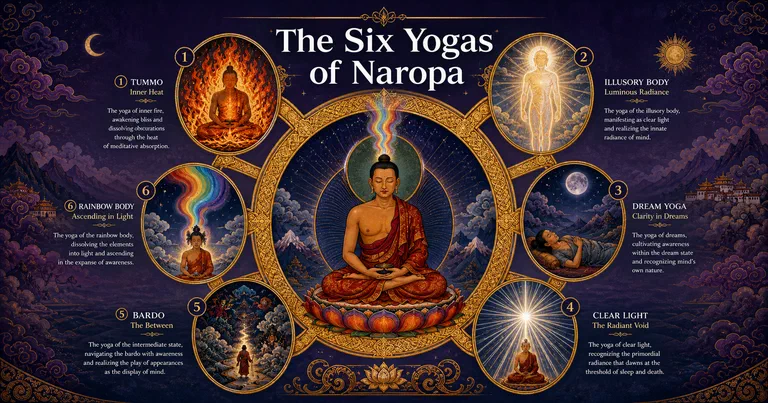
The Six Yogas of Naropa (Tibetan: na ro chos drug, “the six dharmas of Naropa”) are a set of advanced Tibetan Buddhist tantric practices for transforming the body, mind, and consciousness. They form the completion stage of anuttarayoga tantra in the Kagyu lineage, and were transmitted from the Indian master Naropa to his Tibetan student Marpa in the 11th century.
The six practices are:
- Tummo (gtum mo) — inner heat
- Gyulü (sgyu lus) — illusory body
- Milam (rmi lam) — dream yoga
- Ösel (‘od gsal) — clear light
- Bardo (bar do) — the intermediate state between death and rebirth
- Phowa (‘pho ba) — transference of consciousness
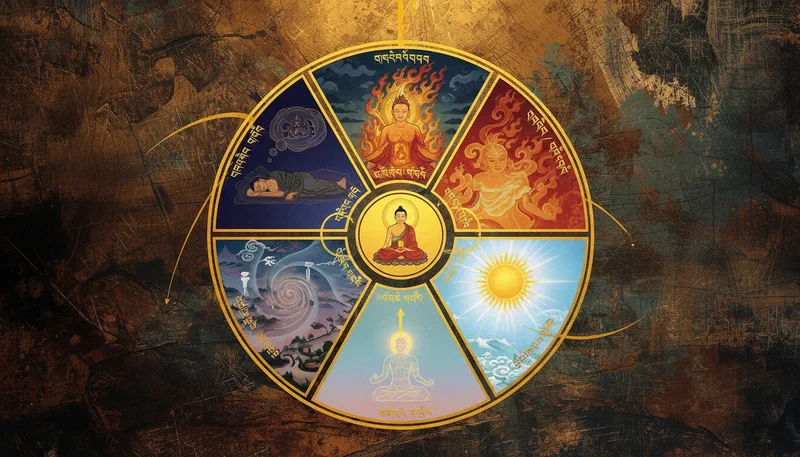
Together they form a complete technology of awakening: practices for waking life (tummo, illusory body), for sleep (dream yoga, clear light), and for death (bardo, phowa). The goal is nothing less than continuity of consciousness across every state of existence.
The Six Yogas at a Glance
| Yoga | Tibetan | Core Practice | Traditional Result |
|---|---|---|---|
| Tummo | gtum mo | Channeling subtle energies to generate inner heat | Bliss, warmth, control of prana |
| Gyulü | sgyu lus | Seeing the body as a dreamlike illusion | Freedom from attachment to form |
| Milam | rmi lam | Maintaining awareness while dreaming | Lucidity through all sleep states |
| Ösel | ‘od gsal | Resting in the luminous nature of mind | Recognition of the ground luminosity |
| Bardo | bar do | Navigating the states between death and rebirth | Conscious death, fearlessness |
| Phowa | ‘pho ba | Ejecting consciousness from the crown at death | Rebirth in a pure land |
History and Origins of the Six Yogas
The story of the Six Yogas begins with the Indian mahasiddha Tilopa (988–1069), who received the teachings from various dakinis and tantric masters — among them Vajravarahi and, according to tradition, the primordial Buddha Vajradhara himself. Tilopa transmitted them to his student Naropa (1016–1100), the famed abbot of Nalanda University.
Naropa’s own story is legendary. After a dakini told him his scholarship was only words, he left Nalanda to find Tilopa and endured the twelve great and twelve lesser hardships under his teacher — plunging into fires, jumping from cliffs, and being beaten at every turn — until his pride had burned away and realization dawned. The Six Yogas he carried were the fruit of that ordeal.
Naropa then passed the teachings to Marpa the Translator (1012–1097), who brought them to Tibet. From Marpa they flowed to the poet-yogi Milarepa — whose mastery of tummo let him meditate in snowbound caves wearing only cotton — and then to Gampopa, who systematized them for the Kagyu monastic order. (For Gampopa’s specific dream yoga method, see our guide to Gampopa’s dream yoga: the throat chakra practice.)
Later, the great reformer Tsongkhapa (1357–1419) reorganized the Six Yogas for the Gelug school around the “three isolations” of body, speech, and mind, and wrote an influential commentary that is still studied today. The Bön tradition, Tibet’s pre-Buddhist spiritual system, preserves its own parallel cycle of practices — its dream yoga is explored in our article on dream yoga in the Bön tradition.
The Six Yogas in Depth
1. Tummo: Inner Heat
Tummo is the most famous of the Six Yogas — and the most misunderstood. It is not a party trick for drying wet sheets in freezing air (the famous demonstration of tummo mastery), but a precise system of subtle-body yoga.
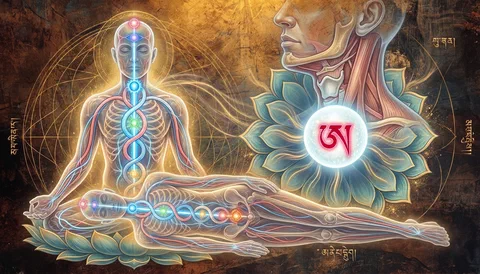
The practice: Using visualization of the body’s channels (tsa), winds (lung), and drops (tigle), the practitioner draws the energies into the central channel and ignites the “inner fire” at the navel center. The sign of success is genuine, blissful warmth that allows meditation in extreme cold.
Why it comes first: Tummo is the energetic foundation of the whole system. The same control of subtle winds it develops powers dream yoga’s lucidity, the illusory body’s pliancy, and the clear light’s luminosity. As the saying goes: without the winds, no yoga of the winds.
2. Gyulü: Illusory Body
Where tummo works with energy, gyulü works with perception. Its premise is the same insight dream yoga teaches — that the body is not as solid as it appears — applied to the waking state.
The practice: Through visualization and the control of prana, the practitioner learns to experience their own body as a rainbow-like apparition: present, vivid, yet empty of solid existence. Advanced practitioners are said to multiply their forms, pass through obstacles, and travel without limit.
Why it matters: Gyulü dissolves the deepest root of fear — identification with the physical body. That fearlessness is the same one bardo yoga requires at death, which is why illusory body and bardo practice are traditionally paired.
3. Milam: Dream Yoga
Dream yoga is the third of the Six Yogas and, for modern practitioners, the most accessible entry point into the entire system.
The practice: Using daytime awareness training, dream recall, and the recognition of dream signs, the practitioner learns to wake up inside the dream — then uses that lucidity to meditate, transform dream content, and investigate the nature of mind itself. The practice begins with simple lucid dreaming and progresses to the clear light of deep sleep.
Why it matters in the system: Dream yoga is the training ground for the two yogas that follow it. The lucidity you learn in dreams becomes the continuity of awareness you need in the bardo, and the dissolution of dream imagery is the rehearsal for recognizing the clear light. If you’re new to the practice, our complete guide explains what dream yoga is, its benefits, and how to practice it.
4. Ösel: Clear Light
If dream yoga is the doorway, clear light is the room at the end of the hall. Ösel refers to the luminous nature of mind — the awareness that remains when thoughts, images, and even the dream body dissolve.
The practice: In the deepest phase of sleep, and in the dissolution of dream imagery, the practitioner rests in bare awareness — without object, without form. The tradition calls this the “clear light of sleep,” and considers recognizing it the highest realization the sleep yogas can offer.
Why it matters: All the preceding yogas prepare for this one recognition. In Tibetan Buddhist cosmology, the same clear light dawns at death; recognizing it then means liberation. Recognizing it every night means the practitioner has made liberation a habit.
5. Bardo: The Intermediate State
Bardo yoga prepares the practitioner for death — not morbidly, but as the ultimate test of awareness.
The practice: The bardo (bar do, “between state”) refers to the transition between death and the next rebirth: the dissolution of the elements, the dawning of the clear light, and the arising of visionary experience. Through study, dream yoga training, and phowa practice, the practitioner learns to recognize each stage as it unfolds and remain conscious through it.
Why dream yoga is essential to it: The Tibetan tradition is explicit: the bardo journey is navigated with the same skills as a lucid dream. “If you cannot recognize your dreams,” the masters say, “you will not recognize the bardo.” Every night of dream practice is a rehearsal for death.
6. Phowa: Transference of Consciousness
Phowa is the final yoga of the cycle: the art of directing consciousness at the moment of death.
The practice: Through visualization of the central channel and the support of a deity such as Amitabha, the practitioner learns to eject consciousness through the crown of the head — either to benefit others (transference into a pure land) or to help a dying person make the transition. There are signs of accomplishment (a small opening at the crown, drops of fluid), and the practice is taught to laypeople as well as monastics.
Why it caps the system: Phowa is the application of everything the other five yogas build: control of the winds (tummo), fearlessness toward the body (gyulü), lucidity (milam), recognition of luminosity (ösel), and familiarity with transition (bardo).
How Dream Yoga Fits Into the Bigger Picture
For most of us, the Six Yogas are not practices we’ll complete — they are a map. And the map has a clear message: the night is practice time. Dream yoga sits at the center of the system precisely because sleep is where all the other yogas converge.
- Downstream from tummo and gyulü: the daytime clarity they build carries into sleep.
- Upstream of ösel and bardo: the lucidity dream yoga trains is their prerequisite.
This is also why dream yoga is the most widely taught of the six today. Teachers from the Dalai Lama to Tenzin Wangyal Rinpoche present its foundations — dream recall, reality checks, lucidity — to general audiences, because the doorway is open to everyone even when the inner rooms require preparation.
Prerequisites and How to Begin
If the Six Yogas inspire you, the honest advice is: begin where beginners begin.
- Study first. Reading about the Six Yogas — and the broader framework of tantra — is valuable and unrestricted. Glenn Mullin’s translation of Tsongkhapa’s commentary (see below) is the standard modern reference.
- Practice the foundations. Daytime mindfulness, meditation, and the preliminary practices of dream yoga (dream journaling, reality checks, intention-setting) are open to everyone. See our guide to the 12 reality checks that trigger lucid dreams to begin.
- Find a teacher. The complete practices require empowerment and personal instruction. If the path calls you, seek out a qualified Kagyu, Gelug, or Bön teacher and begin the ngöndro (preliminary practices) — they are the real first step of the Six Yogas.
The Six Yogas of Naropa are a thousand-year-old map of the night. Dream yoga is the stretch of that map you can walk tonight.

 Chotrul Düchen: The 15 Days of Miracles and Why They Matter for Dream Yoga
 What is Nyungné? A Beginner's Guide to Tibetan Purification Practice
 Wesak vs. the Tibetan Buddhist Calendar: Key Observances Explained
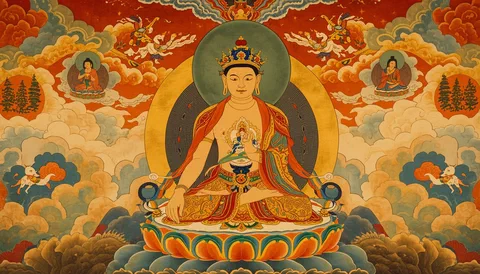 Gampopa's Dream Yoga: A Guide to the Kagyu Tradition
 About Us — Where Ancient Wisdom Meets Modern Sleep Science
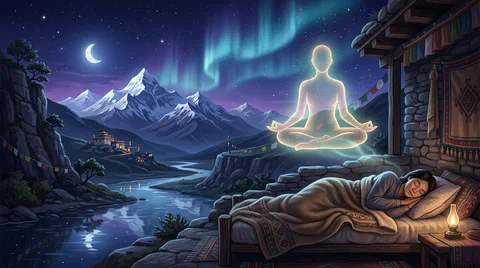 Dream Yoga: What It Is, Benefits, and How to Practice