
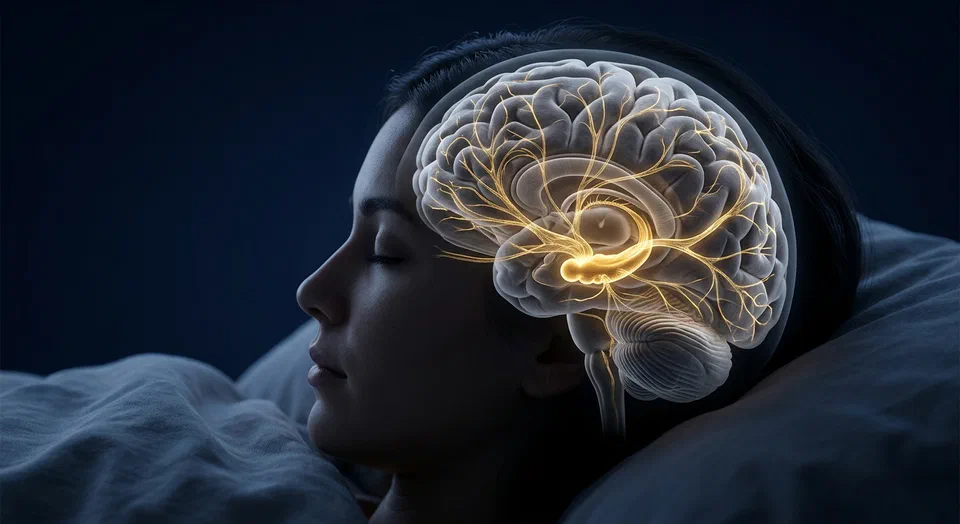
Dream yoga assumes the night is usable. Sleep science, in a different vocabulary, agrees that the night is busy. The overlap is real. The translation is easy to abuse.
Sleep is a memory organ
Rasch and Born’s 2013 Physiological Reviews article remains a standard map: during sleep the brain replays, stabilizes, and reorganizes traces laid down while awake. Slow-wave sleep and REM make different contributions depending on the memory type (declarative, procedural, emotional).
You do not need to become lucid for this housekeeping to run. In fact, protecting sleep architecture is usually more important than decorating it.
Emotion: “overnight therapy” as a hypothesis
Walker and van der Helm (2009) asked whether sleep — especially REM — helps the brain keep the information in an emotional memory while reducing its autonomic sting. They called the idea “overnight therapy.”
A later Current Biology paper (van der Helm et al., 2011) reported that REM sleep was associated with reduced amygdala reactivity to previously viewed emotional images, alongside changes in gamma activity. Goldstein and Walker (2014) reviewed the broader clinical psychology implications: insomnia and REM disruption show up across mood and anxiety disorders.
Walker’s later popular writing has been criticized for overstatement. We cite the peer-reviewed reviews and experiments, not the TED-talk versions.
Where dreaming lives in the cortex
Siclari, Baird, Perogamvros and colleagues (2017) showed that dream experience tracks a posterior hot zone more than the global REM/NREM label. Nir and Tononi (2010) had already argued for moving from folk REM-equals-dreaming to a neurophenomenology of dream contents.
For contemplative practice this suggests:
- Dreaming is a state of conscious experience that can appear in more than one sleep stage
- Recalling a dream is not the same as having had one (report failures are common)
- Training recall (journaling brief) changes what we know about the night, not necessarily how much the brain dreamed
How this informs Mindful Slumber
- We talk about nights as processing time, not lost time — aligned with the memory literature
- We do not promise that a themed meditation will “install” a memory or erase a fear overnight
- Features that destroy slow-wave or REM continuity (aggressive WBTB every night) fight the very physiology we are celebrating
- Emotional-alchemy courses are framed as contemplative skill, not as overnight exposure therapy
If emotion at night is overwhelming, that is a clinical problem first. See nightmares and safety.
Primary sources
- Walker MP, van der Helm E (2009). Overnight therapy? The role of sleep in emotional brain processing Psychological Bulletin, 135(5), 731-748. doi:10.1037/a0016570 PMID 19702380
- van der Helm E, Yao J, Dutt S, Rao V, Saletin JM, Walker MP (2011). REM sleep depotentiates amygdala activity to previous emotional experiences Current Biology, 21(23), 2029-2032. doi:10.1016/j.cub.2011.10.052 PMID 22119526
- Goldstein AN, Walker MP (2014). The role of sleep in emotional brain function Annual Review of Clinical Psychology, 10, 679-708. doi:10.1146/annurev-clinpsy-032813-153716 PMID 24499013
- Siclari F, Baird B, Perogamvros L, et al. (2017). The neural correlates of dreaming Nature Neuroscience, 20, 872-878. doi:10.1038/nn.4545 PMID 28394322
- Nir Y, Tononi G (2010). Dreaming and the brain: from phenomenology to neurophysiology Trends in Cognitive Sciences, 14(2), 88-100. doi:10.1016/j.tics.2009.12.001 PMID 20079677
- Rasch B, Born J (2013). About sleep's role in memory Physiological Reviews, 93(2), 681-766. doi:10.1152/physrev.00032.2012 PMID 23589831
Questions we hear
Does this mean dreams are psychotherapy?
Should I wake myself to journal every REM period?
How we use this evidence
Mindful Slumber is a commercial meditation and dream-yoga app. We use the studies above to decide what we do not claim, as much as what we do. Guided mindfulness, dream journaling, and lucid-dreaming skills are wellness practices. They are not a substitute for cognitive behavioral therapy for insomnia (CBT-I), imagery rehearsal therapy, or other clinician-directed care.
See our editorial standards for how briefs are selected, graded, and updated.