
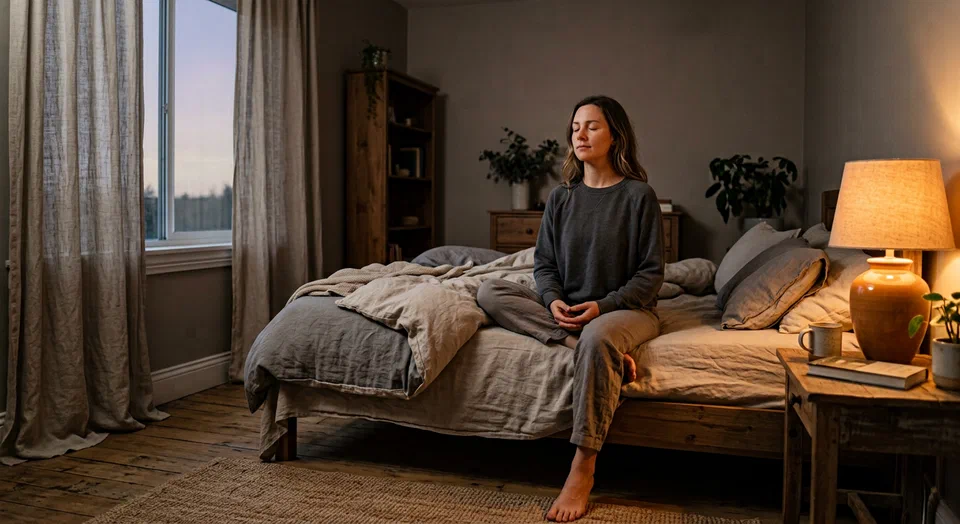
Mindfulness meditation is the best-studied contemplative tool we discuss — and even here the honest summary is modest, condition-dependent, and not first-line for insomnia disorder.
This brief walks through the papers we actually put in the library, with the numbers that marketing copy tends to drop.
A strong RCT in older adults (Black, 2015)
Black, O’Reilly, Olmstead, Breen, and Irwin randomized older adults with moderate sleep disturbance to:
- A standardized mindful awareness practices (MAPs) program, or
- A sleep hygiene education control
Published in JAMA Internal Medicine. Primary outcome: Pittsburgh Sleep Quality Index (PSQI).
Result: the MAPs group improved more than education. Between-group mean difference 1.8 points (95% CI 0.6–2.9), effect size 0.89. Secondary improvements included insomnia symptoms, depression symptoms, and fatigue.
Why this trial is useful:
- Randomized, active control, clinical journal
- Community-accessible program (not a month-long silent retreat)
- Registered (NCT01534338)
Why it does not close the case:
- Older adults with moderate disturbance, not a full CBT-I-eligible insomnia-disorder sample
- Sleep hygiene is a weak control relative to CBT-I
- Short-term outcomes
Chronic insomnia, with an important twist (Ong, 2014)
Ong and colleagues enrolled 54 adults with chronic insomnia and compared MBSR, mindfulness-based therapy for insomnia (MBTI), and self-monitoring.
Both meditation programs beat monitoring on insomnia severity. MBTI is a hybrid: mindfulness plus behavioral insomnia tactics. If your takeaway is “sitting quietly treats insomnia,” you have not read the methods.
The pooled picture (Rusch, 2019)
Rusch et al. synthesized randomized trials of mindfulness for sleep quality.
- Versus nonspecific active controls, mindfulness improved sleep quality (ES 0.33 post-intervention; 0.54 at follow-up).
- Versus specific active controls that are themselves treatments (CBT, exercise), mindfulness did not separate clearly.
NCCIH’s public summary uses this review when it says mindfulness may help sleep more than education-style programs, with effects similar to some established approaches — not better.
That is a responsible ceiling for app copy: may help some people sleep a bit better, especially against doing nothing structured.
The caution from Goyal (2014)
Goyal et al. reviewed 47 RCTs of meditation for stress-related outcomes (JAMA Internal Medicine). Mindfulness showed small-to-moderate effects on anxiety, depression, and pain. For sleep, the authors judged the evidence insufficient to low.
Those two sentences can both be true: later sleep-specific trials (Black, Ong, Rusch) improved the sleep file, while Goyal remains a warning against treating meditation as a general medical intervention.
Limitations we will not bury
- Heterogeneous programs (MBSR, MAPs, MBTI, app-based sessions of uneven length)
- Heavy use of self-report (PSQI, ISI) rather than polysomnography as the main story
- Expectancy: people assigned to meditation often believe they should sleep better
- Few trials of Tibetan dream yoga itself — we are borrowing from adjacent mindfulness literature
How this informs Mindful Slumber
- Pre-sleep sessions should look more like attention training and down-arousal than like a medical protocol.
- We should not imply PSQI-sized gains from a single 10-minute track.
- People whose primary diagnosis is insomnia disorder get pointed to CBT-I.
Tradition still matters to our product, but tradition is labeled as tradition. The trial record above is the scientific floor.
Primary sources
- Black DS, O’Reilly GA, Olmstead R, Breen EC, Irwin MR (2015). Mindfulness meditation and improvement in sleep quality and daytime impairment among older adults with sleep disturbances: a randomized clinical trial JAMA Internal Medicine, 175(4), 494-501. doi:10.1001/jamainternmed.2014.8081 PMID 25686304
- Rusch HL, Rosario M, Levison LM, Olivera A, Livingston WS, Wu T, Gill JM (2019). The effect of mindfulness meditation on sleep quality: a systematic review and meta-analysis of randomized controlled trials Annals of the New York Academy of Sciences, 1445(1), 5-16. doi:10.1111/nyas.13996
- Ong JC, Manber R, Segal Z, Xia Y, Shapiro S, Wyatt JK (2014). A randomized controlled trial of mindfulness meditation for chronic insomnia Sleep, 37(9), 1553-1563. doi:10.5665/sleep.4010 PMID 25142566
- Goyal M, Singh S, Sibinga EMS, et al. (2014). Meditation programs for psychological stress and well-being: a systematic review and meta-analysis JAMA Internal Medicine, 174(3), 357-368. doi:10.1001/jamainternmed.2013.13018 PMID 24395196
- National Center for Complementary and Integrative Health (2022). Meditation and Mindfulness: Effectiveness and Safety National Institutes of Health. Source
Questions we hear
Does mindfulness work as well as sleeping pills?
How big is the effect?
How we use this evidence
Mindful Slumber is a commercial meditation and dream-yoga app. We use the studies above to decide what we do not claim, as much as what we do. Guided mindfulness, dream journaling, and lucid-dreaming skills are wellness practices. They are not a substitute for cognitive behavioral therapy for insomnia (CBT-I), imagery rehearsal therapy, or other clinician-directed care.
See our editorial standards for how briefs are selected, graded, and updated.