
For most of the twentieth century, a dream report was a story told after the fact. Lucid dreaming research changed the epistemology: if a sleeper can move their eyes in a pre-arranged pattern during REM, the experience is timestamped.
That is the foundation we use when we say lucidity is real as a state, not real as a medical treatment.
Signal verification (LaBerge, 1981)
Stephen LaBerge and colleagues showed that people could signal lucidity with volitional eye movements during physiologically verified REM. The method is still the gold standard. Without it, “I was lucid” is a morning memory, subject to reconstruction.
A hybrid EEG signature (Voss, 2009)
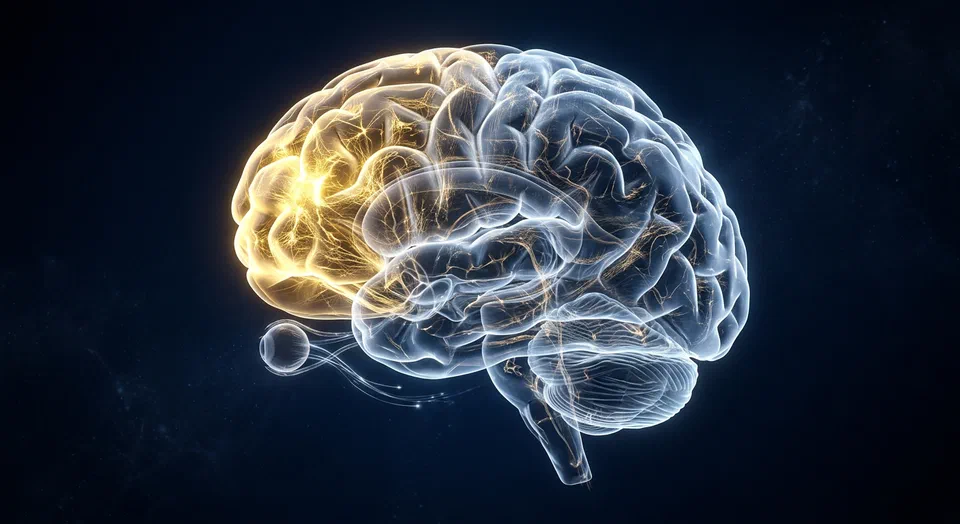
Voss, Holzmann, Tuin, and Hobson recorded lucid REM as a mixture: the dreaming physiology of REM plus wake-like frontolateral gamma (~40 Hz) activity. Insight, control, and dissociation from the dream plot — the phenomenology of lucidity — line up with executive networks that are usually quieter in ordinary REM.
This is often summarized as “the prefrontal cortex wakes up inside the dream.” That slogan is too tidy, but the direction is right: lucidity is not more REM. It is REM plus metacognition.
Imaging lucidity (Dresler, 2012; Baird review, 2019)
A combined EEG/fMRI case study (Dresler et al., 2012) contrasted lucid and non-lucid REM in the same sleeper and reported activation differences in areas tied to self-evaluation and agency.
Baird, Mota-Rolim, and Dresler (2019) reviewed the field in Neuroscience & Biobehavioral Reviews: definitions, prevalence, induction, and neural correlates. Their paper is the best single map we know for a scientifically literate reader. Key points we take from it:
- Lucidity admits degrees (insight without control, control without stable insight)
- Trait lucidity relates to metacognitive and prefrontal measures in some studies
- Induction evidence is mixed; no protocol is a guarantee
- Clinical applications (nightmares) are preliminary relative to imagery rehearsal therapy
Two-way communication (Konkoly, 2021)
Konkoly, Paller, and collaborators across four laboratories asked questions of lucid dreamers during REM. Some participants answered in real time with eye or facial codes — including simple arithmetic.
Current Biology, PMID 33607035. This is the paper to send a skeptic. It does not mean sleepers are awake. It means sensory processing and working memory can, in some people, operate during verified REM.
Dreaming is not identical to REM (Siclari, 2017)
Siclari et al. used high-density EEG and serial awakenings. Dream reports tracked a posterior cortical hot zone in both REM and NREM. REM-on is neither necessary nor sufficient for a dream report.
For dream yoga, that finding is humbling and useful. “Stay aware through the night” is not the same as “stay in REM.” Contemplative sleep yoga that aims at dreamless awareness is asking a different question than lucid-REM induction.
What we do not conclude
- Lucidity is not shown to improve IQ, manifestation, or physical healing
- Frontostimulation studies that try to induce lucidity electrically are experimental, not consumer devices we endorse
- Frequent lucidity practice can cost sleep; see safety
How this informs Mindful Slumber
- We treat lucidity as trainable metacognition in sleep, aligned with LaBerge-style skills (intention, reality checks, dream signs) rather than as occult travel
- We distinguish Tibetan milam (ethics, illusion, compassion) from laboratory lucidity
- In-app challenges should not imply that eye-signal verification is happening on a phone
If your interest is suffering at night, go next to nightmares and imagery rehearsal. Lucidity is a possible tool there — not the recommended starting tool.
Primary sources
- Voss U, Holzmann R, Tuin I, Hobson JA (2009). Lucid dreaming: a state of consciousness with features of both waking and non-lucid dreaming Sleep, 32(9), 1191-1200. PMID 19750924
- Dresler M, Wehrle R, Spoormaker VI, et al. (2012). Neural correlates of dream lucidity obtained from contrasting lucid versus non-lucid REM sleep: a combined EEG/fMRI case study Sleep, 35(7), 1017-1020. doi:10.5665/sleep.1974 PMID 22754049
- Baird B, Mota-Rolim SA, Dresler M (2019). The cognitive neuroscience of lucid dreaming Neuroscience & Biobehavioral Reviews, 100, 305-323. doi:10.1016/j.neubiorev.2019.03.008 PMID 30880167
- Konkoly KR, Appel K, Chabani E, et al. (2021). Real-time dialogue between experimenters and dreamers during REM sleep Current Biology, 31(7), 1417-1427.e6. doi:10.1016/j.cub.2021.01.026 PMID 33607035
- Siclari F, Baird B, Perogamvros L, et al. (2017). The neural correlates of dreaming Nature Neuroscience, 20, 872-878. doi:10.1038/nn.4545 PMID 28394322
- LaBerge SP, Nagel LE, Dement WC, Zarcone VP (1981). Lucid dreaming verified by volitional communication during REM sleep Perceptual and Motor Skills, 52(3), 727-732. doi:10.2466/pms.1981.52.3.727 PMID 24171230
Questions we hear
Does this prove dream yoga’s spiritual claims?
Can everyone learn lucidity?
How we use this evidence
Mindful Slumber is a commercial meditation and dream-yoga app. We use the studies above to decide what we do not claim, as much as what we do. Guided mindfulness, dream journaling, and lucid-dreaming skills are wellness practices. They are not a substitute for cognitive behavioral therapy for insomnia (CBT-I), imagery rehearsal therapy, or other clinician-directed care.
See our editorial standards for how briefs are selected, graded, and updated.