

You were tired all day. Then you got into bed and your brain auditioned for a late-night talk show.
The to-do you forgot, the sentence you wish you hadn’t sent, the rent, the health worry, the plan for Thursday that becomes a plan for your life — all at once, all loud, all now. You glance at the clock. If I fall asleep now I’ll get six hours. The arithmetic wakes you further.
This is pre-sleep cognitive arousal, and it is the single most common complaint among poor sleepers — and, paradoxically, one of the best understood. The science has a name for the state your nervous system is in, a handful of techniques that lower it, and an honest explanation for why “try to clear your mind” almost never works.
This guide gives you that map and a five-step wind-down you can run tonight. It is not a treatment for an anxiety disorder or trauma-related nightmares; it sits inside the Mindful Slumber science approach that puts sleep health before lucidity and keeps the claims inside the citations.
Why your brain gets louder at lights-out
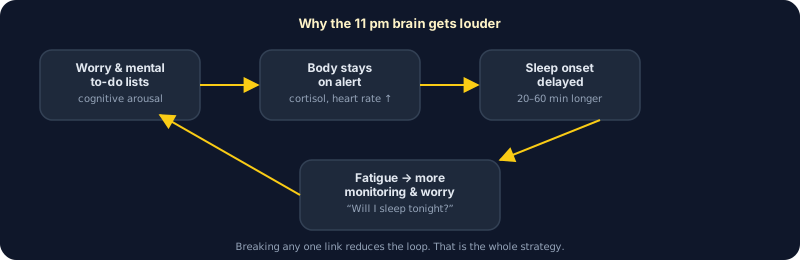
It is not that you are “an overthinker.” Three predictable mechanisms make bedtime the brain’s worst meeting time.
1. The quiet is the trigger. During the day, work, conversation, and screens occupy attention. At bedtime, that occupation ends and the default mode network — the brain system that rehearses autobiographical planning, replay, and what-ifs — becomes more prominent. In sleep studies, people with insomnia show heightened cognitive activity in the minutes before sleep (the Pre-Sleep Arousal Scale’s cognitive subscale, PSAS-C), and that score tracks insomnia severity more strongly than the physical-restlessness score does. The thought flood is not a personality flaw; it is stimulus withdrawal meeting an unoccupied mind [8].
2. Hyperarousal makes everything feel urgent. Chronic poor sleep teaches the nervous system to stay too alert at night. The term in the literature is cortical hyperarousal: elevated high-frequency EEG, a faster and less variable heart rate, a stress response that does not fully stand down when the lights do. Racing thoughts are both cause and consequence of this state. Importantly, a recent study of insomnia patients found that racing thoughts at bedtime — rapid, jumping streams of thought — predicted how long it took to fall asleep, while general rumination and worry did not. The content that keeps you awake is not always anxious in theme; it is anxious in tempo [3][8].
3. The bed learns to mean “think.” If bedtime has been a place where you plan, scroll, argue, or lie awake strategising, the bed becomes a cue for wakefulness. This is conditioned (or learned) arousal. It is why the same person can be exhausted on the sofa and wired at the pillow. The most effective behavioural fix is to re-teach the cue, not to try harder inside it [6].
“Throughout the day, we have all these things cycling through our heads. Some of them seem to continue to cycle. There’s something about the act of writing — physically writing something on paper — that tends to offload it a little bit.” — Michael Scullin, Baylor University, lead author of the 2018 to-do list and sleep study [1]
The cost of a loud bedtime
Pre-sleep arousal doesn’t just delay the first moment of sleep. It fragments the first cycle, lightens early deep sleep, and — because REM sleep is concentrated late — steals the very stage that processes emotional memory and stabilises mood. People often report that the night felt “thin” even when the clock says they slept. The research picture matches: hyperarousal before sleep predicts lighter, more broken sleep even after onset, which is why a wind-down that starts before the bedroom matters more than a clever thought closed inside it [2][4].
The 5 ways — and why each earns its place
Meet Maya. She sleeps six hours on weekdays, scrolls until midnight, and then “tries” to fall asleep while drafting emails in her head. The five steps below are what sleep science would give Maya if she asked for the fewest moves that do the most.
1. The worry window: get the loops out of working memory
The idea is called cognitive offloading. An open task stays active in working memory until the brain is convinced it is stored elsewhere; the classic “Zeigarnik effect” says an interrupted task is remembered better than a finished one for exactly this reason. Writing a to-do list moves the open loops from mind to paper and gives the brain permission to let go.
The best test of that claim used the gold standard: polysomnography. Scullin and colleagues (2018) brought 57 healthy adults into a sleep lab. Before bed, half spent five minutes writing a to-do list about upcoming tasks, half about completed tasks. The to-do writers fell asleep about nine minutes faster, and — crucially — the more specific the list, the faster the sleep onset, while vagueness in the completed-tasks group had the opposite effect. The authors’ interpretation is clean: you do not decrease rumination by reflecting on what is done; you decrease it by capturing what is due [1].
“The more specifically participants wrote their to-do list, the faster they subsequently fell asleep, whereas the opposite trend was observed when participants wrote about completed activities.” — Scullin et al., Journal of Experimental Psychology: General [1]
How to do it well: 1–2 hours before bed (not at lights-out), paper not phone, 5–10 minutes, full specificity (“transfer $200 Thursday after lab, text Maya slides”) and a next action for any worry. When the book closes, tell yourself the line the therapy uses: “That is on tomorrow’s list. Tonight is for rest.” If a new thought arrives at midnight, note it on the same book — one phrase, light on, light off — and leave it there until morning.
2. Imagery distraction: give the mind a nicer job
If worry occupies the mind’s visual workspace, you can displace it by occupying that same workspace with something neutral and immersive. Allison Harvey and colleagues tested this directly: people with insomnia who were instructed to engage with an interesting, non-threatening image (a waterfall, a shaded garden) fell asleep roughly 20 minutes faster than those told to distract however they wished or to do nothing. A Canadian group later found a similar effect for a simple “cognitive shuffle” — picturing random, non-story objects (apple, canoe, lantern) drifting past — which the authors describe as “superficial” because you do not follow a plot you care about [5].
Why not just “think positive”? Because a positive worry is still a worry about an outcome you are invested in. The effective images are sensory, not striving. Walk the garden in your mind slowly. What does the stone feel like underfoot? Where is the light falling? There is nothing to solve, only something to see. That is why it works: the brain cannot simultaneously construct a calm scene and run a fast, verbal what-if at full bandwidth.
3. Downshift the body: breathing and progressive relaxation
Racing thoughts have a body. A tight jaw, a shallow chest breath, a warm skin that will not cool. Physiological arousal feeds cognitive arousal and is often easier to touch directly.
Two tools appear in almost every trial that helps:
- Slow, nasal breathing — around five to six breaths per minute, in through the nose, out a touch longer. No breath holds, no heroics. In autonomic measures this paced rate increases parasympathetic tone; in experience it gives the attention somewhere steady to land.
- Progressive muscle relaxation or body scan — systematically tensing and releasing, or simply noticing, each region. Meta-analyses find small but consistent effects on pre-sleep somatic arousal and on sleep onset when practised nightly as a ritual, not as a rescue trick pulled once [2][4].
A short Mindful Slumber note, since we are a practice site: a five-minute zhiné (calm-abiding) settle — feeling the body sitting or lying, letting the breath be as it is, gently returning when the mind wanders — is a perfectly good delivery system for this. So is a yoga nidra track used before the bedroom, as a wind-down rather than a bed replacement. The mechanism is not exotic; it is permission.
4. The 20-minute rule: protect the bed
This is the least popular and most effective behavioural move in insomnia care, and it is older than most sleep apps.
In 1972, Richard Bootzin proposed stimulus control: the bed should be a cue for sleep and intimacy only. If sleep does not arrive in roughly 20 minutes — or if wakefulness returns and the mind starts working — you get up, go to a dim, cool, slightly boring place, do a quiet activity (read a paper book, listen to a low voice, fold laundry slowly), and return only when sleepy. Repeat as needed. Every major guideline since — the American College of Physicians (2016) and the American Academy of Sleep Medicine (2021) — places multicomponent CBT-I, whose backbone is stimulus control and its companion, sleep restriction, at the top. The AASM explicitly recommends against sleep hygiene alone as a stand-alone treatment because, alone, it does not break the conditioned link [6][7].
This feels counterintuitive. It works because it stops the rehearsal. An hour of calm wakefulness in a chair does less damage to the next night than an hour of clock-watching in bed, where the bed learns again that it is a desk.
Keep two refinements from the trials:
- Estimate 20 minutes; do not watch the clock. Clock-watching feeds the arithmetic that feeds the arousal.
- Keep lights low. You are not banishing yourself; you are giving the homeostatic sleep pressure that built during the day a chance to gather without opposition.
If mornings are short because you obeyed the rule and slept less, keep the same wake time, skip the long nap, and protect the following night. The payoff is consolidation: faster, less broken sleep within a few nights — a durable win bought by a few thin nights, exactly as CBT-I intends [6].
5. Mindful acceptance: notice, note, return
The final way is not a trick but a stance, and it is where modern sleep science and the Tibetan view meet most cleanly.
Thoughts at night are not problems to be solved; they are events in awareness. Trying to argue with each thought — debating the budget at 12:40 a.m. — treats a mental event as a task, which is precisely what keeps working memory engaged. Training the mind to note the thought and return is subtly different. You are not suppressing. You are not indulging. You are letting the thought be a display and choosing, again, the breath, the body, or the image.
A 2022 study of meditators and lucid dreamers found that among mindfulness facets, acceptance (allowing an experience without struggling against it) tracked fewer and less distressing nightmares more strongly than “presence” or monitoring alone — a finding that echoes what dream yoga has taught about meeting fear: steadiness over force [9]. Earlier work on insomnia found that mindfulness-based approaches reduced pre-sleep arousal most when they shifted the relationship to thoughts, not the content [4].
A small, practical form of this is the 3-step note you can use without any app, in the dark:
- Notice: “Thinking is happening.”
- Note: one word — “planning,” “replaying,” “worrying.”
- Return: back to the breath at the nostrils, the weight of the blanket, or the garden path — whichever you chose for step 3 or 4 above.
If a thought is genuinely urgent, the worry book is on the bedside table. One phrase, light on, light off. The thought has a place to live until morning.
“It is better for the lucid and aware dreamer to control the dream than for the dreamer to be dreamed.” — Tenzin Wangyal Rinpoche, The Tibetan Yogas of Dream and Sleep [10]
Dream yoga treats the night as a display of mind, not as a report on reality. A racing thought at 11:30 p.m. is a very good place to practise that view in miniature: see it as a display, note it, and return. You are not rehearsing control over dreams. You are rehearsing the steadiness that makes both sleep and, later, lucidity possible.
Put it together: the 30-minute arc
You don’t need an evening curriculum. You need a short, repeatable arc that starts before the bedroom.
Example for an 11:30 p.m. sleeper:
- 9:30 p.m. — 10-min worry window at the kitchen table + close the book.
- 10:30 p.m. — lights low, screens away, light fiction or quiet chat.
- 11:20 p.m. — brush teeth, bedroom, 5-min breathing + body scan once in bed.
- 11:25 p.m. — gentle imagery (garden or shuffle) until sleep arrives.
- If awake ~20 min — get up, dim room, quiet book, return sleepy.
About 25–30 minutes total, most of it before you get into bed. If you are still awake after ~20 minutes in bed, use the get-up step rather than trying harder.
Earlier in the evening — open the worry window (5–10 min)
Set a timer for 10 minutes, 1–2 hours before bed, away from the bedroom. On paper (not your phone), write two short lists: (1) tomorrow’s to-dos, as specific as possible — ’email Maya the budget draft by 10am’ beats ‘do work’ — and (2) any looping worry with its next actionable step: ‘rent anxiety → check balance, schedule transfer Thursday.’ Be specific; Scullin’s lab found the more detailed the to-do list, the faster people fell asleep. When the timer ends, close the book and put it out of sight. You have given the mind a place to store the open loops [1].Dim the lights and power down screens (30–60 min before bed)
Lower overhead light, keep screens off or in the other room, and do something calm and slightly engaging — light fiction, tidying, a short chat. This is behavioural conditioning, not moralism: bright light and scrolling reliably raise cortical arousal and suppress melatonin, which is exactly the chemistry racing thoughts need to feel urgent [3].In bed — give the body a job: breathing + relax (5 min)
Lie down and let the body settle. Try slow, nasal breathing — in for 4, out for 6, no holding — for 8–10 breaths, then a brief progressive relaxation: tighten the hands for 5 seconds, release; same for shoulders, belly, legs. Or run a 5-minute body scan from crown to toes. The aim is not to feel calm on command; it is to lower physiological arousal so cognitive arousal has less fuel. A mind that tries to ‘force blank’ stays active; a body that softens gives it permission to idle [2][4].If thoughts persist — switch the channel: calm imagery
Instead of arguing with thoughts, occupy the visual channel they use. Pick a calm, familiar place — a lakeshore, a garden — and slowly walk through it in detail: what you see, hear, and feel underfoot. The ‘cognitive shuffle’ variant is to picture unrelated, neutral objects (apple, canoe, lantern) drifting by, without building a story. Trials of imagery distraction reduced pre-sleep arousal and cut sleep-onset time versus unstructured worry or suppression, precisely because it uses the same mental workspace that rumination needs [5].If you're still awake after ~20 minutes — get up, reset, return
If you estimate you’ve been awake about 20 minutes, or the bed starts to feel like a problem-solving desk, get up. Go to a dim, cool place, do something quiet and non-rewarding (read a dull paper book, listen to a low voice), and return only when sleepy. This is stimulus control — Bootzin’s 1972 insight that still anchors every insomnia guideline: protect the bed as a cue for sleep, not for rehearsal. Pair it with one kind self-correction for tomorrow: ‘My wind-down starts at 10:30, not in bed at midnight’ — then let the night go [6][7].

Keep two logs in the morning, each one line: (1) bedtime, wake time, estimated sleep-onset, any night waking; (2) one sentence on what held: “worry window felt complete,” “imagery was vivid,” “got up at 12:10, returned 12:35.” After a week you will have a pattern worth trusting more than last night’s memory. If you use Mindful Slumber, the dream recall guide is the natural companion once sleep feels steadier — long, undisturbed REM is where recall lives, and a racing mind eats that first.
When this isn’t enough
Five techniques handle the ordinary, modern mind that has not yet had its sleep rebuilt. They do not replace care for the minds that need it.
Please speak to a clinician if any of these is true:
- The racing, sleepless nights happen 3+ nights a week for 3+ months despite a consistent wind-down and a protected bed.
- You have panic, trauma replay, mania-like reduced sleep need, or depression that rides beside the thoughts.
- You are relying on alcohol or cannabis nightly to sleep, or stopping causes worse wakefulness.
- A bed partner has seen you stop breathing, gasp, or snore loudly — a separate evaluation for sleep-disordered breathing.
- Thoughts at night include self-harm or hopelessness — reach out the same day.
Our safety brief and CBT-I explainer lay out the referral path and why CBT-I — not sleep hygiene alone — is the first-line, guideline-endorsed treatment when the pattern is chronic [6][7].
The bottom line
Racing thoughts at night are not a sign that your brain is broken. They are a sign that your brain has not been given a better place to put tomorrow, a calmer image to inhabit, a body that has been invited to soften, or a bed that has been protected from becoming a desk.
Give it one or two of those tonight — a specific to-do list earlier in the evening and a calm image when the thoughts persist — and keep the 20-minute rule for the nights they linger. The brain that rehearses fear at midnight can be taught, gently, to rehearse something else.