The short answer
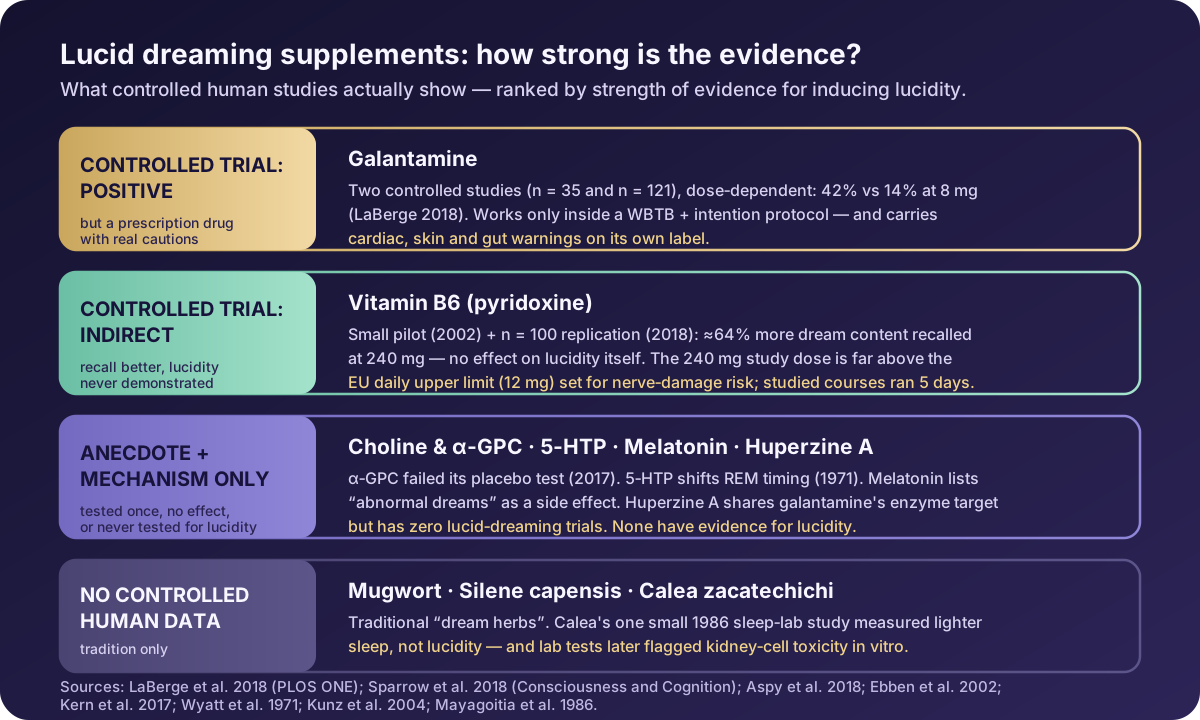
Almost everything sold as a “lucid dreaming supplement” has never been tested on a dreaming human in any controlled way. There is exactly one exception, and it is not a herb, a vitamin or a mushroom: it is galantamine, a prescription drug for Alzheimer’s disease. In the 2018 double-blind, placebo-controlled crossover trial — 121 participants attending the Lucidity Institute’s training workshops — galantamine produced lucid dreams on 27 percent of nights at 4 mg and 42 percent of nights at 8 mg, versus 14 percent on placebo, with a clean dose-response relationship [1].
That sentence is usually where the marketing stops. The rest of it matters more:
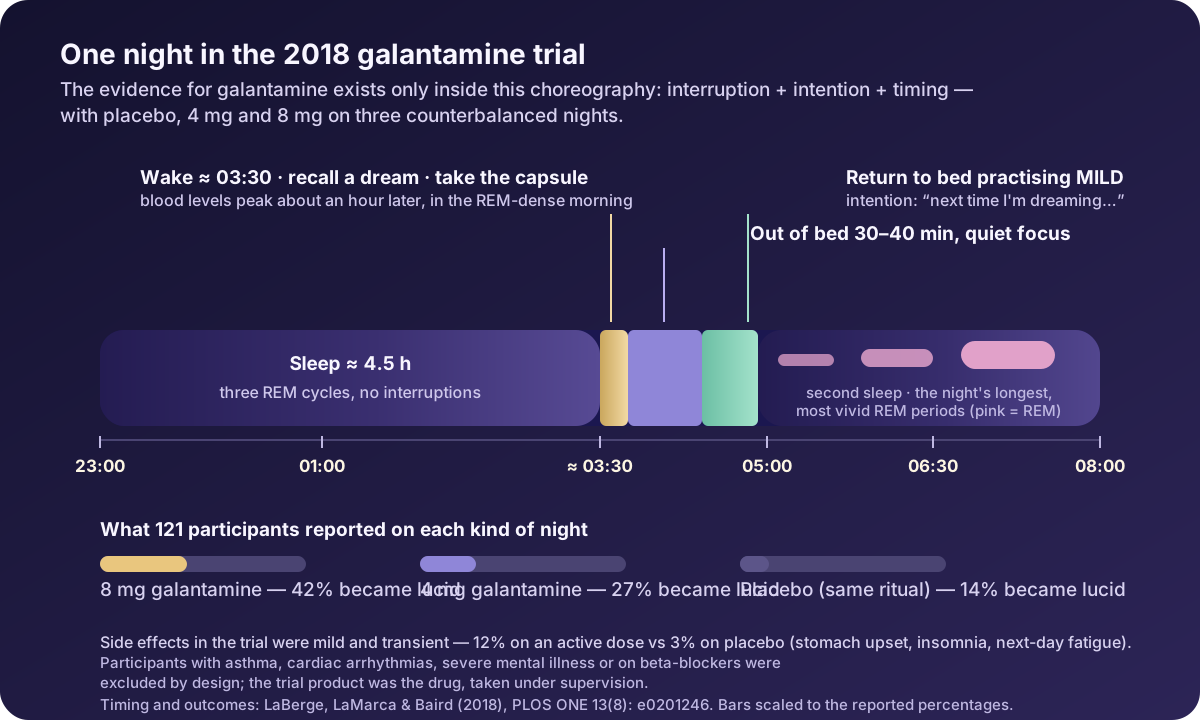
- The drug only worked inside a protocol: participants woke after ~4.5 hours of sleep, recalled a dream, took the capsule, stayed out of bed for at least 30 minutes, then returned to sleep practising the MILD technique. The trial’s authors don’t claim a pill; they claim an integrated protocol that includes one [1].
- The placebo arm is the quietly important result: people doing the wake–recall–intend ritual with a dummy capsule still tripled their baseline rate, hitting 14 percent. Technique-only studies — no substances at all — land in a similar range, around 17 percent of participants within a week [1][2].
- Galantamine is a real drug with a real label: warnings for heart conduction, serious skin reactions and gastrointestinal bleeding — and a trial side-effect rate of about 12 percent versus 3 percent on placebo [1][3].
- When lucid-dream researchers reviewed every induction method in the literature, they concluded that external substances were among the more promising directions — while stressing that the evidence base was thin and needed proper trials [4]. The years since have changed that picture only at the edges: one well-tested substance, one tested-and-failed precursor (α-GPC), one vitamin that improves recall rather than lucidity (B6), and a long tail of tradition and anecdote [5].
Why anyone thinks a pill could work at all
The idea isn’t crazy, which is exactly why it’s worth being precise. REM sleep — the stage where most vivid dreaming happens — is driven and maintained by cholinergic (acetylcholine-based) activity in the brainstem. Boost that signal and REM changes measurably: back in 1994, researchers gave healthy volunteers galantamine at bedtime and watched it shorten the time to the first REM period and increase REM density, while reducing deep slow-wave sleep early in the night [6].
Lucid dreaming, meanwhile, looks like REM sleep with a wake-like overlay: the dorsolateral prefrontal cortex — quiet in ordinary dreams, active in self-reflection — partially reactivates, and acetylcholine is plausibly involved in that too [5]. So the hypothesis is coherent: more cholinergic tone during early-morning REM → more cortex awake enough to notice you’re dreaming. This is the entire scientific backbone of every “lucid pill” ever marketed. The question is which substances actually deliver it, at what cost — and most have never been asked in a trial.
Galantamine: the one with real trials
What it is
Galantamine is an acetylcholinesterase inhibitor: it slows the enzyme that breaks down acetylcholine, leaving more of the neurotransmitter active. It is also a positive allosteric modulator of nicotinic receptors — a dual mechanism reviewers suspect may explain why it, rather than simpler relatives, shows up in the lucid-dream data [5]. Clinically it’s a prescription medicine for mild-to-moderate Alzheimer’s dementia (brand names Razadyne, formerly Reminyl). Everything trial-based below was done on the drug itself, in screened adults, awake at 4 a.m., in a supervised research setting.
The 2018 trial, properly told
LaBerge, LaMarca and Baird ran the study most people cite, and it’s unusually well-designed [1]. One hundred and twenty-one participants, attending intensive lucid-dreaming training workshops, crossed over through three counterbalanced nights: active placebo, 4 mg, and 8 mg, double-blind. Each night followed the same choreography:
- Lights out; sleep ~4.5 hours (about three REM cycles).
- Wake; recall and memorise a dream.
- Swallow that night’s coded capsule.
- Stay out of bed 30–40 minutes in quiet activity focused on lucid dreaming.
- Return to sleep practising MILD — so the drug’s blood-level peak (about an hour after swallowing) lands in the REM-dense morning window.
Results: 14 percent of placebo-night sleepers became lucid, versus 27 percent at 4 mg and 42 percent at 8 mg (odds ratio 4.46 at the high dose; the dose-response trend held at p below one in ten million). Fully 57 percent of participants had at least one lucid dream across their two active-dose nights, including 40 percent of the ten people who had never had a lucid dream before. Galantamine nights also scored higher on dream recall, sensory vividness and dream complexity [1].
A second, smaller controlled study — Sparrow and colleagues, 35 participants across eight nights — tested galantamine paired with a very different practice: middle-of-the-night meditation and dream reliving, where you re-enter a distressing dream in imagination before sleeping. Galantamine outperformed placebo with both pairings (about 40 percent versus 9 percent with Wake-Back-to-Bed, and 34 versus 11 percent with meditation/dream-reliving). It also produced an unexpected wrinkle: when the drug was combined with deliberately re-entering a distressing dream before sleep, subsequent dreams carried more fear and threat content [7]. Effective induction and amplified emotional charge appear to be the same coin — for nightmare sufferers, that detail is a caution, not a bonus.
“The integrated method of taking galantamine in the last third of the night with at least 30 minutes of sleep interruption and with an appropriately focused mental set is one of the most effective methods for inducing lucid dreams available today.” — LaBerge, LaMarca & Baird (2018) [1]
What the safety record actually says
Two datasets deserve to be read side by side:
- In the trial (single early-morning doses of 4–8 mg, healthy screened adults, three nights): about 12 percent reported mild, transient side effects — stomach upset, insomnia, next-day fatigue — versus 3 percent on placebo. Excluded by design: people with asthma, beta-blocker use, severe mental illness, or cardiac arrhythmias [1].
- On the prescription label (chronic daily use at 16–24 mg/day, older patients): nausea in roughly 21 percent of patients, vomiting in about 11, dizziness about 8, plus formal warnings for serious skin reactions (Stevens-Johnson syndrome — discontinue at the first rash that isn’t clearly unrelated), bradycardia and all grades of heart block, and increased risk of gastrointestinal bleeding [3]. The label’s postmarketing section includes a case of torsades de pointes after an accidental 32 mg day, and a healthy volunteer hospitalised with heart block during a drug-interaction study [3].
And the legal reality: galantamine is prescription-only in most of the world. In the United States it is an FDA-approved drug for Alzheimer’s — so any vendor selling it online as a “dietary supplement” is operating outside the approved framework, with none of the pharmaceutical purity oversight that framework imposes [3]. If the molecule genuinely interests you, a doctor’s appointment is the front door.
Choline and α-GPC: the precursor that failed its test
The reasoning sounds convincing: REM needs acetylcholine, so give the brain more choline — acetylcholine’s raw ingredient — via choline bitartrate or the fancier α-GPC. Here is what happened when that idea finally met a placebo: Kern, Appel, Schredl and Pipa ran a double-blind, placebo-controlled field study in 2017 — 33 participants, 1,200 mg of α-GPC versus placebo — and the result could not have been flatter. Six lucid dreams out of 75 total, split two-two-two across baseline, placebo and α-GPC nights, with no change in dream emotion or bizarreness [8].
So where did the legend come from? Largely from Thomas Yuschak’s 2006 self-experimenter classic Advanced Lucid Dreaming, which paired galantamine with choline (the “Lucidimine” stack) and launched a decade of forum protocols [9]. The mechanistic explanation for the flat result is now fairly clear: raw material was never the bottleneck. Galantamine works by blocking acetylcholine’s destruction and by allosterically reshaping nicotinic signalling — prolonging the signal — whereas a precursor merely nudges supply, which the enzyme promptly clears [5]. Supply-side cholinergics and recycling-inhibitors are not interchangeable, whatever the stack forums say.
Huperzine A: galantamine’s untested cousin
Huperzine A is a potent acetylcholinesterase-inhibiting alkaloid from the clubmoss Huperzia serrata, sold over the counter and studied for Alzheimer’s disease — where a 2008 Cochrane review found the trials too small and too short to conclude much beyond “possibly something, needs better studies” [10]. For lucid dreaming it has zero controlled trials; reviewers list it among the rational-but-unproven candidates purely on mechanism [5].
Everything else about it follows the same warnings as any cholinergic drug: nausea, sweating, dizziness, slow pulse, and real interactions with heart medication. The honest grade is not “herbal, therefore gentle”; it is “drug-strength mechanism, never studied for this use.”
Vitamin B6: a recall vitamin, not a lucidity vitamin
Vitamin B6 is the closest thing in this guide to a feel-good story — with a hard boundary. Two controlled trials exist:
- Ebben, Lequerica and Spielman (2002) gave 12 participants placebo, 100 mg or 250 mg of B6 before bed, five days each; the 250 mg condition raised a composite measure of dream vividness, bizarreness, emotionality and colour [11].
- Aspy, Madden and Delfabbro (2018) resolved the question properly: 100 participants, 240 mg of B6 for five days, randomised and placebo-controlled. Dream recall rose sharply — participants remembered about 64 percent more dream content than on placebo — while vividness, bizarreness and colour were statistically unchanged. A parallel B-complex arm actually worsened self-rated sleep quality and morning tiredness [12].
Neither study measured lucidity at all. The fair summary: B6 puts more raw dream material in your morning notebook — which genuinely helps a practice built on recall — but it does not make you lucid.
Now the part the supplement aisle skips. That 240 mg studied dose is twenty times the European Food Safety Authority’s 2023 adult upper limit — 12 mg per day — a limit EFSA set precisely because of peripheral neuropathy: tingling, numbness and burning in hands and feet that can persist for months, documented with chronic high-dose pyridoxine (the US Food and Nutrition Board’s upper limit remains 100 mg/day) [13]. Five study days at 240 mg is one thing; months of “dream stacks” layering B6, B-complexes and fortified energy products on top of each other is how people drift toward neuropathy without ever noticing a dramatic moment of excess. Short, deliberate, occasional courses — with total B6 counted from all sources — is the responsible reading of a promising result.
5-HTP: the serotonin paradox
5-HTP is a serotonin precursor sold for mood and sleep, and it turns up constantly in dream forums. The grain of science: in 1971, a small laboratory study found that 5-HTP increased REM sleep time in normal volunteers — a paradox (serotonin was supposed to suppress REM) that helped fuel the “REM rebound” theory of intense late-night dreaming [14]. A REM-timing nudge from fifty years ago is not a lucid-dreaming study, and none has ever followed.
The safety consideration outweighs the mechanism talk here: 5-HTP plus any SSRI, SNRI, MAOI or triptan is a serotonin-syndrome risk — agitation and racing heart at the mild end, a medical emergency at the other. And batch contamination has been documented in this family of products before. If you take antidepressants, 5-HTP is not a dream experiment; it is a drug interaction. Talk to your prescriber first, or not at all.
Melatonin: real sleep science, borrowed glamour
Melatonin is a chronobiotic — a clock-signaller, not a dream drug — but “melatonin dreams” are common enough that it keeps getting drafted into lucid stacks. What research shows: melatonin can increase REM duration specifically in people with reduced REM sleep, per two small randomised trials [15], and a 2019 systematic review of melatonin’s adverse events lists abnormal and vivid dreams (and, occasionally, nightmares) among the recognised reactions [16].
No trial has ever tested melatonin for lucidity. If you use it for its actual job — jet lag, shifted sleep — expect possibly livelier dreams, keep doses low (0.5–3 mg is the sensible clinical range), and don’t confuse a sleep-timing effect with a lucid-dreaming effect.
The dream herbs: tradition is not a clinical trial
Three names dominate the ethnobotanical dream shelf, and each deserves its honest summary:
- Calea zacatechichi (“dream herb”, Mexico) — the only one with any human study at all: twelve volunteers in a 1986 sleep-lab investigation showed no objective EEG change attributable to the herb versus placebo, lighter sleep overall, and more hypnagogic imagery reports — no lucidity measure anywhere [17]. And for balance: a 2016 laboratory study found the herb significantly toxic to human kidney cells in vitro, at low concentrations [18]. Promise level: folklore plus one ambiguous footprint; risks mapped worse than the benefits.
- Mugwort (Artemisia vulgaris) — pillow stuffing and bedtime tea in European folk practice, commonplace in modern dream oils and sachets. No controlled human trial has ever tested it for dreaming; its essential oil contains thujone; and standard herbal references warn against use in pregnancy.
- Silene capensis (“African dream root”, Xhosa tradition) — taken as a frothy morning infusion to invite vivid, meaningful dreams. Zero clinical publications; and the traditional claim is about culturally sacred dreaming, not laboratory lucidity.
Respect the traditions for what they are — living ritual lineages, not failed pharmaceuticals. Just don’t let a label borrow their aura to imply scientific evidence.
What actually induces lucid dreams
The comparison the supplement industry has to work around is embarrassingly good for the free option:
- In the National Australian Lucid Dream Induction Study, 17 percent of the combined-technique group (reality testing + WBTB + MILD) reported a lucid dream within the first week — and 46 percent over the full study. No capsules involved [2].
- In the galantamine trial itself, the placebo nights — full ritual, no drug — hit 14 percent [1].
- The largest induction study to date (nearly 1,700 participants) again found the strongest effects from combining mental techniques — with SSILD performing on par with the classic MILD approach [19].
Follow the same hygiene the researchers insist on: don’t run WBTB nights when sleep-deprived, and if you’re prone to sleep paralysis or have a mental-health history, read our evidence-based guide to whether lucid dreaming is safe first.
Put simply: the supplements literature is a set of footnotes to the practice literature. Galantamine at 8 mg roughly tripled a 14 percent result. It did not create the 14 percent.
The quality problem nobody posts about
The supplement-and-herb aisle has an engine problem: in the United States, products are largely post-market regulated, meaning regulators chase bad actors after products ship. When researchers analysed a decade of FDA warnings (2007–2016), they found 776 dietary-supplement products containing undeclared pharmaceutical ingredients — in 97.6 percent of cases never hinted at on the label [20]. Nootropic-adjacent “dream” and “brain” blends live in exactly that gray zone. A bottle labelled “galantamine complex 8 mg” from a web storefront has no pharmaceutical oversight: you cannot reliably know what is in it, at what dose, or what else rode along. That is not a reason to be frightened of your dreams; it is a reason to be strict about evidence and provenance before swallowing anything whose entire job is to change your brain at 4 a.m.
If you’re still considering it
If, after all of that, you remain curious — here is the hierarchy the evidence supports, compressed to five steps.
This is a month of foundation-building before any capsule is even on the table. In the 2018 galantamine trial, the wake–recall–intend ritual alone (on placebo nights) produced lucid dreams 14 percent of the time — the ritual is not packaging around the pill; it is most of the effect.
Weeks 1–2: build dream recall — no pills
Every supplement in this guide is pointless if you cannot remember your dreams. For two weeks, keep a notebook or recorder by the bed and write down whatever you remember on waking, even a single image. Our guide on how to remember your dreams gives the exact morning protocol. You are not wasting time: recall is the bottleneck for every induction method, chemical or not, and it is also the only variable vitamin B6 was ever shown to improve in a controlled trial [12].Weeks 2–4: learn MILD, and use Wake-Back-to-Bed
Learn the MILD technique (’next time I’m dreaming, I will remember I’m dreaming’) and, once recall is reliable, add one Wake-Back-to-Bed night a week. In the largest technique trials, comparable protocols produced lucid dreams in about one in six people within a week — completely pill-free [2]. You want to know what you can do unaided before you can meaningfully judge what a supplement adds.Week 4: run the exclusion list with a clinician
Before considering anything from this page, take the same list the researchers used, plus the label warnings, to a doctor or pharmacist: asthma, any heart-rhythm problem or beta-blocker use, stomach-ulcer history, pregnancy or plans for it, epilepsy, mental-health conditions (bipolar or psychosis-spectrum above all), and every medication you take — especially SSRIs if you are eyeing 5-HTP, and anticholinergics if you are eyeing galantamine [1][3]. This is not box-ticking: galantamine’s own prescribing information warns about heart conduction, serious skin reactions and gastrointestinal bleeding [3].If you ever experiment: one variable, lowest legal option, measured
If, after all that, you and your clinician decide to try something legal and low-risk, change exactly one variable: same bedtime, same technique, lowest label dose, on a night with no obligations the next morning. Log dose, timing, sleep quality, dream recall and lucidity for two weeks, exactly as the trials do. Never stack several new substances at once — if something goes wrong you will not know what was responsible, and the studies never tested stacks.Respect the stop signals
Stop immediately and seek medical advice for: any skin rash (galantamine’s label instructs discontinuation at the first appearance of a rash [3]), palpitations, faintness or an unusually slow pulse, black stools or stomach pain, tingling or numbness in hands or feet (the classic early sign of B6 excess [13]), escalating insomnia, or worsening nightmares. Nothing in dream practice is worth ignoring these for — they are the difference between an experiment and a problem.
And one framing that respects both the science and the contemplative tradition this site is grounded in: dream yoga reaches back a thousand years without a single molecule; intention, habit and the structure of REM sleep itself did all the work (see the four stages of dream yoga). Even Stephen LaBerge’s own classic text is a practice manual, not a shopping list [21]. If you want the deepest and safest “supplement” for lucid dreaming, it is still a notebook on the nightstand — and a reason to wake up inside your own mind.



 Is Lucid Dreaming Dangerous? Safety, Sleep Paralysis & Who Should Be Careful
 WBTB: Wake-Back-to-Bed Method Explained
 How to Remember Your Dreams (9 Science-Backed Tips)
 Sleep Cycles & the 90-Minute Rule: What They Mean for Practice