The short answer
For most healthy adults, lucid dreaming is not dangerous. That is not a marketing claim; it is what the population data say. In the largest surveys, people who lucid dream often do not sleep worse, do not score higher on measures of psychopathology, and, on average, report slightly higher well-being than people who never lucid dream [1][2]. Lucid dreams are also not rare or exotic: about 55 percent of adults have had at least one, and roughly a quarter have them monthly [3]. If lucidity were toxic, we would know by now.
But “lucid dreaming is safe” is an incomplete sentence, because the risks that do exist are not in the dream. They live in three other places: how you induce lucidity, what you do with it, and who you are. The rest of this guide takes those in turn, and closes with the thing everyone actually wants to know about, sleep paralysis, and a clear list of who should be careful.
Where the risks actually sit
It helps to picture three layers.
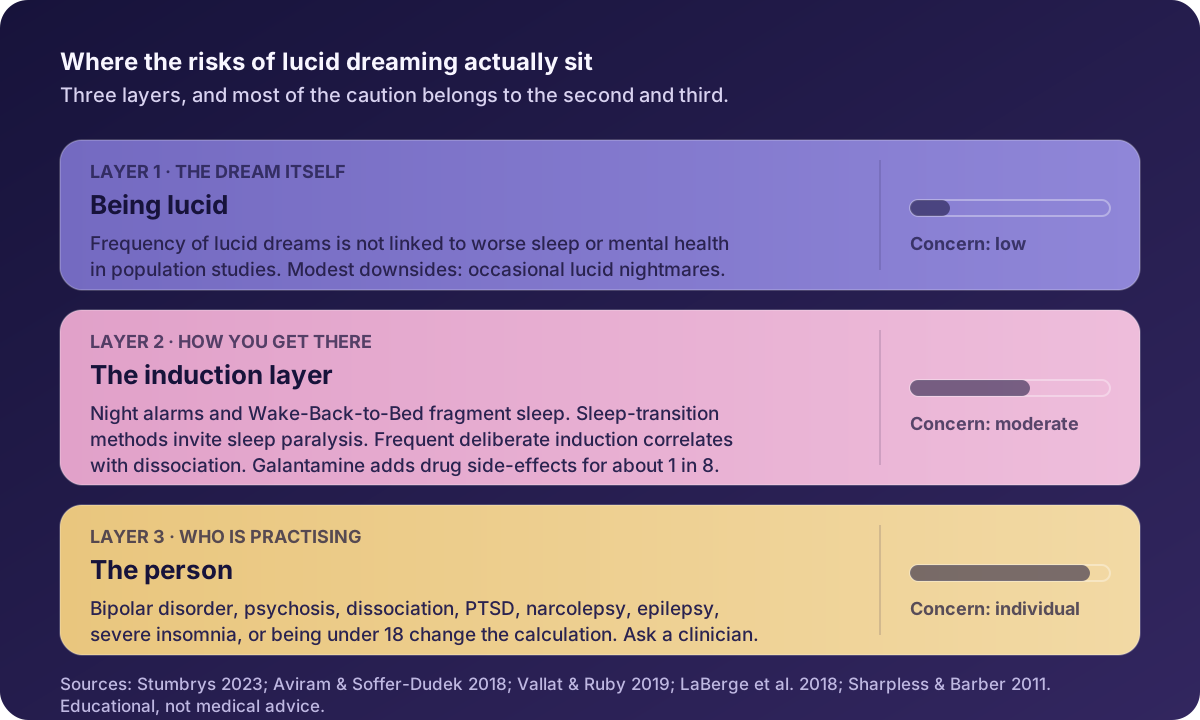
Layer one is the lucid dream itself. Here the evidence is reassuring. Tadas Stumbrys’s 2023 survey of 489 people, almost all lucid dreamers, found no association between lucid-dream frequency and poorer sleep quality or dissociation, and a positive association with well-being. Most respondents reported no negative consequences at all; around ten percent of their lucid dreams were negatively toned, which is if anything fewer than ordinary dreams [1]. The paper’s title captures its conclusion: Dispelling the shadows of the lucid night.
Layer two is the induction layer. The techniques that reliably increase lucid dreams mostly work by making REM sleep slightly more wakeful, and several of them do that by interrupting sleep. Here the concerns are real, if modest, and we treat them in detail below.
Layer three is the person. A practice that is harmless for one nervous system can be unwise for another. The conditions that change the calculation, and why, are listed in the section on who should be careful.
Keeping the three layers apart resolves most of the apparent contradiction in the literature. Studies that ask “do lucid dreamers do worse?” tend to find no. Studies that ask “do people who try hard to induce lucidity do worse?” sometimes find yes [2][4]. Both can be true.
What the research says about sleep quality
The technique most people start with, Wake-Back-to-Bed, is a deliberate sleep interruption: an alarm after four to six hours, a short period awake, then back to sleep aiming for REM. It works, and it is exactly the kind of thing sleep physicians would normally tell you not to do.
Two findings put this in proportion. First, in the International Lucid Dream Induction Study, which followed 355 people through a week of practice, sleep quality was not worse overall, and participants reported better sleep on nights when they became lucid. What hurt were the failed attempts: lying awake for a long time after the alarm [5]. Second, Stumbrys’s survey found that the negative effects people did report, tiredness and disrupted sleep, were tied to unsuccessful induction attempts rather than to lucid dreaming [1].
Against that, Raphael Vallat and Perrine Ruby argued in 2019 that we do not know what years of intensive induction do to REM sleep, which is when the brain consolidates emotional memory. They noted that lucid dreaming is a hybrid state with features of both sleep and waking, and asked whether repeatedly inducing it, especially with sleep interruption, might have costs invisible in one-week studies [6]. That is an open question, not a finding, but it is the reason this site’s technique guides all say the same thing: practise on nights when you can afford to be a little tired, keep the wake period short, stop if it is not working within about ten minutes, and never practise when already sleep-deprived.
What the research says about mental health
Here the picture is more nuanced, and worth reading slowly.
A 2018 study by Liat Aviram and Nirit Soffer-Dudek followed 187 people over two months. Lucid-dream frequency by itself was not related to any measure of psychopathology. But the frequency of deliberate induction attempts was correlated with dissociation, schizotypal traits, depressive and obsessive-compulsive symptoms, and sleep problems, and predicted increases in dissociation and schizotypy over the two months [2]. Soffer-Dudek followed up with a paper titled A call for caution in lucid dream research, arguing that studies had been asking whether lucid dreaming is good for people when they should be asking who is doing it, how, and why [4].
Two readings of those data are compatible with them. One is that intensive induction, which involves repeatedly questioning whether you are awake, blurs the boundary between dream and waking in people who were already somewhat prone to that blurring. The other is that people who are already dissociating or struggling are more drawn to intensive dream practice in the first place. Both are plausible, and the honest position is that we cannot yet separate them.
What we can say is more specific:
- Sleep paralysis and lucid dreaming are correlated with each other, and dissociative experiences during the day are the one factor that predicts both. But the two states differ in their other correlates: sleep paralysis tracks poor sleep, anxiety and life stress, while lucid dreaming tracks a positive daydreaming style and vivid imagery [7].
- In the one study of psychotic patients, people with schizophrenia or bipolar disorder had lucid dreams about as often as healthy controls, but 67 to 73 percent of them controlled their dreams, compared with 23 percent of healthy lucid dreamers. The authors concluded that inducing lucidity in psychosis could reinforce delusional thinking about controlling reality, and advised against it [8].
- Reality checks, the daytime habit of asking “am I dreaming?”, are safe for almost everyone, but for someone with derealisation or a dissociative disorder they can feed the very uncertainty the condition consists of. If asking the question makes the world feel less solid rather than more, stop, and choose a method like MILD that rests on intention rather than doubt.
The dream yoga tradition arrived at a related conclusion from the inside. Its texts treat the practice as a discipline built on a stable daytime mind, and they insist that the goal is not control for its own sake. Tenzin Wangyal Rinpoche’s line, “It is better for the lucid and aware dreamer to control the dream than for the dreamer to be dreamed,” is often quoted, but the same book spends most of its pages on calm, on motivation, and on not grasping at experiences [9]. That ordering, stability first, is a safety practice.
Sleep paralysis: the fear that puts people off
If you search for lucid dreaming risks, sleep paralysis dominates the results, usually with an illustration of a demon on someone’s chest. Here are the facts.
What it is. During REM sleep your brain switches off voluntary muscle tone so that you do not act out your dreams. Sleep paralysis is that switch staying on for a few seconds to a couple of minutes after your mind has woken (or switching on before it has fully gone to sleep). You are conscious, you cannot move, and because the dreaming brain is still partly running, you may hallucinate.
What it feels like. Allan Cheyne’s research identified three clusters of sensation: the intruder (a sensed presence, footsteps, a figure in the room), the incubus (pressure on the chest, difficulty breathing), and vestibular-motor experiences (floating, falling, out-of-body sensations, sometimes bliss) [10]. The chest pressure feels like suffocation because the REM breathing pattern is shallow and you cannot take the deep breath you want; you are, in fact, breathing normally.
How common it is. A 2011 review of 35 studies and more than 36,000 people estimated that 7.6 percent of the general population has experienced sleep paralysis at least once, rising to 28 percent among students and 32 percent among psychiatric patients [11]. It is common, and by itself it is not a disorder.
What brings it on. Sleep deprivation, irregular schedules, jet lag, stress, anxiety, sleeping on your back, and, relevant here, deliberately holding awareness across the boundary of sleep [12]. That is why the techniques that carry consciousness into sleep, WILD and its relatives, provoke it more often than dream-initiated methods do. SSILD and MILD rarely cause it, because you simply fall asleep.
Is it dangerous? No. Nobody has been physically harmed by sleep paralysis, and the episode ends by itself. The harm is fear, and the fear responds to understanding. In a small 2020 pilot in narcolepsy patients, a four-step meditation-relaxation routine practised during episodes roughly halved the number of days with sleep paralysis within two months [13]. The routine is below, because it is the most useful thing on this page for anyone who has had an episode.
Episodes usually last from a few seconds to a couple of minutes. Rehearse the four steps while awake so that they are available when you need them; the routine was designed to be memorised, not read.
Reappraise: name what is happening
Tell yourself, in words, “This is sleep paralysis. It is common, it is harmless, and it will end on its own.” The paralysis is the normal muscle inhibition of REM sleep lingering for a moment after your mind has woken; nothing is pressing on you and your breathing is not blocked, however it feels. Naming the state accurately is the single most useful move, because fear is what turns an odd sensation into an ordeal.Distance yourself from the fear
Remind yourself that whatever you seem to see, hear or feel, a presence in the room, a weight on the chest, a voice, is produced by a dreaming brain and cannot harm you. You do not have to make the images go away; you only have to stop treating them as information. Some practitioners find it helps to think of the episode as a lucid dream that happens to include the bedroom.Focus attention inward on something meaningful
Instead of struggling to move or straining to see, turn attention to a positive inner object: a prayer or mantra if you have one, the face of someone you love, a place where you feel safe, or simply the sensation of the breath moving in and out. In the original therapy this inward focus is the core of the method. Keep the attention gentle and steady, as in zhiné meditation.Relax the body and do not fight
Let the muscles go soft rather than trying to force movement; attempts to thrash tend to prolong the episode and intensify the sensations. If you want to end it, a small deliberate movement often works better than a large one: wiggle a toe or a finger, move the eyes, or change your breathing rhythm. Then let yourself wake fully, sit up for a minute, and, if it happens often, note the time and what preceded it.
When sleep paralysis means something else. Frequent episodes, especially with excessive daytime sleepiness, sudden muscle weakness when you laugh or are surprised, or dream-like hallucinations as you fall asleep, are classic features of narcolepsy and warrant a sleep-medicine referral. Isolated episodes after a bad week do not.
For the neuroscience of the state and its relation to out-of-body experiences, see our dream yoga versus astral projection explainer, which covers the same threshold from a different angle.
Lucid nightmares and false awakenings
Two other experiences deserve honest mention.
A lucid nightmare is a dream in which you know you are dreaming but cannot change events or wake up, often with intense fear. In a survey of 574 lucid dreamers, about seven percent of lucid dreams were of this kind; they were more common in people whose lucidity arrives spontaneously than in those who trained for it [14]. Lucidity gives you options, exit, observe, change, but it does not guarantee that any of them will work on a given night. Our nightmares guide covers how to use those options and what to do when they fail.
A false awakening is a dream of waking up: you get out of bed, make coffee, and discover, sometimes several layers deep, that you are still asleep. They are more common around lucid dreams and are disorienting rather than harmful. A reality check on every waking, especially after a lucid dream, ends the loop.
Can you get stuck? No. Every REM period ends. In a 2024 study, lucid dreamers instructed to wake themselves up did so sooner than controls, most effectively by closing their eyes inside the dream [15]. “Stuck” is almost always a false-awakening chain or a spell of sleep paralysis, both of which resolve within minutes.
Supplements and galantamine
A cottage industry sells “lucid dreaming supplements”. Most, such as vitamin B6, mugwort and choline, have little or no evidence and modest risk. One is different.
Galantamine is a prescription acetylcholinesterase inhibitor licensed for Alzheimer’s disease. Because REM sleep is driven by acetylcholine, it plausibly intensifies dreaming, and in the only placebo-controlled trial, run by Stephen LaBerge’s group with 121 experienced lucid dreamers, it worked: taken after a Wake-Back-to-Bed with MILD, lucid dreams occurred on 14 percent of placebo nights, 27 percent on 4 mg, and 42 percent on 8 mg [16]. But the same paper reports that about 12 percent of participants had side effects, mainly insomnia, nausea and fatigue, and that people with asthma, heart rhythm disorders, or on beta-blockers were excluded for safety. Galantamine also lengthens the awake period and fragments sleep, precisely the induction-layer risk discussed above.
Our position is simple: a prescription drug for dementia is not a casual sleep aid. If you are considering it, involve a doctor, disclose it to anyone prescribing for you, never combine it with other cholinergic substances, and do not use it while learning. Most people who reach a dependable lucid-dreaming practice never touch it.
Who should be careful
None of the following makes lucid dreaming impossible, but each changes the risk calculation enough that you should talk to a clinician before starting any induction practice, and prioritise sleep over lucidity throughout. Dream journaling and gentle daytime awareness are fine for almost everyone.
| If you have… | Why it matters | A safer starting point |
|---|---|---|
| Bipolar disorder | Sleep loss is a well-known trigger for mania; alarm-based and supplement-based methods interrupt sleep by design. | Regular sleep, daytime mindfulness, dream journal; no WBTB without your psychiatrist’s agreement. |
| Psychosis, or a family history of it | Reality testing and dream control may reinforce beliefs about controlling reality [8]. | Grounding practices; avoid reality checks and induction. |
| A dissociative disorder or derealisation | Induction attempts have been correlated with increased dissociation over time [2]. | Body-based practice; if “am I dreaming?” makes the world feel less solid, stop. |
| PTSD with nightmares | Nightmares are a symptom that responds to specific treatment; lucidity is at most an adjunct [17]. | Imagery rehearsal therapy with a clinician first; see the nightmares guide. |
| Narcolepsy or frequent sleep paralysis | Sleep-transition techniques provoke paralysis and hallucinations; both are already frequent. | Treat the narcolepsy; dream-initiated methods only, if any. |
| Epilepsy, especially with sleep-related seizures | Sleep deprivation lowers the seizure threshold. | No sleep interruption; discuss with your neurologist. |
| Chronic insomnia or sleep apnoea | Any deliberate waking worsens the underlying problem [17]. | Treat the sleep disorder first (CBT-I, apnoea therapy); return to lucidity later. |
| Pregnancy, or you are under 18 | Sleep needs are higher and there is no safety data for supplements or sustained interruption. | Journaling and daytime awareness only; no galantamine, no alarms. |
A general rule from our safety brief applies to everyone: if two weeks of practising an induction technique have made your sleep or mood worse, stop the induction layer, keep the journal, and reassess. Lucid dreaming will still be there when your sleep is solid again.
How to practise safely
If none of the cautions above applies to you, the following habits keep the induction layer’s risks where they belong, small and manageable.
- Sleep first. Keep a regular schedule, and never practise on a night when you are already short of sleep. Lucid dreams come from long, healthy REM periods; there is no version of this practice that works better tired.
- Prefer dream-initiated methods. MILD and SSILD let you fall asleep normally and become lucid inside the dream. Save WILD-style techniques, which cross the boundary consciously, until you are experienced and unbothered by sleep paralysis.
- Keep the wake period short. If you use WBTB, get back to sleep within about ten minutes of finishing your technique. The data say that is when it works and when it costs you least [5].
- Practise two or three nights a week, not seven. Frequency of attempts was the variable linked to trouble in the mental-health data; you can get all the lucidity you want on a lighter schedule.
- Learn the sleep paralysis routine before you need it. Rehearse the four steps above while awake. An episode met with “I know what this is” is a curiosity; the same episode met with panic is a trauma.
- Do not chase experiences. The dream yoga tradition is emphatic on this: grasping after intense dreams destabilises both the practice and the practitioner. Recognise, stabilise, then explore, in that order, as described in our four stages of dream yoga.
- Keep a light hand with reality checks. Two or three genuine checks a day, done with curiosity, are plenty. Compulsive checking is a sign to ease off.
- Notice the morning after. A good lucid dream leaves you rested and a little delighted. If instead you are consistently groggy, anxious, or preoccupied with dreams during the day, the practice has drifted out of balance; reduce it.
The bottom line
Lucid dreaming is a natural state that most people have visited, that the majority of practitioners experience as positive, and that leaves no signature of harm in population studies. The genuine risks are attached to the ladder, not the room at the top: sleep interruption, boundary-crossing techniques, drugs, and, for a minority of people with specific conditions, a practice that asks the wrong questions of a vulnerable mind. Respect the ladder, know your own history, and keep sleep in first place, and the answer to the title question is a reassuring one.



 How to Stop Nightmares (and What Lucidity Can & Can't Do)
 SSILD Technique: Senses-Initiated Lucid Dreaming
 WBTB: Wake-Back-to-Bed Method Explained
 How to Remember Your Dreams (9 Science-Backed Tips)