First, the good news
Nightmares feel like the least controllable thing that happens to us. They arrive when we are unconscious, we cannot argue with them, and the standard advice, “try not to think about it”, is exactly wrong. Yet nightmares are, by a wide margin, one of the most treatable sleep complaints. The treatment with the best evidence does not require medication, equipment, a sleep lab, or even the ability to remember your dreams well. It takes a pen, a quiet quarter of an hour a day, and a few weeks.
That treatment is imagery rehearsal therapy (IRT), and it is where this guide begins, because it is where the evidence begins. We will then look honestly at what lucid dreaming, the subject this site cares most about, can add: sometimes a great deal, sometimes nothing, and occasionally a new problem of its own. Finally, we will be clear about the nightmares that are symptoms rather than nuisances, and belong in a clinic.
What counts as a nightmare, and how common they are
A nightmare, in the clinical sense, is a vivid, intensely unpleasant dream that usually wakes you, with the story and the fear still clear in your mind on waking. That last part distinguishes nightmares from night terrors, which happen in deep non-REM sleep, involve screaming or thrashing, and leave little or no memory behind. Nightmares are a REM-sleep phenomenon, which is why they cluster in the second half of the night, when REM periods are longest.
Everyone has nightmares occasionally. They become nightmare disorder when they are frequent enough to cause distress or impair your day: roughly weekly counts as moderate, nightly as severe. Estimates put nightmare disorder at around two to six percent of adults, with women reporting them more often than men, and children more often than either [1][2]. In people with post-traumatic stress disorder the figure is far higher; recurrent trauma nightmares are one of PTSD’s defining symptoms.
Why nightmares happen
The most widely cited account is the affect network dysfunction model proposed by Ross Levin and Tore Nielsen. In their view, ordinary dreaming quietly does emotional work: it replays fragments of frightening memories in new combinations and gradually strips them of their charge, a kind of nightly fear-extinction rehearsal. Nightmares are what happens when that system is overloaded or misfiring [3].
Two factors interact. The first is affect load, the sheer quantity of emotional pressure you are under this week: stress, grief, conflict, illness, bad sleep. The second is affect distress, a longer-standing trait of reacting to negative events with high emotional intensity. High load plus high distress produces nightmares in almost anyone; trauma pushes both dials to the top. A 2019 international consensus paper adds two more contributors worth knowing about: thought suppression (deliberately not thinking about the dream, which tends to make it recur) and, in some people, sleep-disordered breathing, since apnoeas late in the night can trigger frightening arousals from REM [4].
This model has a practical consequence. If nightmares are fear-extinction that has stalled, then a treatment that lets you rehearse a different, safer version of the story while calm and awake is doing, deliberately, what the sleeping brain was trying to do on its own.
Imagery rehearsal therapy: the treatment that works
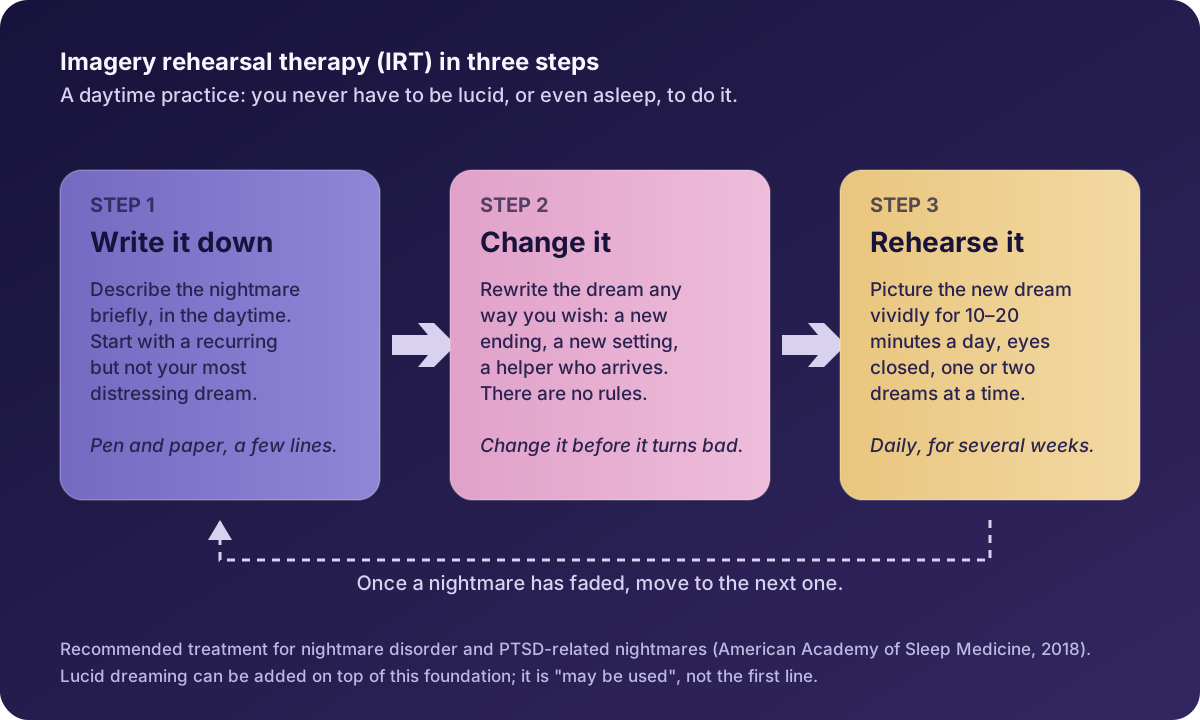
IRT was developed and tested by Barry Krakow and colleagues through the 1990s and 2000s. Its logic is almost embarrassingly simple: treat the nightmare as a learned behaviour, a habit of the imagination, and replace it with a different one. You write down a nightmare, rewrite it any way you like, and rehearse the new version in your mind for ten to twenty minutes a day.
The landmark trial was published in JAMA in 2001. One hundred and sixty-eight women with PTSD after sexual assault, most of them with years of chronic nightmares, were randomised to three sessions of IRT or a waiting list. Those who received IRT had fewer nightmares, slept better, and, without any direct trauma processing, showed substantially lower PTSD symptoms. The improvements were sustained at six months [5].
Since then, meta-analyses have repeatedly found medium to large effects of IRT on nightmare frequency, sleep quality and PTSD symptoms, maintained at follow-up [6][7]. In 2018 the American Academy of Sleep Medicine published a position paper reviewing every studied treatment for nightmares. IRT was the only therapy rated “recommended” for both nightmare disorder and PTSD-associated nightmares. A second tier, rated “may be used”, included cognitive behavioural therapy, exposure and rescripting therapies, hypnosis, progressive muscle relaxation, the blood-pressure drug prazosin, and, notably for readers of this site, lucid dreaming therapy [1]. In 2025 the World Sleep Society endorsed the same hierarchy.
“Imagery rehearsal therapy is recommended for the treatment of nightmare disorder… [and] for the treatment of PTSD-associated nightmares.” — American Academy of Sleep Medicine position paper, 2018 [1]
Three things make IRT unusually kind as a treatment. You never have to relive the nightmare in detail; the emphasis is on the new dream, not the old one. You do not need good dream recall, since one remembered nightmare is enough to start. And you do not have to do anything at night: the whole practice happens awake, during the day, which is why it fits alongside almost any other approach to sleep, including dream yoga.
How to do imagery rehearsal at home
The protocol below follows the self-help versions used in published trials, including the brief three-session format. If your nightmares follow a trauma or you have PTSD, do this with a clinician rather than alone: the method is the same, but the support matters.
About 15–20 minutes a day, ideally at the same time each day and not in bed. Most trials ran for two to six weeks. If your nightmares follow a trauma, or you have PTSD, do this with a clinician rather than alone.
Pick one nightmare, not the worst one
Choose a nightmare that recurs, or a recent one that has stayed with you, but not the most distressing dream you have. Trials of IRT deliberately start with milder material so the first attempt teaches you the method instead of flooding you. If a nightmare replays a real trauma scene, leave it for now and work on it with a therapist.Write it down briefly, in daylight
In a few lines, describe the dream as it happens: setting, characters, the turn where it goes wrong, the feeling. This is not a journaling exercise and it should not take long, five minutes is plenty. Do it during the day, not at bedtime, so the dream is not the last thing you think about.Change the dream any way you wish
Rewrite the story. The instruction in the original protocol is exactly that open: change it any way you wish. Many people change the ending, but you can change the setting, add a helper, give yourself a skill, alter the moment before it turns bad, or turn the pursuer into something absurd. The only rule of thumb from clinicians is to make the change before the worst moment rather than fighting through it. Write the new version out in the present tense.Rehearse the new dream for 10–20 minutes
Sit somewhere quiet, close your eyes, and run the new dream in your mind’s eye with as much sensory detail as you can: what you see, hear, and feel in your body. Aim for ten to twenty minutes once a day. You are not trying to fall asleep and you do not need to feel calm for it to count. Work on one or two dreams at a time, not a whole catalogue.Keep going, then move to the next dream
Continue daily for at least two weeks. In the trials, people typically noticed the rehearsed nightmare fading or changing within a few weeks, and other nightmares often faded with it. When a nightmare has lost its grip, choose the next one. Keep a simple tally of nightmares per week so you can see the trend rather than relying on your memory of the worst nights.Optional: add a lucidity cue
If you already have some dream recall, you can add a small lucid-dreaming layer. During each rehearsal, include the thought “When this happens, I will realise I am dreaming” at the point where the dream usually turns. Some people then find they notice the dream while it is happening and can watch it, change it, or simply wake up. This is an add-on to steps 1–5, not a replacement, and if it disrupts your sleep or makes bedtime feel like homework, drop it and keep the rehearsal.
A few practical notes from the clinical literature. The rehearsal is meant to be pleasant, or at least neutral; if rehearsing the new dream leaves you shaky, the change you made was probably too close to the original, so change it more radically. Rehearse in the day rather than in bed, so that the practice does not become associated with lying awake. And resist the urge to analyse what the nightmare “means” before you change it. IRT works without interpretation, and people who wait to understand a dream before acting on it tend to wait a long time. If you are curious about meaning anyway, the Buddhist view of dream interpretation is a gentler place to start than a symbol dictionary.
Two related methods deserve a mention. Exposure, relaxation and rescripting therapy (ERRT) adds sleep-hygiene and relaxation components to the rehearsal and has similar evidence [1]. And in 2022, a Geneva group showed that pairing IRT with a sound played during REM sleep, a technique called targeted memory reactivation, produced fewer nightmares and more positive dream emotion than IRT alone, with the gains still present three months later [8]. That is not something you can do at home yet, but it is a striking confirmation that the rehearsed new dream really is being consolidated during sleep.
What lucid dreaming can add
Now to the question most of our readers arrive with. If you could realise, inside the nightmare, that you are dreaming, could you simply stop it?
Sometimes, yes, and the idea is not new: the lucid-dreaming pioneer Paul Tholey was recommending it to his students in the 1980s, and Tibetan dream yoga has taught it for a thousand years. The scientific evidence is real but thin:
- In a 2006 pilot study, 23 chronic nightmare sufferers were given a single two-hour session of lucid dreaming training (individually or in a group) and compared with a waiting list. Twelve weeks later, nightmare frequency had fallen in the treated groups. The most interesting finding was that the reduction did not depend on becoming lucid: people who never had a lucid dream improved too, apparently because rehearsing “this is a dream, and I can change it” in the daytime works much like IRT [9].
- In a 2015 trial, 32 patients completed ten weeks of either Gestalt therapy alone or Gestalt therapy plus lucid dreaming training. Both groups improved, but the lucid-dreaming group improved faster and further on nightmare frequency and distress [10].
- A 2010 study of self-help formats found that IRT alone reduced nightmares more than IRT combined with sleep hygiene and lucid dreaming exercises, a reminder that adding more techniques is not automatically better [11].
- A 2019 review of lucid dreaming as a nightmare treatment concluded that it is promising but that every study to date is small, unblinded and short [12]. The AASM’s verdict of “may be used” is a fair summary [1].
So what does lucidity actually offer? Three distinct things, which the research literature now separates clearly [13]:
- Exit. You can wake yourself up. A 2024 field study asked lucid dreamers to try to wake up on purpose, using strategies such as closing their eyes in the dream. Compared with a control task, those who tried woke sooner, and higher lucidity went with less negative emotion on waking. For a nightmare, waking is a perfectly good outcome [13].
- Observe. You can stay in the dream and watch it, knowing it cannot hurt you. This is the move closest to contemplative practice, and it seems to be where much of the emotional benefit lies. Tholey found that when dreamers looked calmly at hostile dream figures instead of fleeing, the figures lost their threatening character in most cases, while fighting them often made them regress into something worse [14].
- Change. You can alter the dream: turn, face the pursuer, ask it what it wants, fly away, switch the scene. This is what most people imagine when they think of lucid dreaming, and it is also the least reliable, because control in lucid dreams is partial and comes and goes.
The Tibetan teacher Tenzin Wangyal Rinpoche puts the underlying principle well:
“When we think of an experience as ‘only a dream’ it is less ‘real’ to us. It loses power over us, power that it only had because we gave it power.” — Tenzin Wangyal Rinpoche, The Tibetan Yogas of Dream and Sleep [15]
That sentence explains why the 2006 pilot worked even for people who never became lucid. The recognition “this is a dream” is doing the therapeutic work, and it can be trained in daylight.
What lucidity can’t do, and the lucid nightmare
Here is the honest part. Lucidity is not a light switch.
Knowing you are dreaming does not guarantee control. In a 2018 survey of 574 lucid dreamers, about seven percent of lucid dreams were “lucid nightmares”: the dreamer knew they were dreaming, yet could not change events or wake up, and experienced intense fear. The commonest features were a lack of control (36%), overwhelming fear (35%), violent dream characters who acted autonomously (28%), and being unable to wake (27%). Just over half of the respondents had never had one, but one percent had them weekly, and they were more frequent in people whose lucidity arrives spontaneously rather than through practice [16]. A later estimate from a different sample put the lifetime rate higher still. For a small minority, in other words, lucidity is the nightmare’s setting, not its cure.
Lucidity can create an expectation of control that fails. If you have been told that a lucid dreamer can always fly away, discovering that you cannot is frightening in itself. The realistic teaching is that lucidity gives you options, exit, observe, change, and that any of them counts as success.
Induction methods cost sleep. The techniques that reliably increase lucid dreams, such as WBTB and MILD, involve waking in the night. Broken sleep is itself a nightmare trigger, and the 2010 self-help study is a warning that piling induction on top of IRT can dilute the benefit [11]. If you are in the middle of a bad nightmare spell, do IRT first and add induction later, if at all.
Lucidity is not trauma treatment. Trauma nightmares are a symptom of PTSD, and PTSD responds to specific therapies. Lucid dreaming may help a person tolerate their nights while that treatment happens; it is not a substitute for it.
For a fuller account of the risks and who should be careful with induction, see our companion guide, Is lucid dreaming dangerous?, and the citation-first safety brief.
The dream yoga view: meeting fear inside the dream
Tibetan dream yoga, milam, arrived at the observe-and-transform strategies centuries before Tholey. In the classical sequence, the practitioner first learns to recognise the dream, then to stabilise that recognition, and only then to transform what appears, deliberately multiplying, shrinking or changing frightening images to learn, in the most direct way possible, that they are mind-made. The four stages of milam describe this arc in detail.
Modern data offer a small, interesting confirmation. In 2022 a Radboud and Marburg team published two surveys, one of 338 mostly ordinary dreamers and one of 187 frequent lucid dreamers, most of whom also meditated. Across both, nightmare frequency and distress were more robustly related to one specific facet of mindfulness, acceptance, the capacity to allow an experience without struggling against it, than to “presence” or attention. People with substantial meditation experience who also practised lucid-dream induction reported the fewest nightmares [17]. Whether the acceptance produces the calmer nights or the calmer nights produce the acceptance is not settled, but the direction matches what the tradition has always said: what protects you in a frightening dream is not force but steadiness.
If you practise, the simplest way to bring this to a nightmare is the instruction Wangyal gives for the transformation stage: when you become lucid and afraid, stop, turn, and look. Do not run, do not fight; look at the frightening thing long enough to notice that it is made of dream. If you cannot manage that, wake up. Both are practice.
“It is better for the lucid and aware dreamer to control the dream than for the dreamer to be dreamed.” — Tenzin Wangyal Rinpoche [15]
Everyday habits that reduce nightmares
None of these replace IRT, but each removes a known trigger:
- Protect the second half of your night. Nightmares live in late REM. Alcohol, which suppresses REM early and lets it rebound late, is a classic nightmare trigger, as is REM rebound after several short nights. Regular sleep and wake times matter more than any supplement.
- Check your medications. Beta-blockers, some antidepressants, and withdrawal from sedatives are all associated with vivid or disturbing dreams. Do not stop anything on your own; ask the prescriber whether timing or dose can change.
- Stop suppressing. Trying not to think about the nightmare during the day tends to increase its recurrence [4]. Writing it down once, as in step 2 of IRT, is the opposite of suppression.
- Keep a light dream journal. You do not need elaborate recall for IRT, but a two-line morning note of any dream builds the awareness that lucidity needs later, and lets you see whether nightmares are actually decreasing. Our dream recall guide is the gentle version.
- Wind down the nervous system. A short body scan, a few minutes of zhiné (calm-abiding) meditation, or a yoga nidra track in the evening lowers the “affect load” that the nightmare model identifies as one half of the problem.
- Do not fear the bed. If you have started dreading sleep, that anticipatory anxiety becomes its own trigger. IRT usually resolves it within a couple of weeks; if it does not, a clinician can add cognitive behavioural therapy for insomnia.
When nightmares need a clinician
Most nightmares respond to the self-help approach above. Some are signals. Please see a doctor, a sleep specialist, or a mental-health professional if:
- Nightmares follow a trauma or replay a real event. This is the territory of PTSD, and effective treatments exist; IRT is often part of them, but it should be delivered with support.
- You act out your dreams: shouting, punching, kicking, or falling out of bed while dreaming. This can indicate REM sleep behaviour disorder, which needs assessment.
- You snore loudly, gasp, or wake choking, or someone has seen you stop breathing. Sleep apnoea can trigger late-night nightmares and is treatable [4].
- Nightmares come with sleep attacks, sudden weakness with laughter, or frequent sleep paralysis. These are features of narcolepsy.
- You have bipolar disorder, a psychotic illness, or a dissociative disorder, or a recent episode of any of them. Both the nightmares and any lucid-dreaming practice should be discussed with your treating team first.
- You have thoughts of harming yourself. Frequent nightmares are an independent risk marker for suicidality; that association is a reason to talk to someone, quickly.
- A child has frequent nightmares that persist for months or follow a stressful event. Children respond well to gentle rescripting with a parent, but persistent cases deserve a paediatric review.
Our nightmares and imagery rehearsal brief summarises the primary studies, and the safety brief lists the red flags for any sleep or dream practice.
A realistic plan for the next month
If you want the shortest honest version of this article, here it is.
Weeks one and two: do IRT daily on one recurring nightmare. Keep a tally of nightmares per week. Change nothing else.
Weeks three and four: if the nightmare has faded, move to the next. If you are sleeping reasonably well and want to explore lucidity, add the intention cue from step 6, and begin the gentle dream recall practice. Leave night-time induction techniques for later.
At any point: if the red flags above apply, or if four weeks of honest practice have made no difference, see a clinician. Nightmares that resist self-help usually respond to the same methods delivered with guidance.
Nightmares are the mind rehearsing fear. The remedy, it turns out, is to rehearse something else, and lucidity, when it comes, is a way of doing that rehearsal live.



 Is Lucid Dreaming Dangerous? Safety, Sleep Paralysis & Who Should Be Careful
 Nightmares: imagery rehearsal first, lucidity later
 Sleep Cycles & the 90-Minute Rule: What They Mean for Practice
 WBTB: Wake-Back-to-Bed Method Explained