
Dreams, particularly lucid ones, have a way of revealing layers of consciousness often hidden in waking life. Tibetan Buddhism offers a distinctive perspective on this through bardo teachings, which describe the states of awareness that arise between different phases of existence — from life to death and beyond. Within that framework, lucid dreaming is more than an intriguing experience; it is a field in which the mind can encounter its own habits, symbols, and capacity for recognition.
Understanding the Tibetan Bardo
The after-death state is very much like a dream state, and its dreams are the children of the mentality of the dreamer.
— The Tibetan Book of the Dead (Bardo Thodol)
The bardo concept is rooted in Tibetan Buddhist teachings, especially The Tibetan Book of the Dead (Bardo Thodol). Although “bardo” is commonly associated with the transition after death, it actually refers to transitional phases in general — states of consciousness experienced within life, sleep, and moments of change. The classic death-and-rebirth narrative outlines three major bardos:
Chikhai Bardo (the moment of death). Consciousness first encounters what the texts call the “clear light,” the unmediated nature of mind. Recognizing this light is presented as a path of liberation; not recognizing it sets the subsequent transitions in motion.
Chonyid Bardo (the bardo of visions). The next phase is marked by vivid, often symbolic imagery that reflects the practitioner’s own mind. Calm, non-attached awareness is considered essential for navigating these powerful appearances without being overwhelmed by them.
Sidpa Bardo (rebirth). In the final phase, consciousness is drawn toward a new form of existence, shaped by habitual patterns and attachments.
These bardos are not only a map of death. For the dreamer and the lucid-dreaming practitioner, they offer a mirror for how the mind meets transition, symbolism, and unfamiliar states — which is one reason Tibetan Buddhism treats dream practice as relevant to them.

Lucid Dreaming as a Practice for Exploring Transitional States
Lucid dreaming — becoming aware while still in a dream — has long been used as a way to prepare the mind for transitions. By practicing awareness inside a dream environment, a practitioner can learn to meet unfamiliar or challenging material with steadier attention, which parallels the attitude Tibetan teachings recommend for the bardo states.
Encountering light in dreams. Bardo teachings emphasize the importance of recognizing the clear light of pure awareness. In lucid dreams, practitioners sometimes work with light as a symbol of presence and clarity. Becoming familiar with that light in a dream context is intended to make the mind more available to it in other transitions — not as a guarantee, but as a form of training.
Facing symbols and darkness with calm awareness. The Chonyid Bardo presents powerful images that mirror the mind itself. Lucid dreamers, too, encounter symbolic and emotional content that can be intense. Observing these appearances without panic or grasping mirrors the calm approach the teachings encourage — meeting unfamiliar material with curiosity rather than fear.
Letting go of control and attachment. Tibetan teaching highlights the need to release habitual clinging during transitions, especially when strong desires or aversions arise. In lucid dreams, where a sense of control can feel natural, practicing openness to what unfolds can reflect the non-attached stance recommended in the bardo states.
The Connection Between Lucid Dreams, the Bardo, and Near-Death Experiences
Near-death experiences (NDEs) share several elements with the bardo descriptions, which is why people often compare them. Many reports include movement through darkness, an encounter with intense light, and a sense of peace or heightened perception — qualities that resonate with the Tibetan accounts of transitional states.
Darkness and light as transitional states. Both lucid dreamers and some people who report NDEs describe a passage from darkness into brilliant light. That movement loosely parallels the shift from the Chikhai Bardo toward the Chonyid Bardo. Tibetan teachings suggest that meeting such light with receptivity can be revelatory; the peace often described in NDEs is a parallel, not a proof.
Visions and symbols reflecting inner life. In the Chonyid Bardo, the mind is met with images that reflect its own content. NDEs and lucid dreams can also display meaningful, personal imagery. The common thread is that what appears is not random scenery — it tends to carry emotional and symbolic weight. Reading those symbols as aspects of one’s own mind can support self-awareness.
Preparing for transition with an open mind. Tibetan teachings repeatedly emphasize approaching all thresholds with openness and equanimity. That posture can be helpful for lucid dreamers and for anyone reflecting on NDE-like experiences. Openness does not resolve every mystery, but it can change how a person meets the unknown.
How to Use Lucid Dreaming and Awareness Practices to Explore Consciousness
Through both lucid dreaming and bardo study, a practitioner can develop tools for understanding the continuity of consciousness. The aim is not to collect dramatic experiences, but to become more familiar with the mind’s movement through different states and more stable in meeting them.

Practice visualizing light in meditation or before sleep. Before sleep, spend a few minutes visualizing a gentle, radiant light and set the intention to meet it with openness rather than expectation. This kind of attention exercise connects to the clear-light emphasis in bardo teaching and gives the mind a simple object to return to.
Observe challenging symbols and emotions with detachment. If you encounter difficult imagery or strong feelings in a lucid dream, practice noticing them without immediately reacting or judging. This mirrors the advice given for the Chonyid Bardo, where calm attention is valued over resistance.
Release control and allow the dream to unfold. In a lucid dream, it is easy to try to steer everything. Try, instead, loosening the grip of control and seeing what arises. The exercise is not about passivity; it is about cultivating a flexible, less grasping relationship to experience — a quality the bardo teachings consider important.
Lucid Dreaming as a Pathway to Understanding Consciousness
The bardo concept reminds us that consciousness is not confined to the waking state. It is a continuum that passes through many thresholds — dreams, sleep, and, in the traditional view, death and rebirth. Lucid dreaming offers a relatively accessible way to study part of that continuum directly.
By practicing awareness in dreams, you can learn how quickly the mind generates worlds, how easily identification and fear shape experience, and how recognition can change the tone of a moment. Working with light, facing unsettling symbols, and loosening the impulse to control can deepen that understanding. Over time, the insights can extend beyond the dream bed into the larger transitions of life.
If you are new to the broader context, see what dream yoga is, its benefits, and how to practice it. For practical steps, our reality checks that trigger lucid dreams and zhiné (calm-abiding) meditation are useful next reads.
Frequently Asked Questions
What is the bardo in Tibetan Buddhism?
How are lucid dreams related to the bardo?
Do near-death experiences and the bardo describe the same thing?
Can lucid dreaming prepare you for death?
Is it safe to practice lucid dreaming with these themes in mind?
What is the 'clear light' in the bardo teachings?
Start Exploring the Transitions
The bardo teachings and lucid dreaming both point to a simple but unsettling idea: consciousness is more mobile and more creative than the solid, permanent self we usually assume. That idea can be intimidating, but it can also be liberating. Instead of meeting transition with dread, you can practice meeting it with recognition — in dreams first, and eventually in the larger transitions life brings.


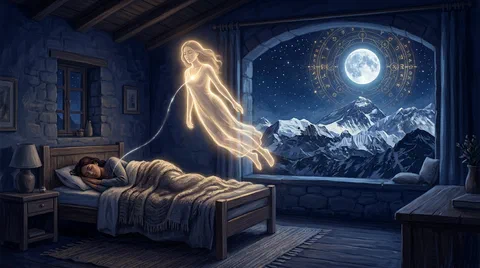
 Dream Yoga: What It Is, Benefits, and How to Practice
 Reality Checks: 12 Tests That Trigger Lucidity
 Chotrul Düchen: The 15 Days of Miracles and Why They Matter for Dream Yoga
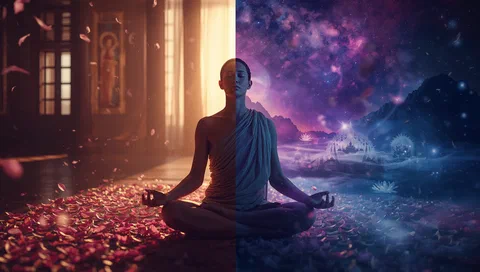 Dream Yoga vs Meditation: What's the Difference?