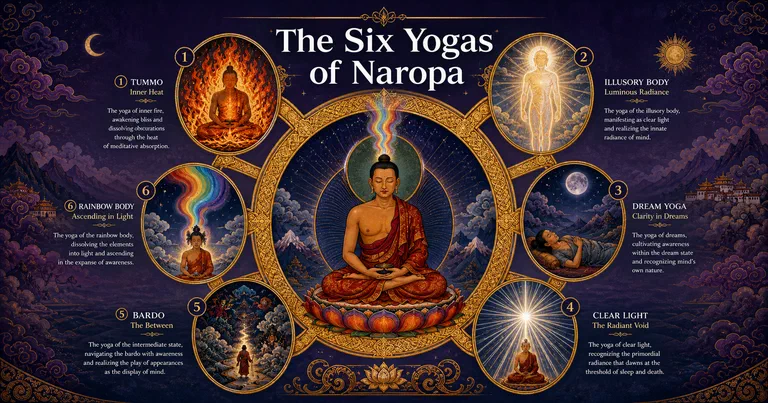
For those who want depth — the lineage trail preserves the thousand-year-old teachings that make dream yoga more than a sleep hack. Learn the Six Yogas, Gampopa’s throat-chakra method, and the Bön roots that keep the view honest.
Modern lucid-dreaming culture excels at technique. Tibetan lineage excels at view — what to do with lucidity once you have it, and how dream practice ripples into waking life, death, and awakening.
What you’ll learn in this trail
- The Six Yogas of Naropa — tummo, illusory body, dream yoga (milam), clear light, bardo, and phowa — how they fit as one system
- Gampopa’s 4-stage method — the Kagyu throat-chakra visualization that bridges waking mind into dream
- Bön Dzogchen view — the ancient, non-Buddhist root of Tibetan dream yoga and its emphasis on natural awareness
- Bodhicitta in dreams — turning lucidity into compassion training (tonglen in the dream state)
- Dream interpretation — the three traditional dream types (karmic, clear-light, prophetic) and what they are not
Your curated path — depth in order
1) The big map: Six Yogas
The Six Yogas of Naropa Explained: A Complete Guide — The authoritative 2,300-word overview with lineage, purpose of each yoga, and where dream yoga sits inside the larger path. Start here for the 360° view.
2) The practical lineage method: Gampopa
Gampopa’s Dream Yoga: The Complete 4-Stage Tibetan Method — Naropa → Marpa → Milarepa → Gampopa. Learn the throat-center visualization, the 4 stages (recognize → transform → multiply → clear light), and common pitfalls (waking up right after lucidity). Note: This historical page is being split into 3 focused guides (overview, throat-chakra HowTo, and clear-light view) for easier mobile reading — watch this hub for updates.
3) The other root: Bön
Exploring Dream Yoga in the Bön Tradition — How Bön’s Dzogchen approach differs (less visualization, more resting in natural mind) and what to borrow even if you practice in the Kagyu style.
4) Heart training: Bodhicitta
Cultivating Bodhicitta Through Dream Yoga — How to turn a lucid dream into tonglen: breathing in fear as black smoke, breathing out white light, seeing the “threat” as mind. Not “nice thought” but rigorous heart training that carries into daylight.
5) Meaning: Dream interpretation
Dream Interpretation in Tibetan Buddhism — The traditional 3-fold typology, why Tibetans are cautious about dictionary-style decoding, and when to journal vs. when to ask a teacher. We’re expanding this thin post (1,178w) to 2,500w with 10 symbols in context, karma view, and FAQs — see SEO audit.
How this trail connects
- Lineage → Techniques: Lineage gives you why to stay lucid; Techniques gives you how. If you’re new, do Foundations → Techniques first, then return here for depth.
- Lineage → Science: Read Meditation & the Brain and Sleep, Memory & Emotion for what neuroscience can and cannot say about subtle-body language like “chakras” and “winds.”
- Lineage → Calendar: Lineage teachings come alive on Düchen days. The Calendar hub shows when practice is traditionally amplified.
Common questions
Do I need empowerment or a teacher? For the full subtle-body methods, traditional texts recommend transmission. For the view and basic dream-yoga steps here, you can begin journaling and reflection without it, but treat throat-chakra and tummo sections as study, not self-prescription.
Are “clear-light” dreams real? In tradition, clear-light is not “vivid” but non-dual awareness. It’s rare and not the goal of early practice. Focus on recognition + stability first.
Is dream interpretation accurate? Tradition says some dreams are karmic residue, some are clear-light glimpses, but fixed symbol dictionaries are discouraged. Journal, notice patterns, and hold meanings lightly.
Study suggestion
Read the Six Yogas overview, then one lineage post per week with a notebook. Ask: What view does this add to my Technique practice? If you’re practicing nightly, let Gampopa’s stage 1 (recognition) be your threshold for 30 days before chasing transformation.
All lineage articles are listed below, newest first. Explore by topic or continue to another trail.