Search “astral projection vs lucid dreaming” and you land in a decade-old argument. One side insists they are identical: same brain, same night, different labels. The other insists they are categorically different: one is a mind-made movie, the other is real travel. Both sides have testimonials. Neither side has a laboratory.
Meanwhile Tibetan Buddhism has been running a third conversation for a thousand years, in which the question “did I really leave my body?” is considered a distraction from the actual work.
This guide separates the three claims — what astral projection says, what lucid dreaming says, and what dream yoga says — and then tells you what the evidence supports, what remains genuinely open, and where to start. In this article you’ll find:
- What astral projection actually is — its Theosophical origins, its classic phenomenology, and where the vocabulary came from
- What dream yoga actually is — and why it is not astral projection with incense
- Astral projection vs lucid dreaming compared across the dimensions that matter, at a glance and in depth
- What neuroscience says about leaving the body — including which claims fail under testing
- A safe, practical path if you want to explore any of it
If you’re new to the Tibetan practice, start with our pillar guide to what dream yoga is. This page is the bridge between that tradition and the out-of-body literature it is constantly confused with.
What Is Astral Projection?
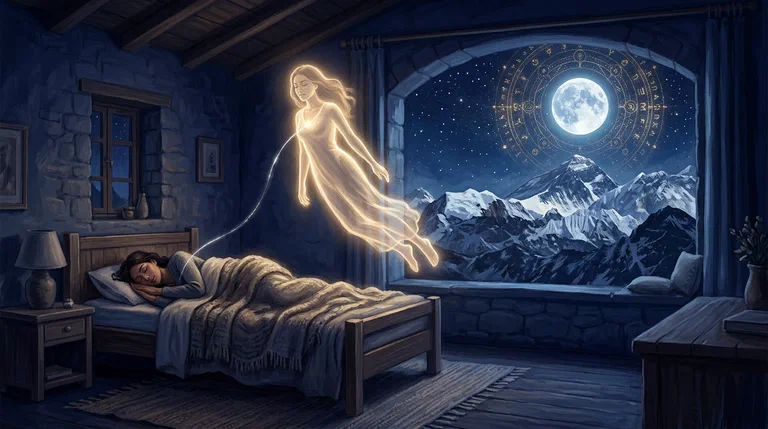
Astral projection is the deliberate practice of separating awareness from the physical body and travelling in a subtle “astral” body through an independently existing non-physical environment. The claim is ontological, not merely experiential: the projector does not say “I had a vivid dream of leaving my body.” They say they went somewhere.
Where the idea comes from
The vocabulary is much younger than people assume.
- Ancient precedents. Ideas of a double or soul-body that leaves the sleeper appear across cultures — the Egyptian ka and ba, the Indian subtle body (sukshma sharira), the “silver cord” of Ecclesiastes. These are relatives, not the modern doctrine.
- Theosophy (late 1800s). Helena Blavatsky, C. W. Leadbeater and the Theosophical Society systematised the term, folding it into a seven-fold map of planes and bodies in which the astral body is the vehicle of emotion and desire, able to function on an astral plane organised into sub-planes of decreasing density. [1]
- Muldoon and Carrington (1929). The Projection of the Astral Body gave the modern practice its handbook and its standard vocabulary — the astral double, the cataleptic state, the “silver cord,” passive-will and dream-control methods. Their 1951 sequel argued projection proves a subtle body independent of the brain. [2] [3]
- Robert Monroe (1971). Journeys Out of the Body took projection out of occult circles and into bookstores. Monroe was a radio executive with no occult training whose spontaneous experiences began in 1958; his Institute popularised audio methods (Hemi-Sync) built on binaural beats and relaxation. [4]
Notice what happened along the way: the practice became secular in tone but metaphysical in claim. Modern books promise a repeatable technique and a real destination, without asking you to join a religion.

The classic sequence
Projection literature describes a remarkably consistent sequence — which is itself evidence of something worth explaining:
- Deep relaxation lying still, often in the late-night or pre-dawn hours
- A cataleptic or paralysed state — the body will not respond
- The “vibrational state” — buzzing, electrical surges, loud internal sounds
- Separation — rolling out, floating up, being pulled out; often seeing the body below
- Exploration — moving through a stable environment that “feels more real than real”
- Return — often sudden, sometimes with a startle back into the body
Hold that list. In a moment it will look very familiar.
What Is Dream Yoga?
Dream yoga (Tibetan: milam, རྨི་ལམ་) is the Tibetan Buddhist and Bön practice of recognising the dream state while dreaming, then using that recognition for insight — seeing through the dream, transforming fear, and finally resting in the luminous nature of mind. Its goal is not to travel anywhere. It is to stop mistaking appearances for solid, independent reality.
Condensed from our full guide to what dream yoga is:
- Lucidity is the entrance, not the destination. Recognising “this is a dream” is stage one of four. The later stages are transforming dream content, dissolving fear by recognising the dream’s unreality, and eventually maintaining awareness in dreamless sleep. See the four stages of dream yoga.
- It sits inside a larger system. Milam is one of the Six Yogas of Naropa, spanning waking life (inner heat, illusory body), sleep (dream, clear light), and death (bardo, phowa). Dreams are treated as rehearsal for dying — the same skill of recognising awareness while appearances shift. Our guide to the bardo and lucid dreams develops that parallel.
- The dream body is made of mind. Some Tibetan teachers do describe a “special dream body” created from mind and subtle energy, capable of going anywhere instantly. Crucially, it is not a second physical self visiting a real place — it is a manifestation of mind, and the practice uses it to demonstrate that appearances are mind-made.
- The direction of travel is inward, not outward. Tenzin Wangyal Rinpoche’s summary is blunt: the dream is a projection of our own mind, like a reflection mistaken for a separate thing. [5] Where astral projection asks “where can I go?”, dream yoga asks “who is going?”

Astral Projection vs Lucid Dreaming at a Glance
| Aspect | Astral projection | Lucid dreaming | Tibetan dream yoga |
|---|---|---|---|
| Core claim | Awareness leaves the body and enters a real non-physical environment | You are asleep and dreaming, and you know it | The dream is mind’s display; recognise it and you recognise waking life too |
| Where it comes from | Theosophy, 19th–20th c. occultism (Blavatsky, Leadbeater, Muldoon & Carrington 1929, Monroe 1971) | Cross-cultural; modern research since LaBerge (1980s) | Tibetan Buddhism & Bön; the Six Yogas of Naropa, 11th-c. transmission |
| Typical entry | Waking → relaxation → sleep paralysis → “vibrations” → exit (a wake-initiated transition) | Usually inside a dream already under way (recognition), or via wake-initiated methods | Daytime mindfulness + bedtime intention + dream recognition |
| What happens first | Body-leaving sensations, often seeing the body below | A reality check clicks; the scene is recognised as dream | Recognition, then stabilisation and deliberate practice |
| Environment | Reported as stable, hyper-real, resistant to thought | Reported as malleable, responsive to expectation | Treated as a karmic display to be seen through, not navigated |
| Goal | Exploration, contact, proof of survival, spiritual experience | Insight, nightmare relief, creativity, enjoyment, training ground | Insight into emptiness, freedom from grasping, preparation for death |
| Status of the experience | Interpreted as literal travel | Interpreted as a dream state | Interpreted as mind’s luminous display |
| Evidence | Experience well documented; physical travel not demonstrated | Verified in sleep labs via pre-arranged eye signals; EEG gamma signature | Contemplative tradition; lab work supports the lucidity component only |
| Main risk | Sleep disruption; fear during sleep paralysis; dissociation in vulnerable people | Sleep fragmentation; occasional lucid nightmares | Same as lucidity, plus the risk of spiritual bypassing |
The Differences That Actually Matter
1. The claim is different, not just the experience
This is the hinge of the whole “astral projection vs lucid dreaming” debate, and it is worth stating precisely. Two people can have nearly identical experiences — floating, looking down at a bed, moving through a familiar house — and attach different frameworks to them. Lucid-dream researchers at Stanford recorded exactly this: in lab-verified lucid dreams, about 10% of reports began with lying in bed, strange bodily sensations, vibrations, loud humming, and rising “out of body.” Their conclusion was that out-of-body experiences arise from the same physiological conditions as wake-initiated lucid dreams, and that “the difference between OBEs and lucid dreams lies solely in the semantic frameworks used to interpret them.” [6]
That is a strong statement from people who studied both. It does not disprove projection. It says the experience itself does not settle the question.
2. The entry point is different
Lucid dreaming usually begins inside a dream already in progress: something is off, you test it, you know. Astral projection literature insists on entering from waking — consciously, without a gap — through relaxation into paralysis into the vibrational state. In sleep-lab language that is a wake-initiated transition through sleep-onset REM, and it is precisely where out-of-body sensations cluster. [7] Practically, this is why projection methods feel harder: you are asking the mind to stay awake while the body goes to sleep, and the toll gate on that road is sleep paralysis.
3. What you do there is different
Give a projector and a dream yogi the same night and they will do different things. The projector explores: goes somewhere, checks something, meets someone, tries to verify. The dream yogi practices: recognises, transforms, and then dissolves the scene — in advanced work, by resting in the awareness that the display arises within. Control is not the point; recognition is. If lucidity becomes a control project, the tradition considers it a detour, not an achievement.
4. The map of reality is different
Astral projection inherits a dualistic cosmology: a physical world, an astral plane with its own geography, and a traveller who crosses between them. Tibetan Buddhism inherits a non-dual epistemology: there is no independently existing “over there” to visit, because the dream — and, on inspection, the waking world — lacks inherent existence. A projector wants the astral plane to be real. A dream yogi wants to see that nothing, including the astral plane, is real in the way it appears.
5. The traditions answer to different authorities
Theosophy answered to “the Masters” and to its own seers; modern projection culture answers to YouTube, forums, and paid courses. Dream yoga answers to a lineage: transmissions, texts, teachers, and a path that begins with ethics and waking-life mindfulness rather than techniques. From the Bön presentation to Gampopa’s Kagyu method, the container is considered part of the practice — which is why dream yoga is rarely sold as a 21-day exit challenge.

The Shared Doorway: Sleep Paralysis
If astral projection and lucid dreaming are cousins, sleep paralysis is the family house.
Sleep paralysis is the state in which REM muscle atonia overlaps with waking awareness: you are conscious and cannot move, and dream imagery bleeds into the bedroom. Roughly 7.6% of the general population report at least one episode in a lifetime, rising to about 28% in student samples; newer, larger reviews put the figure higher still. [8] During those episodes, floating, flying, and out-of-body sensations are among the most common hallucinations — reported in around a third of episodes in recent work, grouped by researchers as “vestibular-motor hallucinations.” [9] [7]
Now line up the classic projection sequence with sleep paralysis: paralysis, buzzing vibrations, loud sounds, a sense of being pulled out, floating, seeing the room from above. The overlap is not suggestive — it is nearly one-to-one. What differs is the story told afterwards.
What Does the Science Say About Astral Projection?
Mindful Slumber’s editorial line is citation-first and hype-free, so here is the honest ledger. Read how we grade evidence.
Out-of-body experiences are real as experiences. Surveys put lifetime prevalence around 6–14%, and the phenomenology is consistent across cultures. [10]
The brain can generate them on demand. Electrical stimulation of the right angular gyrus repeatedly produced out-of-body sensations — “I see myself lying in bed, from above” — in a patient being evaluated for epilepsy, and stimulation there also produced vestibular and body-shape distortions. [11] In healthy volunteers, Henrik Ehrsson produced the same self-location illusion with cameras and multisensory conflict. [12] The working explanation is that the temporoparietal junction normally integrates touch, balance, and vision into one coherent “I am here”; when that integration breaks, the sense of location breaks with it. [7]
Lucid dreaming, by contrast, is verified in the sleep lab. Dreamers signal lucidity with pre-arranged eye movements during physiologically confirmed REM, and lucid REM shows a hybrid signature — dreaming physiology plus wake-like frontal gamma around 40 Hz. [13] Induction techniques combining intention, reality testing, and timed awakenings reliably raise lucidity across studies, though no protocol is a guarantee. [14] See our brief on the neuroscience of lucid dreaming.
The veridical claims have not held up. The most famous laboratory case is Charles Tart’s 1968 “Miss Z” study: over four nights, a subject who reported frequent out-of-body experiences was asked to read a five-digit number placed on a shelf near the ceiling. On the fourth night she reported it correctly. Critics noted the number could have been glimpsed by ordinary means, that the subject was never searched or continuously observed, and that the EEG showed interference consistent with movement. It was never replicated. [3] [10]
On a much larger scale, the AWARE study followed cardiac-arrest patients across 25 hospitals, placing upward-facing images high in resuscitation rooms to test whether anyone saw them “from above.” Of the survivors interviewed, a small number reported experiences suggestive of awareness — none identified the hidden images. The 2023 follow-up (AWARE II) found the same: no survivor identified the displayed targets. [15]
What remains open. A first-person claim about where awareness “goes” is not the kind of claim neuroscience can disprove — it can only fail to confirm it. Serious researchers note the field is under-studied rather than settled, and propose testable models linking sleep-onset REM, sleep paralysis, and OBEs. [7] The intellectually honest summary: the experience is well documented, the mechanism is plausibly neural, and the metaphysical claim is unproven.
What Tibetan Buddhism Actually Teaches
Because this site exists for dream yoga, one clarification matters: dream yoga is not Tibetan astral projection, and the tradition would not recognise the term.
- No astral plane to travel to. Theosophy’s graduated sub-planes have no counterpart in Buddhist cosmology. The six realms are states of karmic experience, not destinations you fly to.
- The dream body demonstrates a point. When teachers describe the dream body travelling instantly, the teaching is about the flexibility of mind and the insubstantiality of identity — not about visiting a parallel world. See how that fits in the illusory-body and dream stages.
- The nearest relatives are about death, not exploration. The bardo mental body and consciousness transference (phowa) concern what happens when the physical body is finished. Read our bardo guide.
- Grasping is the enemy, including grasping at the experience. Projection culture rewards extraordinary states. Dream yoga explicitly warns against mistaking fireworks for insight; the aim is that dreams lose their grip, not that they get more impressive.
- Motivation is different. Dream yoga sits on a foundation of ethics and compassion — the reason bodhicitta is taught alongside it, not after it.
None of this makes the Tibetan view a scientific claim. It makes it a different kind of claim: a first-person, lineage-transmitted method for examining what experience is, offered by a tradition that has been running the experiment for a millennium. [5] [16]
Which Should You Explore?
Choose lucid dreaming if you want… a state that is measurable, trainable, and useful — fewer nightmares, more creativity, a laboratory for your own mind. Start here. It is also the honest prerequisite for everything else on this page.
Choose dream yoga if you want… lucidity put to work on the thing it is actually good for: seeing how mind constructs experience, loosening fear, and preparing for transitions — including the final one. It is slower, demands daytime practice, and rewards patience. Compare it with sitting meditation or yoga nidra to see where each fits.
Choose astral projection only if… you already have the skills and you want the interpretation. There is almost no unique technique in projection literature that is not a wake-initiated lucid dream method — relaxation, hypnagogic observation, “rolling out,” visualisation of a target scene. Learn the skills once, in the framework you find most honest, and keep the labels loose.
Avoid all three for now if you have frequent frightening sleep paralysis, a psychosis-spectrum condition, current dissociation, bipolar disorder, or untreated trauma — or if you are already short of sleep. Our safety brief explains why, and when to see a clinician.
A Safe Path: Build the Skills, Not the Belief
Whatever you call the destination, the road is the same four steps — and all four are practices you can start tonight.
- Recall. Journal every morning before touching your phone. Fragments count; “no recall” counts too. Evidence and method in our dream recall brief.
- Reality checks. Five to ten genuine “am I dreaming?” tests a day. Our reality-check guide gives twelve and explains the habit mechanics that make them transfer into dreams.
- Intention (MILD). LaBerge’s mnemonic method: rehearse recognising the dream as you fall asleep. Best combined with a brief timed awakening (WBTB) — which is, not coincidentally, the same window projection methods use. MILD guide.
- View. Once lucidity is reliable, decide what it is for. The four stages of dream yoga give you the traditional answer; calming the daytime mind first (zhiné) makes the night work possible.
If a vibrational state or an out-of-body sensation arrives on its own, the useful response is the same one dream yoga teaches for any surprising appearance: recognise, stay calm, do not grasp. You can explore it without buying a cosmology.
One rule overrides all of it: never trade sleep for practice. If night techniques leave you tired or anxious, scale back to morning recall and daytime mindfulness.
Five Claims to Treat With Care
- “The hyper-reality proves it’s not a dream.” Out-of-body experiences are famous for feeling more real than waking. That is a property of the state, not evidence about it — the same vividness appears in lucid dreams and in epileptic and virtual-reality OBEs. [11] [12]
- “Astral projection proves the soul survives death.” No controlled study has demonstrated a subtle body leaving the physical one. The Miss Z case and the AWARE target tests are the two most-cited attempts, and neither supports the claim. [15]
- “Dream yoga is just astral projection with incense.” The techniques overlap; the aims are opposite. One seeks a real elsewhere, the other seeks to dissolve the sense that there is one.
- “Sleep paralysis means something is attacking you.” It is a common sleep phenomenon with a known mechanism, made worse by fear and by sleeping on your back. Understanding it is the most protective thing available. [8]
- “You need a paid course to project.” The underlying skills — recall, reality checks, intention, staying calm through hypnagogia — are free, published, and testable. If a programme’s main product is certainty, be suspicious.
Frequently Asked Questions
Is astral projection the same as lucid dreaming?
Is astral projection real?
What is the difference between astral projection and an out-of-body experience?
Can a lucid dream turn into astral projection?
Does Tibetan Buddhism teach astral projection?
Which is easier to learn: astral projection or lucid dreaming?
Is astral projection dangerous?
What is the 'silver cord' in astral projection?
The Difference, in One Sentence
Astral projection says the traveller left; lucid dreaming says the dreamer woke up inside the dream; dream yoga says the dream was never solid to begin with. You do not have to settle that question to benefit from the night — but you should know which question you are asking, because it decides what you do next.
Start with recall and reality checks. Learn to recognise a dream. Then decide whether you want a map of another world, or freedom from needing one.



 Dream Yoga: What It Is, Benefits, and How to Practice
 Dream Yoga vs Meditation: What's the Difference?
 The 3am Alarm You Didn't Set: Tibetan Dream Yoga for Better Sleep
 Cultivating Bodhicitta Through Dream Yoga: Awakening Compassion in the Dream State
 Exploring Dream Yoga in the Bön Tradition