Waking to a dark room and a glowing clock can make the night feel strangely precise. You were asleep; now it is 3am; morning seems impossibly close. The mind often fills the gap with a story: something must be wrong, this always happens, or tomorrow is already ruined.
Before adding meaning, add context. Brief arousals happen throughout a normal night, and many people do not remember them. A remembered 3am awakening can reflect ordinary sleep architecture, your schedule, the environment, stress, alcohol, pain, a medication, or a sleep disorder. The number on the clock is a time stamp—not a diagnosis.
Tibetan Dream Yoga can still offer something useful here, but not because it proves that 3am is a mystical doorway or because it reliably cures insomnia. It offers a way to relate to thoughts, images, and fear with more awareness. That contemplative lens works best when it sits alongside, rather than replaces, good sleep medicine.
Why you may wake around 3am
Sleep is not one continuous depth. You cycle through non-REM and REM sleep roughly every 80 to 100 minutes, usually completing four to six cycles in a night. Brief awakenings can occur between cycles, especially as sleep becomes lighter toward morning. The National Heart, Lung, and Blood Institute explains that deep stage 3 sleep is more prominent earlier in the night, while REM periods become longer later on.
That pattern matters because a person who goes to bed around 10 or 11pm may reach a lighter, more REM-rich part of sleep in the early morning. A small sound, a full bladder, a warm room, reflux, a partner’s movement, or an anxious thought may be enough to bring awareness to the surface. Someone with a different bedtime or chronotype may have the same sleep transition at a different clock time.
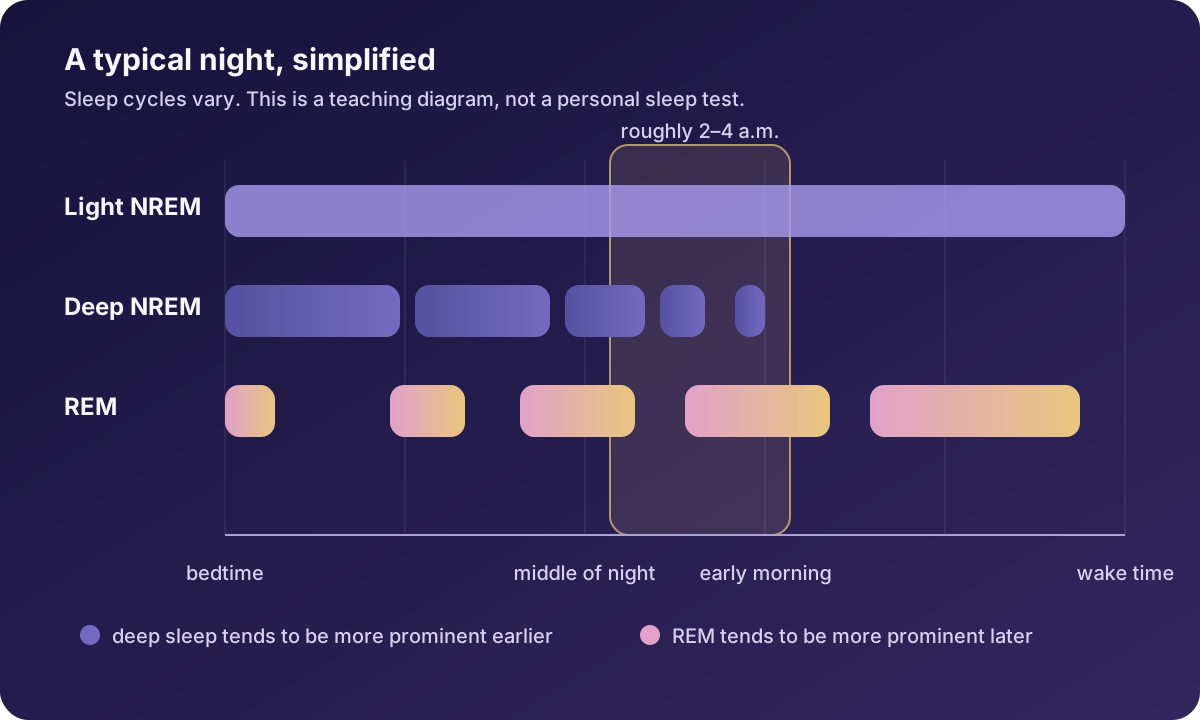
Your circadian system also changes across the night. Core body temperature generally reaches its lowest point in the late night or early morning, while cortisol follows a daily rhythm and rises toward the morning. These are real physiological patterns, but they do not create a universal 3am alarm. The National Institute of Neurological Disorders and Stroke describes the normal shift toward longer REM periods later in the sleep episode; research on the stress system shows that cortisol and sleep stage interact in more complicated ways than a simple 3am cause-and-effect story.
Other common contributors include:
- alcohol, caffeine, nicotine, or a late heavy meal;
- noise, light, temperature, pets, or an uncomfortable mattress;
- stress, grief, anxiety, or the habit of checking the clock and calculating lost sleep;
- pain, reflux, hot flashes, needing to urinate, or a medication effect; and
- sleep apnea, restless legs syndrome, circadian-rhythm differences, or another health condition.
None of these can be diagnosed from an article. They are reasons to look at the whole pattern rather than blame a single hour.
A note about the “shadow hour”
It is tempting to call 2–4am a universal “shadow hour,” when the unconscious supposedly becomes more accessible. That phrase can be evocative, but it is not a medical term, and it is not a single, pan-Tibetan teaching.
Tibetan Buddhist lineages contain different explanations of dreams, sleep, subtle-body practice, and the timing of practice. Bön traditions have their own history and terminology as well. Some teachers give special attention to early-morning dream recall; other instructions emphasize daytime awareness, intention, or a specific teacher-guided sequence. Those differences are a reason to name a source, not to turn one schedule into a rule for everyone.
A 3am awakening may become a meaningful moment because of how you meet it. That is different from claiming that the clock itself opens a spiritual channel. You do not need to stay awake, wake yourself deliberately, or interpret an ordinary arousal as a message in order to practice with awareness.
What Tibetan Dream Yoga actually is
Milam is a Tibetan word for dream. In Tibetan Buddhist contexts, Dream Yoga refers to a family of practices that use the dream state as a field for awareness and contemplation. A practitioner may train to recognize a dream while dreaming, stabilize that recognition, and investigate the dreamlike quality of appearances.
Dream Yoga is associated with the teachings known in English as the Six Yogas of Nāropa. The Oxford Reference overview describes milam as the practice of maintaining conscious awareness in the dream state and places the transmission in the Kagyü context. Contemporary presentations also differ about whether Dream Yoga is counted separately or explained within illusory-body practice; Study Buddhism’s glossary makes that variation explicit.
This history matters because Dream Yoga is not simply a sleep-hacking trick. In its traditional setting, lucid recognition is a means within a larger Buddhist path. The practice is connected with questions about grasping, impermanence, the nature of mind, and—depending on the lineage—clear light and other advanced tantric practices. A vivid dream, a controllable dream, or a dream about a spiritual figure is not by itself evidence of realization.
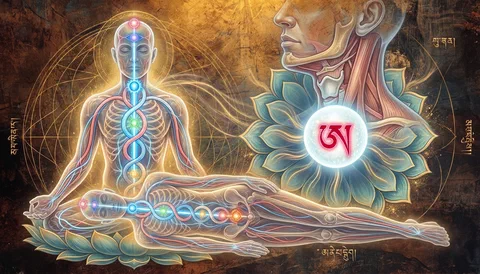
Traditional language about tsa (channels), lung (winds), and thigle (drops) belongs to a contemplative subtle-body model. It should not be presented as an undiscovered map of nerves, hormones, or the physical cause of a 3am awakening. Formal subtle-body practices may involve empowerment, preparation, and individualized instruction. A general-interest article or an app cannot supply that transmission.
Can a contemplative practice help you sleep?
It can help change the second problem that often follows the first awakening: the fear of being awake. Clock-watching, rehearsing tomorrow, and trying to force sleep can increase mental and physical arousal. A quiet body scan or a kind intention may interrupt that spiral for some people.
But Dream Yoga itself has not been established as a treatment for chronic insomnia. Its traditional purpose is spiritual, and its formal methods are not the same thing as CBT-I, relaxation training, or a clinical evaluation. Even a gentle meditation can make some people more alert, especially when it becomes a performance test. If a practice keeps you awake, it is not the right practice for that moment.
For persistent insomnia, the American Academy of Sleep Medicine recommends cognitive behavioral therapy for insomnia as the strongest behavioral approach in its guideline. CBT-I includes cognitive work, stimulus control, sleep scheduling, and other components tailored to the person. It is more than generic advice to keep the bedroom cool or stop looking at screens.
A gentle response to a 3am awakening
The routine below is intentionally modest. It is a sleep-preserving adaptation inspired by the attitude of Dream Yoga, not a complete Tibetan practice and not a promise that you will become lucid.
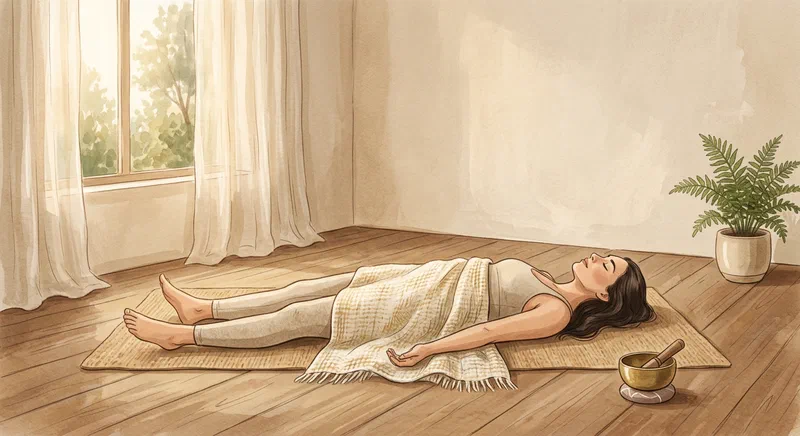
The full steps are also available in a short, accessible format here:
Use only what feels calming. If you are still awake and frustrated after roughly 20 minutes, use the stimulus-control step rather than trying harder.
Remove the pressure to solve the night
If you notice the time, turn the clock away and put the phone out of reach. Remind yourself that one awakening is not a verdict about tomorrow. Take three ordinary, unforced breaths. Do not hold the breath, count down, or try to manufacture a special state.Feel the body resting
Notice a few simple sensations: the mattress under your back or side, the weight of the blanket, and the movement of breathing. Let attention move slowly from the jaw to the shoulders, belly, and legs. The aim is to reduce struggle, not to monitor yourself until sleep arrives.Set a gentle awareness intention
If the idea feels supportive, silently form an intention such as May I meet whatever arises with ease. If an image, thought, or dream fragment appears, notice it as an experience rather than a message you must decode. This is a secular adaptation inspired by dream yoga, not a formal subtle-body instruction.Let sleep return, or change rooms
If you feel drowsy, allow the practice and the intention to fade. If you are becoming frustrated or estimate that you have been awake for roughly 20 minutes, leave the bed and sit somewhere dim and comfortable. Read a few pages of a quiet paper book or do another non-stimulating activity; return to bed when sleepy.Record the pattern without judging it
In the morning, note the approximate time, how long you think you were awake, anything that might have affected sleep, and how you feel during the day. A short record is enough. Keep your usual wake time where possible, and use the pattern—not one difficult night—to decide whether to seek help.
If you prefer the short version, remember this sequence: reduce pressure, feel the body, notice experience, and leave the bed if wakefulness becomes frustrating. The American Academy of Sleep Medicine’s patient guide describes stimulus control in similar terms: go to bed when sleepy, reserve the bed for sleep, and leave it when you cannot sleep. The “20 minutes” is an approximate cue based on perceived wakefulness—not an instruction to stare at a clock.
When you get up, keep the light low and choose something quiet. Avoid work, news, social media, and anything that turns the night into a second daytime. If getting out of bed is unsafe because of mobility, dizziness, caregiving, or your environment, adapt the principle: reduce stimulation and physical struggle without putting yourself at risk.
Three beginner-friendly ways to explore the tradition
You can begin with the attitude of Dream Yoga without copying advanced visualizations from a book or a social-media post.
1. Practice recognition during the day
Once or twice during an ordinary day, pause and notice how an experience is constructed. You might feel irritation, see a message, or hear a sound. Name the sensation, the thought about it, and the urge that follows. This is not pretending that waking life is unreal or that consequences do not matter. It is practicing the gap between an event and the story you immediately attach to it.
That daytime familiarity is closer to the logic of dream practice than treating 3am as a magical appointment. If you later become lucid in a dream, recognition may feel less like a completely new event.
2. Set an intention, then release it
Before sleep, use one relaxed sentence: If I dream, may I recognize the dream and meet it gently. Repeat it only while it feels settling. Do not sacrifice sleep, wake yourself repeatedly, or judge the night by whether a lucid dream occurs.
If you have received a specific instruction from a teacher, follow that instruction rather than mixing visualizations from several traditions. In particular, an online description of a red syllable, throat center, or luminous drop is not a universal recipe for all Tibetan Dream Yoga.
3. Treat dream recall as observation, not divination
Keep a notebook nearby and write a few words after waking. Record what happened, the strongest emotion, and whether you knew you were dreaming while it was happening. “I remembered a dream” and “I was lucid in the dream” are different observations.
A dream journal can support curiosity without turning every image into a prediction. It also gives a clinician useful information if your sleep problem continues. No dream recall is a valid entry; it is not a spiritual failure.
What about nine-round breathing and sleep posture?
Nine-round breathing appears in some Tibetan practice contexts, but its details and purpose depend on the lineage. It may include specific visualizations, nostril patterns, or breath instructions that are not appropriate to improvise when you are half-awake. Unless you have been taught the practice, use normal breathing. Never add breath-holding or forceful breathing to make the exercise feel more authentic.
Likewise, a traditional text may recommend a posture for a particular practice, but no universal sleep position prevents 3am awakenings. Choose a position that is comfortable, safe, and compatible with medical advice. A painful posture is not a sign of commitment.
When a 3am awakening deserves medical attention
One isolated night is not insomnia. The NHLBI describes chronic insomnia as difficulty falling or staying asleep that occurs at least three nights a week for three months or longer, with meaningful effects on daily life. Repeated early-morning waking can fit that pattern, but it can also point to another cause that deserves evaluation.
Make an appointment if the problem keeps recurring, leaves you impaired during the day, or makes you anxious about going to bed. Seek advice sooner if someone notices loud snoring, gasping, choking, or pauses in breathing; if your legs feel restless or painful; or if pain, hot flashes, reflux, urination, medication changes, or mood symptoms are part of the picture.
A sleep diary for one to two weeks can help you and a clinician see relationships among bedtime, wake time, naps, caffeine, alcohol, symptoms, and daytime alertness. Do not use the diary to grade yourself. Use it to replace a frightening blur with information.
Try a beginner Dream Yoga meditation
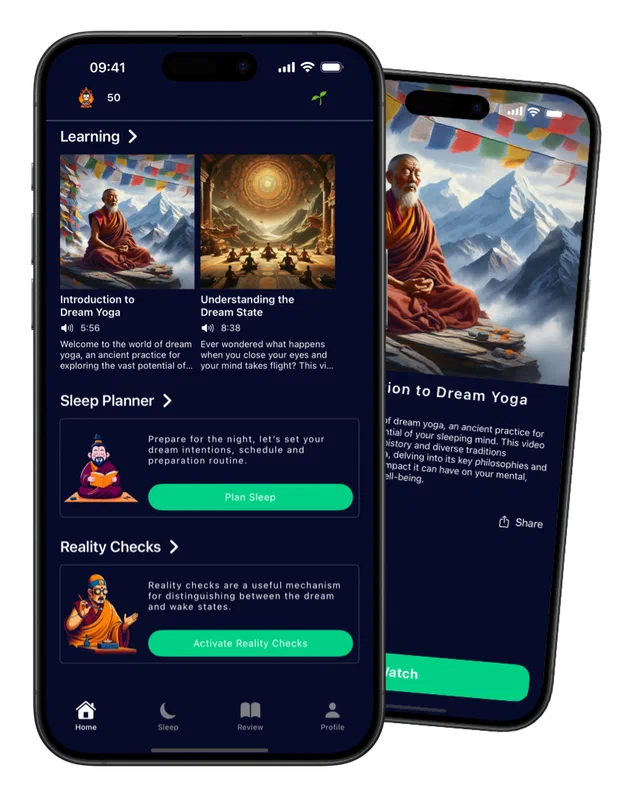
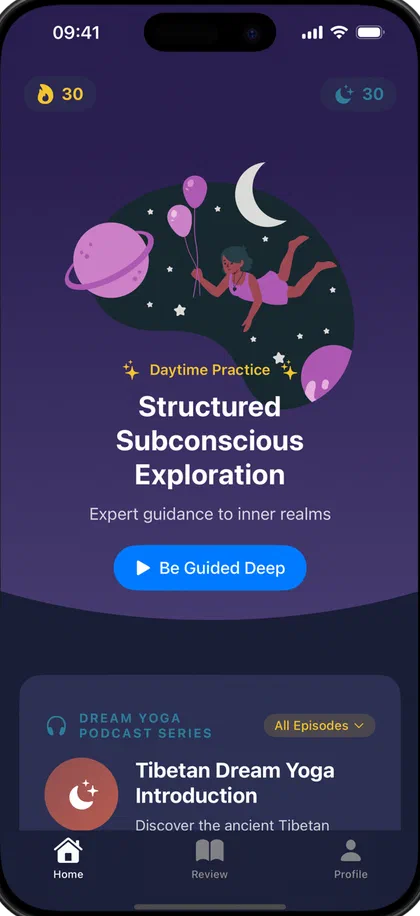
Mindful Slumber’s guided practices can give you a calm structure for a pre-sleep intention, body awareness, and dream reflection. Use the app as an optional support for rest and contemplation—not as a diagnostic tool, a replacement for CBT-I, or a substitute for a qualified teacher in formal Tibetan practice.
The next time you wake at 3am, you do not have to choose between dismissing the moment and making it mystical. You can check the practical basics, respond gently, and seek help if the pattern persists. If a Dream Yoga-inspired intention helps you meet the moment with less fear, let it be a light touch—not another task to complete before morning.
Your awakening may be ordinary, medical, emotional, spiritual, or some combination of those descriptions. Awareness begins by leaving room for the evidence.


 Dream Yoga vs Astral Projection: Difference Explained
 Cultivating Bodhicitta Through Dream Yoga: Awakening Compassion in the Dream State
 Dream Yoga vs Meditation: What's the Difference?
 Dream Yoga: What It Is, Benefits, and How to Practice
 Exploring Dream Yoga in the Bön Tradition